

In Step 4, salmon leave the net pens in late spring to early summer and spend their
lives at sea. After 1 to 6 years in the ocean, they return to the place they imprinted
upon with the goal of reproducing in freshwater.
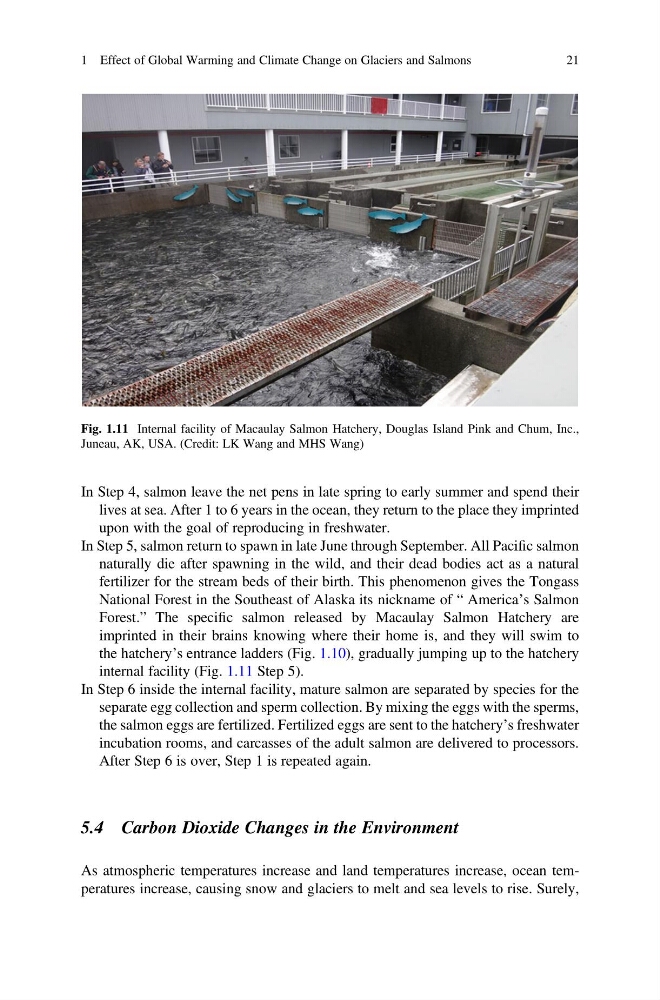
In Step 5, salmon return to spawn in late June through September. All Pacific salmon
naturally die after spawning in the wild, and their dead bodies act as a natural
fertilizer for the stream beds of their birth. This phenomenon gives the Tongass
National Forest in the Southeast of Alaska its nickname of “ America’s Salmon
Forest.” The specific salmon released by Macaulay Salmon Hatchery are
imprinted in their brains knowing where their home is, and they will swim to
the hatchery’s entrance ladders (Fig. 1.10), gradually jumping up to the hatchery
internal facility (Fig. 1.11 Step 5).
In Step 6 inside the internal facility, mature salmon are separated by species for the
separate egg collection and sperm collection. By mixing the eggs with the sperms,
the salmon eggs are fertilized. Fertilized eggs are sent to the hatchery’s freshwater
incubation rooms, and carcasses of the adult salmon are delivered to processors.
After Step 6 is over, Step 1 is repeated again.
5.4 Carbon Dioxide Changes in the Environment
As atmospheric temperatures increase and land temperatures increase, ocean temperatures increase, causing snow and glaciers to melt and sea levels to rise. Surely,
Fig. 1.11 Internal facility of Macaulay Salmon Hatchery, Douglas Island Pink and Chum, Inc.,
Juneau, AK, USA. (Credit: LK Wang and MHS Wang)
1 Effect of Global Warming and Climate Change on Glaciers and Salmons
21
lives at sea. After 1 to 6 years in the ocean, they return to the place they imprinted
upon with the goal of reproducing in freshwater.
In Step 5, salmon return to spawn in late June through September. All Pacific salmon
naturally die after spawning in the wild, and their dead bodies act as a natural
fertilizer for the stream beds of their birth. This phenomenon gives the Tongass
National Forest in the Southeast of Alaska its nickname of “ America’s Salmon
Forest.” The specific salmon released by Macaulay Salmon Hatchery are
imprinted in their brains knowing where their home is, and they will swim to
the hatchery’s entrance ladders (Fig. 1.10), gradually jumping up to the hatchery
internal facility (Fig. 1.11 Step 5).
In Step 6 inside the internal facility, mature salmon are separated by species for the
separate egg collection and sperm collection. By mixing the eggs with the sperms,
the salmon eggs are fertilized. Fertilized eggs are sent to the hatchery’s freshwater
incubation rooms, and carcasses of the adult salmon are delivered to processors.
After Step 6 is over, Step 1 is repeated again.
5.4 Carbon Dioxide Changes in the Environment
As atmospheric temperatures increase and land temperatures increase, ocean temperatures increase, causing snow and glaciers to melt and sea levels to rise. Surely,
Fig. 1.11 Internal facility of Macaulay Salmon Hatchery, Douglas Island Pink and Chum, Inc.,
Juneau, AK, USA. (Credit: LK Wang and MHS Wang)
1 Effect of Global Warming and Climate Change on Glaciers and Salmons
21