

there will be negative effects as a result of changing the earth’s composition. In order
to stay away from the most severe consequences, the concentration levels of CO 2 in
the atmosphere must be stabilized.
Currently, the concentration of carbon dioxide is 430 parts per million (ppm)
CO 2 , whereas the concentration of CO 2 before the industrial revolution was only
280 ppm. Concentrations of CO 2 have caused the world to warm by more than half a
degree Celsius and will warm by another half a degree over the next few decades,
because of the inertia in the climate system. “Even if the annual flow of emissions
did not increase beyond today’s rate, the stock of greenhouse gases in the atmosphere would reach double pre-industrial levels by 2050 – that is 550 ppm CO 2 – and
would continue growing thereafter.
But the annual flow of emissions is accelerating, as fast-growing economies
invest in high-carbon infrastructure and as demand for energy and transport
increases around the world. The level of 550 ppm CO 2 could be reached as early
as 2035. At this level there is at least a 77% chance (and perhaps up to a 99% chance,
depending on the climate model used)of a global average temperature rise exceeding
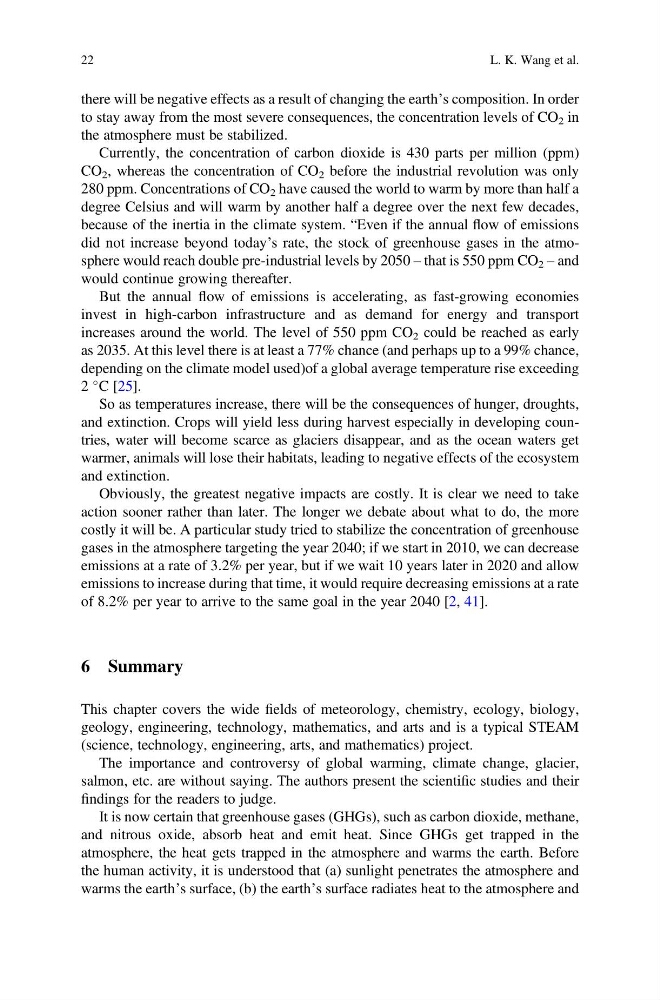
2
C [25].
So as temperatures increase, there will be the consequences of hunger, droughts,
and extinction. Crops will yield less during harvest especially in developing countries, water will become scarce as glaciers disappear, and as the ocean waters get
warmer, animals will lose their habitats, leading to negative effects of the ecosystem
and extinction.
Obviously, the greatest negative impacts are costly. It is clear we need to take
action sooner rather than later. The longer we debate about what to do, the more
costly it will be. A particular study tried to stabilize the concentration of greenhouse
gases in the atmosphere targeting the year 2040; if we start in 2010, we can decrease
emissions at a rate of 3.2% per year, but if we wait 10 years later in 2020 and allow
emissions to increase during that time, it would require decreasing emissions at a rate
of 8.2% per year to arrive to the same goal in the year 2040 [2, 41].
6 Summary
This chapter covers the wide fields of meteorology, chemistry, ecology, biology,
geology, engineering, technology, mathematics, and arts and is a typical STEAM
(science, technology, engineering, arts, and mathematics) project.
The importance and controversy of global warming, climate change, glacier,
salmon, etc. are without saying. The authors present the scientific studies and their
findings for the readers to judge.
It is now certain that greenhouse gases (GHGs), such as carbon dioxide, methane,
and nitrous oxide, absorb heat and emit heat. Since GHGs get trapped in the
atmosphere, the heat gets trapped in the atmosphere and warms the earth. Before
the human activity, it is understood that (a) sunlight penetrates the atmosphere and
warms the earth’s surface, (b) the earth’s surface radiates heat to the atmosphere and
22
L. K. Wang et al.
to stay away from the most severe consequences, the concentration levels of CO 2 in
the atmosphere must be stabilized.
Currently, the concentration of carbon dioxide is 430 parts per million (ppm)
CO 2 , whereas the concentration of CO 2 before the industrial revolution was only
280 ppm. Concentrations of CO 2 have caused the world to warm by more than half a
degree Celsius and will warm by another half a degree over the next few decades,
because of the inertia in the climate system. “Even if the annual flow of emissions
did not increase beyond today’s rate, the stock of greenhouse gases in the atmosphere would reach double pre-industrial levels by 2050 – that is 550 ppm CO 2 – and
would continue growing thereafter.
But the annual flow of emissions is accelerating, as fast-growing economies
invest in high-carbon infrastructure and as demand for energy and transport
increases around the world. The level of 550 ppm CO 2 could be reached as early
as 2035. At this level there is at least a 77% chance (and perhaps up to a 99% chance,
depending on the climate model used)of a global average temperature rise exceeding
2
C [25].
So as temperatures increase, there will be the consequences of hunger, droughts,
and extinction. Crops will yield less during harvest especially in developing countries, water will become scarce as glaciers disappear, and as the ocean waters get
warmer, animals will lose their habitats, leading to negative effects of the ecosystem
and extinction.
Obviously, the greatest negative impacts are costly. It is clear we need to take
action sooner rather than later. The longer we debate about what to do, the more
costly it will be. A particular study tried to stabilize the concentration of greenhouse
gases in the atmosphere targeting the year 2040; if we start in 2010, we can decrease
emissions at a rate of 3.2% per year, but if we wait 10 years later in 2020 and allow
emissions to increase during that time, it would require decreasing emissions at a rate
of 8.2% per year to arrive to the same goal in the year 2040 [2, 41].
6 Summary
This chapter covers the wide fields of meteorology, chemistry, ecology, biology,
geology, engineering, technology, mathematics, and arts and is a typical STEAM
(science, technology, engineering, arts, and mathematics) project.
The importance and controversy of global warming, climate change, glacier,
salmon, etc. are without saying. The authors present the scientific studies and their
findings for the readers to judge.
It is now certain that greenhouse gases (GHGs), such as carbon dioxide, methane,
and nitrous oxide, absorb heat and emit heat. Since GHGs get trapped in the
atmosphere, the heat gets trapped in the atmosphere and warms the earth. Before
the human activity, it is understood that (a) sunlight penetrates the atmosphere and
warms the earth’s surface, (b) the earth’s surface radiates heat to the atmosphere and
22
L. K. Wang et al.