

Georgieva et al. [33] produced biochar adsorbent, which is classified as a microporous material via thermal degradation of walnut shells in a nitrogen atmosphere.
Nanostructuring of the agricultural wastes typically requires special processing or
synthesis techniques for fabricating well-defined nanostructured adsorbent. Khattak
et al. [34] used watermelon waste to fabricate magnetic graphitic nanostructures for
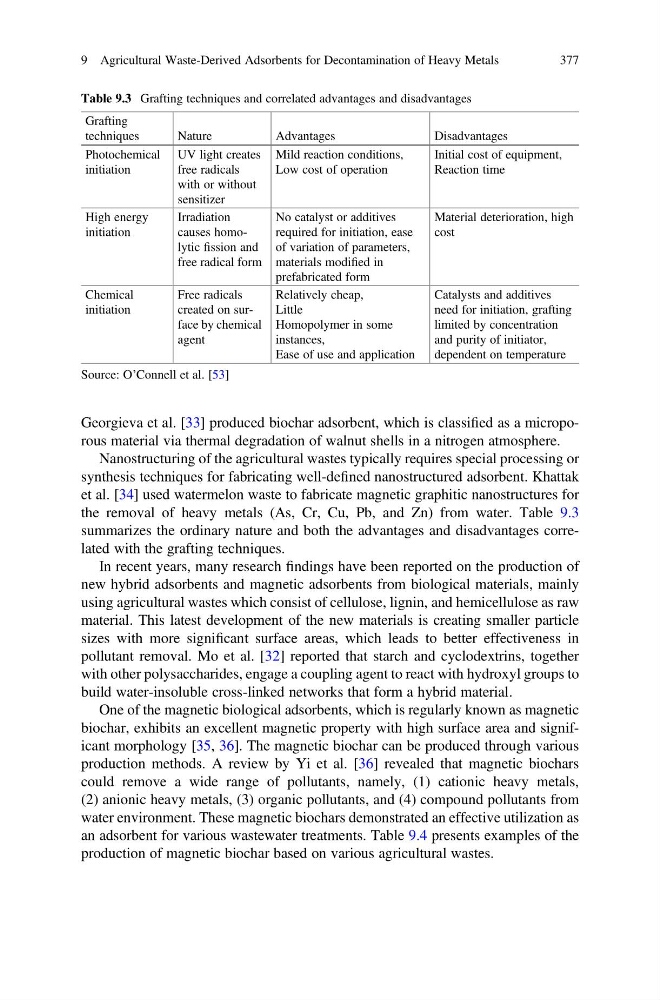
the removal of heavy metals (As, Cr, Cu, Pb, and Zn) from water. Table 9.3
summarizes the ordinary nature and both the advantages and disadvantages correlated with the grafting techniques.
In recent years, many research findings have been reported on the production of
new hybrid adsorbents and magnetic adsorbents from biological materials, mainly
using agricultural wastes which consist of cellulose, lignin, and hemicellulose as raw
material. This latest development of the new materials is creating smaller particle
sizes with more significant surface areas, which leads to better effectiveness in
pollutant removal. Mo et al. [32] reported that starch and cyclodextrins, together
with other polysaccharides, engage a coupling agent to react with hydroxyl groups to
build water-insoluble cross-linked networks that form a hybrid material.
One of the magnetic biological adsorbents, which is regularly known as magnetic
biochar, exhibits an excellent magnetic property with high surface area and significant morphology [35, 36]. The magnetic biochar can be produced through various
production methods. A review by Yi et al. [36] revealed that magnetic biochars
could remove a wide range of pollutants, namely, (1) cationic heavy metals,
(2) anionic heavy metals, (3) organic pollutants, and (4) compound pollutants from
water environment. These magnetic biochars demonstrated an effective utilization as
an adsorbent for various wastewater treatments. Table 9.4 presents examples of the
production of magnetic biochar based on various agricultural wastes.
Table 9.3 Grafting techniques and correlated advantages and disadvantages
Grafting
techniques
Nature
Advantages
Disadvantages
Photochemical
initiation
UV light creates
free radicals
with or without
sensitizer
Mild reaction conditions,
Low cost of operation
Initial cost of equipment,
Reaction time
High energy
initiation
Irradiation
causes homolytic fission and
free radical form
No catalyst or additives
required for initiation, ease
of variation of parameters,
materials modified in
prefabricated form
Material deterioration, high
cost
Chemical
initiation
Free radicals
created on surface by chemical
agent
Relatively cheap,
Little
Homopolymer in some
instances,
Ease of use and application
Catalysts and additives
need for initiation, grafting
limited by concentration
and purity of initiator,
dependent on temperature
Source: O’Connell et al. [53]
9 Agricultural Waste-Derived Adsorbents for Decontamination of Heavy Metals
377
Nanostructuring of the agricultural wastes typically requires special processing or
synthesis techniques for fabricating well-defined nanostructured adsorbent. Khattak
et al. [34] used watermelon waste to fabricate magnetic graphitic nanostructures for
the removal of heavy metals (As, Cr, Cu, Pb, and Zn) from water. Table 9.3
summarizes the ordinary nature and both the advantages and disadvantages correlated with the grafting techniques.
In recent years, many research findings have been reported on the production of
new hybrid adsorbents and magnetic adsorbents from biological materials, mainly
using agricultural wastes which consist of cellulose, lignin, and hemicellulose as raw
material. This latest development of the new materials is creating smaller particle
sizes with more significant surface areas, which leads to better effectiveness in
pollutant removal. Mo et al. [32] reported that starch and cyclodextrins, together
with other polysaccharides, engage a coupling agent to react with hydroxyl groups to
build water-insoluble cross-linked networks that form a hybrid material.
One of the magnetic biological adsorbents, which is regularly known as magnetic
biochar, exhibits an excellent magnetic property with high surface area and significant morphology [35, 36]. The magnetic biochar can be produced through various
production methods. A review by Yi et al. [36] revealed that magnetic biochars
could remove a wide range of pollutants, namely, (1) cationic heavy metals,
(2) anionic heavy metals, (3) organic pollutants, and (4) compound pollutants from
water environment. These magnetic biochars demonstrated an effective utilization as
an adsorbent for various wastewater treatments. Table 9.4 presents examples of the
production of magnetic biochar based on various agricultural wastes.
Table 9.3 Grafting techniques and correlated advantages and disadvantages
Grafting
techniques
Nature
Advantages
Disadvantages
Photochemical
initiation
UV light creates
free radicals
with or without
sensitizer
Mild reaction conditions,
Low cost of operation
Initial cost of equipment,
Reaction time
High energy
initiation
Irradiation
causes homolytic fission and
free radical form
No catalyst or additives
required for initiation, ease
of variation of parameters,
materials modified in
prefabricated form
Material deterioration, high
cost
Chemical
initiation
Free radicals
created on surface by chemical
agent
Relatively cheap,
Little
Homopolymer in some
instances,
Ease of use and application
Catalysts and additives
need for initiation, grafting
limited by concentration
and purity of initiator,
dependent on temperature
Source: O’Connell et al. [53]
9 Agricultural Waste-Derived Adsorbents for Decontamination of Heavy Metals
377