

initial cost because biomass from agricultural wastes is usually available in large
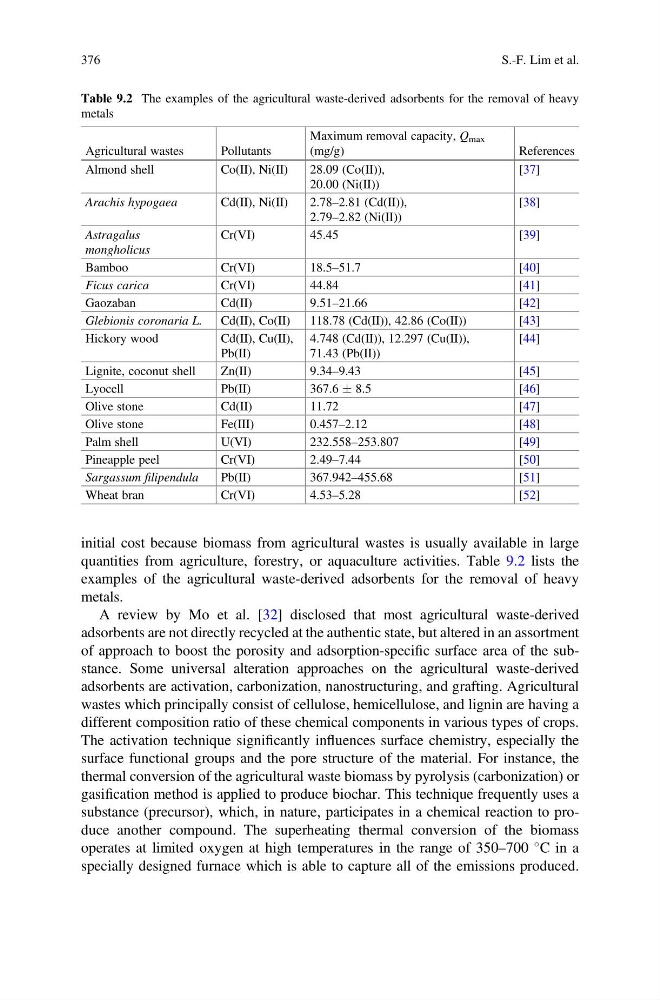
quantities from agriculture, forestry, or aquaculture activities. Table 9.2 lists the
examples of the agricultural waste-derived adsorbents for the removal of heavy
metals.
A review by Mo et al. [32] disclosed that most agricultural waste-derived
adsorbents are not directly recycled at the authentic state, but altered in an assortment
of approach to boost the porosity and adsorption-specific surface area of the substance. Some universal alteration approaches on the agricultural waste-derived
adsorbents are activation, carbonization, nanostructuring, and grafting. Agricultural
wastes which principally consist of cellulose, hemicellulose, and lignin are having a
different composition ratio of these chemical components in various types of crops.
The activation technique significantly influences surface chemistry, especially the
surface functional groups and the pore structure of the material. For instance, the
thermal conversion of the agricultural waste biomass by pyrolysis (carbonization) or
gasification method is applied to produce biochar. This technique frequently uses a
substance (precursor), which, in nature, participates in a chemical reaction to produce another compound. The superheating thermal conversion of the biomass
operates at limited oxygen at high temperatures in the range of 350–700
C in a
specially designed furnace which is able to capture all of the emissions produced.
Table 9.2 The examples of the agricultural waste-derived adsorbents for the removal of heavy
metals
Agricultural wastes
Pollutants
Maximum removal capacity, Q max
(mg/g)
References
Almond shell
Co(II), Ni(II)
28.09 (Co(II)),
20.00 (Ni(II))
[37]
Arachis hypogaea
Cd(II), Ni(II)
2.78–2.81 (Cd(II)),
2.79–2.82 (Ni(II))
[38]
Astragalus
mongholicus
Cr(VI)
45.45
[39]
Bamboo
Cr(VI)
18.5–51.7
[40]
Ficus carica
Cr(VI)
44.84
[41]
Gaozaban
Cd(II)
9.51–21.66
[42]
Glebionis coronaria L. Cd(II), Co(II)
118.78 (Cd(II)), 42.86 (Co(II))
[43]
Hickory wood
Cd(II), Cu(II),
Pb(II)
4.748 (Cd(II)), 12.297 (Cu(II)),
71.43 (Pb(II))
[44]
Lignite, coconut shell
Zn(II)
9.34–9.43
[45]
Lyocell
Pb(II)
367.6 Æ 8.5
[46]
Olive stone
Cd(II)
11.72
[47]
Olive stone
Fe(III)
0.457–2.12
[48]
Palm shell
U(VI)
232.558–253.807
[49]
Pineapple peel
Cr(VI)
2.49–7.44
[50]
Sargassum filipendula
Pb(II)
367.942–455.68
[51]
Wheat bran
Cr(VI)
4.53–5.28
[52]
376
S.-F. Lim et al.
quantities from agriculture, forestry, or aquaculture activities. Table 9.2 lists the
examples of the agricultural waste-derived adsorbents for the removal of heavy
metals.
A review by Mo et al. [32] disclosed that most agricultural waste-derived
adsorbents are not directly recycled at the authentic state, but altered in an assortment
of approach to boost the porosity and adsorption-specific surface area of the substance. Some universal alteration approaches on the agricultural waste-derived
adsorbents are activation, carbonization, nanostructuring, and grafting. Agricultural
wastes which principally consist of cellulose, hemicellulose, and lignin are having a
different composition ratio of these chemical components in various types of crops.
The activation technique significantly influences surface chemistry, especially the
surface functional groups and the pore structure of the material. For instance, the
thermal conversion of the agricultural waste biomass by pyrolysis (carbonization) or
gasification method is applied to produce biochar. This technique frequently uses a
substance (precursor), which, in nature, participates in a chemical reaction to produce another compound. The superheating thermal conversion of the biomass
operates at limited oxygen at high temperatures in the range of 350–700
C in a
specially designed furnace which is able to capture all of the emissions produced.
Table 9.2 The examples of the agricultural waste-derived adsorbents for the removal of heavy
metals
Agricultural wastes
Pollutants
Maximum removal capacity, Q max
(mg/g)
References
Almond shell
Co(II), Ni(II)
28.09 (Co(II)),
20.00 (Ni(II))
[37]
Arachis hypogaea
Cd(II), Ni(II)
2.78–2.81 (Cd(II)),
2.79–2.82 (Ni(II))
[38]
Astragalus
mongholicus
Cr(VI)
45.45
[39]
Bamboo
Cr(VI)
18.5–51.7
[40]
Ficus carica
Cr(VI)
44.84
[41]
Gaozaban
Cd(II)
9.51–21.66
[42]
Glebionis coronaria L. Cd(II), Co(II)
118.78 (Cd(II)), 42.86 (Co(II))
[43]
Hickory wood
Cd(II), Cu(II),
Pb(II)
4.748 (Cd(II)), 12.297 (Cu(II)),
71.43 (Pb(II))
[44]
Lignite, coconut shell
Zn(II)
9.34–9.43
[45]
Lyocell
Pb(II)
367.6 Æ 8.5
[46]
Olive stone
Cd(II)
11.72
[47]
Olive stone
Fe(III)
0.457–2.12
[48]
Palm shell
U(VI)
232.558–253.807
[49]
Pineapple peel
Cr(VI)
2.49–7.44
[50]
Sargassum filipendula
Pb(II)
367.942–455.68
[51]
Wheat bran
Cr(VI)
4.53–5.28
[52]
376
S.-F. Lim et al.