

Acid rain has not been shown to be harmful to human health, but some of the
particles, which can be formed from sulfate and nitrate ions, can affect respiration.
They can be transported long distances by winds and inhaled deep into people’s
lungs. Fine particles can also penetrate indoors. Many scientific studies have identified a relationship between elevated levels of fine particles and increased illness and
premature death from heart and lung disorders, such as asthma and bronchitis.
Acid deposition has also caused deterioration of buildings and monuments. Many
of these are built of stone that contains calcium carbonate. Marble is one such
material. The acid rain can turn the calcium carbonate to calcium sulfate (gypsum).
The calcium sulfate can crumble and be washed away:
CaCO 3 solid
ð
Þþ H 2 SO 4 aqueous
ð
ÞÐ CaSO 4 solid
ð
Þþ CO 2 gas
ð Þþ H 2 O liquid
ð
Þ
Acid rain also increases the corrosion rate of metals, in particular iron, steel,
copper, and bronze. Figure 7.12 shows how Harvard University wraps some of the
bronze and marble statues on its campus with waterproof covers every winter, in
order to protect them from erosion caused by acid rain and acid snow.
8.2 History and Regulations
Acid rain was first observed in the mid-nineteenth century, when some people
noticed that forests located downwind of large industrial areas showed signs of
deterioration. The term “acid rain” was coined in 1872 by Robert Angus Smith, an
English scientist [47]. Smith observed that acidic precipitation could damage plants
and materials.
Acid rain was not considered a serious environmental problem until the 1970s.
During that decade, scientists observed the increase in acidity of some lakes and
streams. At the same time, research into long-range transport of atmospheric pollutants, such as sulfur dioxide, indicated a possible link to distant sources of pollution.
Many power plants use coal with a relatively high concentration of sulfur as fuel.
Scientists realized that sulfur dioxide emitted from many of these plants could be
transported to the Northeast. When we began to see acid rain as a regional, rather
than a local, problem, the federal government had to become involved.
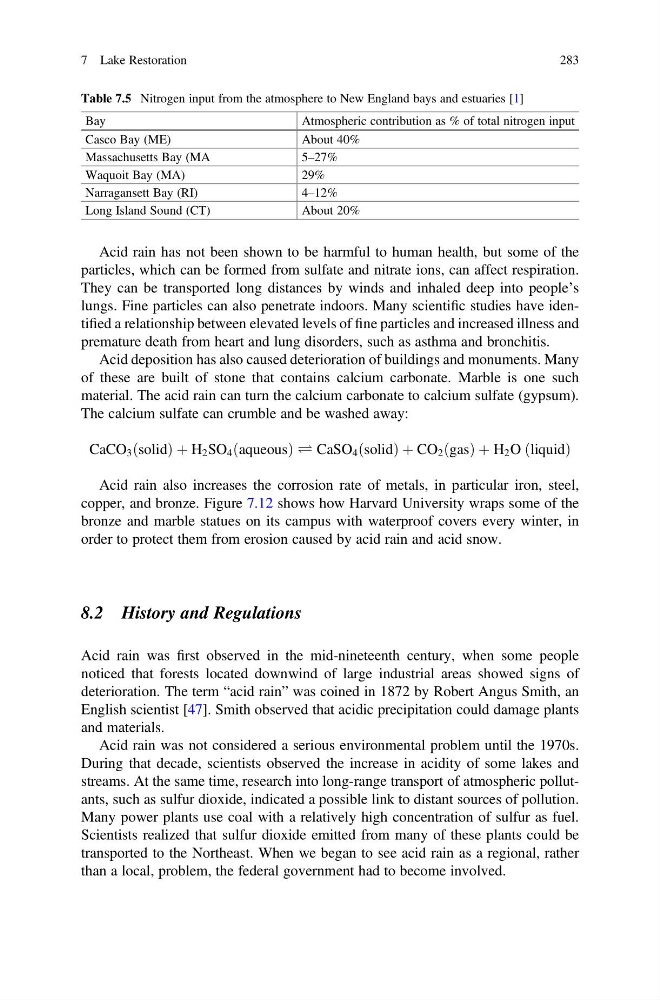
Table 7.5 Nitrogen input from the atmosphere to New England bays and estuaries [1]
Bay
Atmospheric contribution as % of total nitrogen input
Casco Bay (ME)
About 40%
Massachusetts Bay (MA
5–27%
Waquoit Bay (MA)
29%
Narragansett Bay (RI)
4–12%
Long Island Sound (CT)
About 20%
7 Lake Restoration
283
particles, which can be formed from sulfate and nitrate ions, can affect respiration.
They can be transported long distances by winds and inhaled deep into people’s
lungs. Fine particles can also penetrate indoors. Many scientific studies have identified a relationship between elevated levels of fine particles and increased illness and
premature death from heart and lung disorders, such as asthma and bronchitis.
Acid deposition has also caused deterioration of buildings and monuments. Many
of these are built of stone that contains calcium carbonate. Marble is one such
material. The acid rain can turn the calcium carbonate to calcium sulfate (gypsum).
The calcium sulfate can crumble and be washed away:
CaCO 3 solid
ð
Þþ H 2 SO 4 aqueous
ð
ÞÐ CaSO 4 solid
ð
Þþ CO 2 gas
ð Þþ H 2 O liquid
ð
Þ
Acid rain also increases the corrosion rate of metals, in particular iron, steel,
copper, and bronze. Figure 7.12 shows how Harvard University wraps some of the
bronze and marble statues on its campus with waterproof covers every winter, in
order to protect them from erosion caused by acid rain and acid snow.
8.2 History and Regulations
Acid rain was first observed in the mid-nineteenth century, when some people
noticed that forests located downwind of large industrial areas showed signs of
deterioration. The term “acid rain” was coined in 1872 by Robert Angus Smith, an
English scientist [47]. Smith observed that acidic precipitation could damage plants
and materials.
Acid rain was not considered a serious environmental problem until the 1970s.
During that decade, scientists observed the increase in acidity of some lakes and
streams. At the same time, research into long-range transport of atmospheric pollutants, such as sulfur dioxide, indicated a possible link to distant sources of pollution.
Many power plants use coal with a relatively high concentration of sulfur as fuel.
Scientists realized that sulfur dioxide emitted from many of these plants could be
transported to the Northeast. When we began to see acid rain as a regional, rather
than a local, problem, the federal government had to become involved.
Table 7.5 Nitrogen input from the atmosphere to New England bays and estuaries [1]
Bay
Atmospheric contribution as % of total nitrogen input
Casco Bay (ME)
About 40%
Massachusetts Bay (MA
5–27%
Waquoit Bay (MA)
29%
Narragansett Bay (RI)
4–12%
Long Island Sound (CT)
About 20%
7 Lake Restoration
283