

In 1980, the US Congress passed an Acid Deposition Act. From the start, policy
advocates from all sides attempted to influence NAPAP (National Acid Precipitation
Assessment Program) activities to support their particular policy advocacy efforts or
to disparage those of their opponents [55]. This Act established a 10-year research
program under the direction of the NAPAP program. NAPAP looked at the entire
problem. It enlarged a network of monitoring sites to determine how acidic the
precipitation actually was and to determine long-term trends and established a
network for dry deposition. It looked at the effects of acid rain and funded research
on the effects of acid precipitation on freshwater and terrestrial ecosystems, historical buildings, monuments, and building materials. It also funded extensive studies
on atmospheric processes and potential control programs. Significant impacts of
NAPAP were lessons learned in the assessment process and in environmental
research management to a relatively large group of scientists, program managers,
and the public [56].
In 1991, NAPAP provided its first assessment of acid rain in the United States. It
reported that 5% of New England Lakes were acidic, with sulfates being the most common
problem. They noted that 2% of the lakes could no longer support brook trout and 6% of
the lakes were unsuitable for the survival of many species of minnow. Subsequent reports
to Congress have documented chemical changes in soil and freshwater ecosystems,
nitrogen saturation, decreases in amounts of nutrients in soil, episodic acidification,
regional haze, and damage to historical monuments.
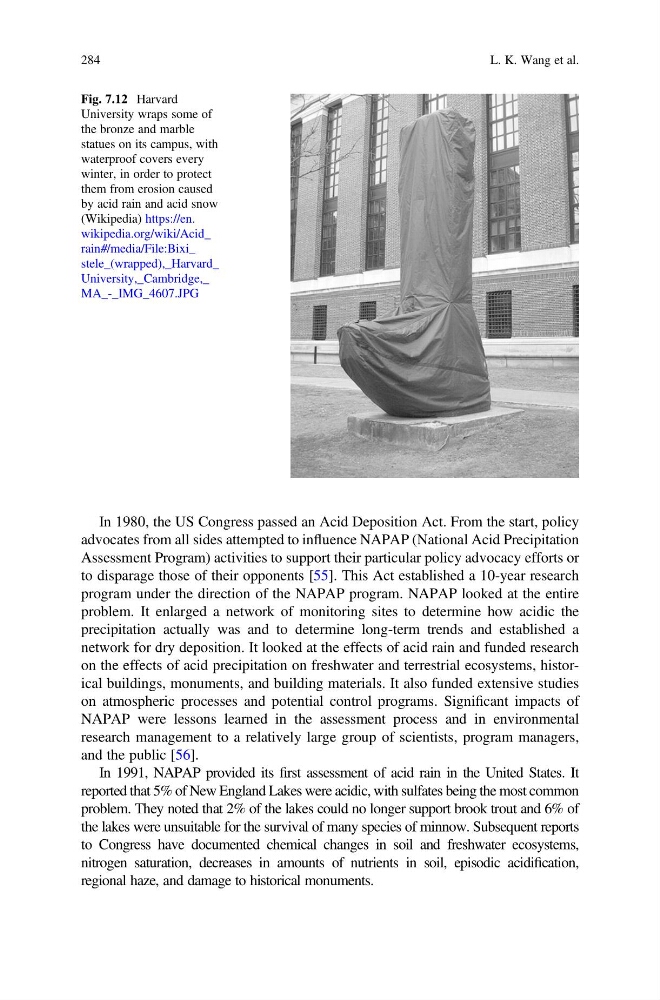
Fig. 7.12 Harvard
University wraps some of
the bronze and marble
statues on its campus, with
waterproof covers every
winter, in order to protect
them from erosion caused
by acid rain and acid snow
(Wikipedia) https://en.
wikipedia.org/wiki/Acid_
rain#/media/File:Bixi_
stele_(wrapped),_Harvard_
University,_Cambridge,_
MA_-_IMG_4607.JPG
284
L. K. Wang et al.
advocates from all sides attempted to influence NAPAP (National Acid Precipitation
Assessment Program) activities to support their particular policy advocacy efforts or
to disparage those of their opponents [55]. This Act established a 10-year research
program under the direction of the NAPAP program. NAPAP looked at the entire
problem. It enlarged a network of monitoring sites to determine how acidic the
precipitation actually was and to determine long-term trends and established a
network for dry deposition. It looked at the effects of acid rain and funded research
on the effects of acid precipitation on freshwater and terrestrial ecosystems, historical buildings, monuments, and building materials. It also funded extensive studies
on atmospheric processes and potential control programs. Significant impacts of
NAPAP were lessons learned in the assessment process and in environmental
research management to a relatively large group of scientists, program managers,
and the public [56].
In 1991, NAPAP provided its first assessment of acid rain in the United States. It
reported that 5% of New England Lakes were acidic, with sulfates being the most common
problem. They noted that 2% of the lakes could no longer support brook trout and 6% of
the lakes were unsuitable for the survival of many species of minnow. Subsequent reports
to Congress have documented chemical changes in soil and freshwater ecosystems,
nitrogen saturation, decreases in amounts of nutrients in soil, episodic acidification,
regional haze, and damage to historical monuments.
Fig. 7.12 Harvard
University wraps some of
the bronze and marble
statues on its campus, with
waterproof covers every
winter, in order to protect
them from erosion caused
by acid rain and acid snow
(Wikipedia) https://en.
wikipedia.org/wiki/Acid_
rain#/media/File:Bixi_
stele_(wrapped),_Harvard_
University,_Cambridge,_
MA_-_IMG_4607.JPG
284
L. K. Wang et al.