

[47]. Chronic or long-term acidification results from years of acidic rainfall. It
reduces the alkalinity (buffering capacity) and increases the acidity of the water.
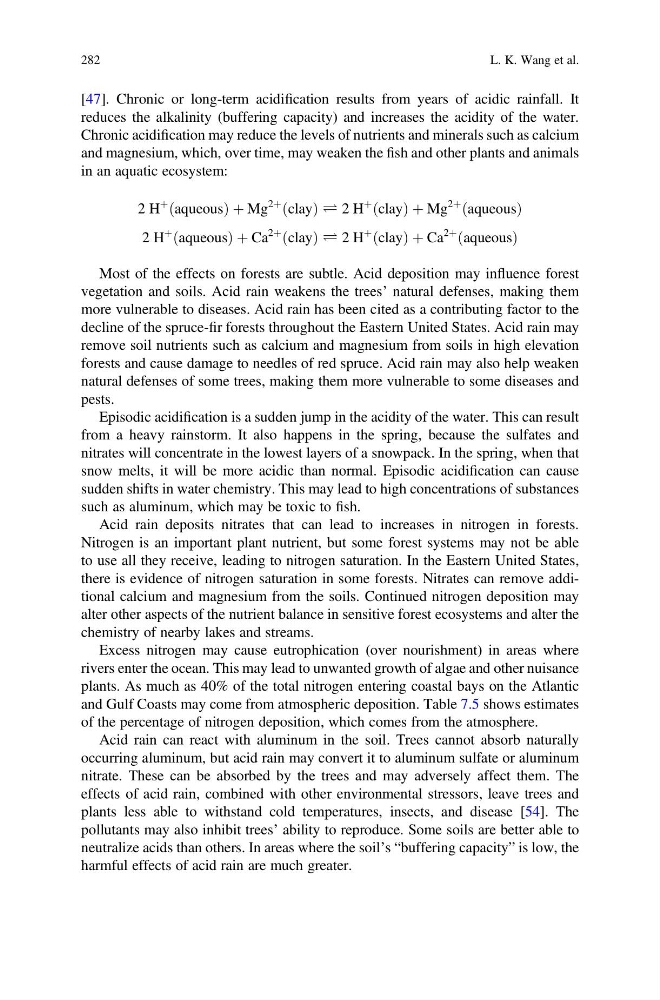
Chronic acidification may reduce the levels of nutrients and minerals such as calcium
and magnesium, which, over time, may weaken the fish and other plants and animals
in an aquatic ecosystem:
2 H
þ aqueous
ð
ÞþMg
2þ clay
ð
Þ Ð 2 H
þ clay
ð
ÞþMg
2þ aqueous
ð
Þ
2 H
þ aqueous
ð
ÞþCa
2þ clay
ð
Þ Ð 2 H
þ clay
ð
ÞþCa
2þ aqueous
ð
Þ
Most of the effects on forests are subtle. Acid deposition may influence forest
vegetation and soils. Acid rain weakens the trees’ natural defenses, making them
more vulnerable to diseases. Acid rain has been cited as a contributing factor to the
decline of the spruce-fir forests throughout the Eastern United States. Acid rain may
remove soil nutrients such as calcium and magnesium from soils in high elevation
forests and cause damage to needles of red spruce. Acid rain may also help weaken
natural defenses of some trees, making them more vulnerable to some diseases and
pests.
Episodic acidification is a sudden jump in the acidity of the water. This can result
from a heavy rainstorm. It also happens in the spring, because the sulfates and
nitrates will concentrate in the lowest layers of a snowpack. In the spring, when that
snow melts, it will be more acidic than normal. Episodic acidification can cause
sudden shifts in water chemistry. This may lead to high concentrations of substances
such as aluminum, which may be toxic to fish.
Acid rain deposits nitrates that can lead to increases in nitrogen in forests.
Nitrogen is an important plant nutrient, but some forest systems may not be able
to use all they receive, leading to nitrogen saturation. In the Eastern United States,
there is evidence of nitrogen saturation in some forests. Nitrates can remove additional calcium and magnesium from the soils. Continued nitrogen deposition may
alter other aspects of the nutrient balance in sensitive forest ecosystems and alter the
chemistry of nearby lakes and streams.
Excess nitrogen may cause eutrophication (over nourishment) in areas where
rivers enter the ocean. This may lead to unwanted growth of algae and other nuisance
plants. As much as 40% of the total nitrogen entering coastal bays on the Atlantic
and Gulf Coasts may come from atmospheric deposition. Table 7.5 shows estimates
of the percentage of nitrogen deposition, which comes from the atmosphere.
Acid rain can react with aluminum in the soil. Trees cannot absorb naturally
occurring aluminum, but acid rain may convert it to aluminum sulfate or aluminum
nitrate. These can be absorbed by the trees and may adversely affect them. The
effects of acid rain, combined with other environmental stressors, leave trees and
plants less able to withstand cold temperatures, insects, and disease [54]. The
pollutants may also inhibit trees’ ability to reproduce. Some soils are better able to
neutralize acids than others. In areas where the soil’s “buffering capacity” is low, the
harmful effects of acid rain are much greater.
282
L. K. Wang et al.
reduces the alkalinity (buffering capacity) and increases the acidity of the water.
Chronic acidification may reduce the levels of nutrients and minerals such as calcium
and magnesium, which, over time, may weaken the fish and other plants and animals
in an aquatic ecosystem:
2 H
þ aqueous
ð
ÞþMg
2þ clay
ð
Þ Ð 2 H
þ clay
ð
ÞþMg
2þ aqueous
ð
Þ
2 H
þ aqueous
ð
ÞþCa
2þ clay
ð
Þ Ð 2 H
þ clay
ð
ÞþCa
2þ aqueous
ð
Þ
Most of the effects on forests are subtle. Acid deposition may influence forest
vegetation and soils. Acid rain weakens the trees’ natural defenses, making them
more vulnerable to diseases. Acid rain has been cited as a contributing factor to the
decline of the spruce-fir forests throughout the Eastern United States. Acid rain may
remove soil nutrients such as calcium and magnesium from soils in high elevation
forests and cause damage to needles of red spruce. Acid rain may also help weaken
natural defenses of some trees, making them more vulnerable to some diseases and
pests.
Episodic acidification is a sudden jump in the acidity of the water. This can result
from a heavy rainstorm. It also happens in the spring, because the sulfates and
nitrates will concentrate in the lowest layers of a snowpack. In the spring, when that
snow melts, it will be more acidic than normal. Episodic acidification can cause
sudden shifts in water chemistry. This may lead to high concentrations of substances
such as aluminum, which may be toxic to fish.
Acid rain deposits nitrates that can lead to increases in nitrogen in forests.
Nitrogen is an important plant nutrient, but some forest systems may not be able
to use all they receive, leading to nitrogen saturation. In the Eastern United States,
there is evidence of nitrogen saturation in some forests. Nitrates can remove additional calcium and magnesium from the soils. Continued nitrogen deposition may
alter other aspects of the nutrient balance in sensitive forest ecosystems and alter the
chemistry of nearby lakes and streams.
Excess nitrogen may cause eutrophication (over nourishment) in areas where
rivers enter the ocean. This may lead to unwanted growth of algae and other nuisance
plants. As much as 40% of the total nitrogen entering coastal bays on the Atlantic
and Gulf Coasts may come from atmospheric deposition. Table 7.5 shows estimates
of the percentage of nitrogen deposition, which comes from the atmosphere.
Acid rain can react with aluminum in the soil. Trees cannot absorb naturally
occurring aluminum, but acid rain may convert it to aluminum sulfate or aluminum
nitrate. These can be absorbed by the trees and may adversely affect them. The
effects of acid rain, combined with other environmental stressors, leave trees and
plants less able to withstand cold temperatures, insects, and disease [54]. The
pollutants may also inhibit trees’ ability to reproduce. Some soils are better able to
neutralize acids than others. In areas where the soil’s “buffering capacity” is low, the
harmful effects of acid rain are much greater.
282
L. K. Wang et al.