

2.5 Semiconductor Subcategory
2.5.1 Description and Production Process
Semiconductors are solid electrical devices that conduct, by guiding or moving, an
electrical current and act as insulator, by preventing the passage of heat or electricity.
Simple diodes and integrated circuits (ICs) are variety of semicondutors
manufactured in the electrical and electronic industries. The diodes are monopurpose, mainly affecting the flow of electrical current. ICs combine multiple of
such diodes (>200) and as such they are multipurpose and effective. ICs are
assembled on chips with sizes as small as a thumbnail of a mature man. Several of
the functions they perform include information processing and display, power
handy, data storage, signal conditioning, and conversion between light energy and
electrical energy. They are widely used in consumer electronic products, telecommunication equipment, industrial machinery, transportation equipment, and military
hardware; however, their usage in computers account for about 40% of the semiconductor available in the market [15]. Semiconductors are made purely of silicon or
with other crystalline materials like gallium and germanium; they are classified
according to the type of material used in their production. Common semiconductor
products available include silicon-based integrated circuits, gallium arsenide, gallium phosphide glass water devices, silicon, and germanium. They are used in
forming different devices like bipolar, light-emitting diodes (LED), diodes, transistors, liquid crystal display, etc.
Production process involved in the manufacturing of semiconductors is complex,
and as such some of the processes are repeated to complete the production. Distinctly, these processes may be divided into five steps [20], which are design, crystal
processing, water fabrication, final layering and cleaning, and assembly.
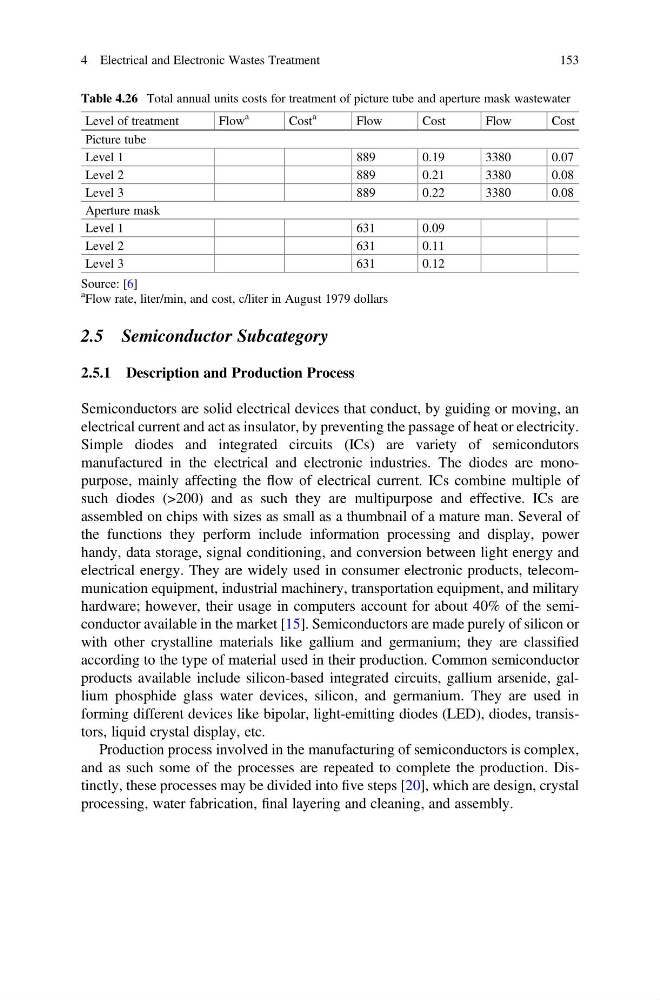
Table 4.26 Total annual units costs for treatment of picture tube and aperture mask wastewater
Level of treatment
Flow
a
Cost
a
Flow
Cost
Flow
Cost
Picture tube
Level 1
889
0.19
3380
0.07
Level 2
889
0.21
3380
0.08
Level 3
889
0.22
3380
0.08
Aperture mask
Level 1
631
0.09
Level 2
631
0.11
Level 3
631
0.12
Source: [6]
a Flow rate, liter/min, and cost, c/liter in August 1979 dollars
4 Electrical and Electronic Wastes Treatment
153
2.5.1 Description and Production Process
Semiconductors are solid electrical devices that conduct, by guiding or moving, an
electrical current and act as insulator, by preventing the passage of heat or electricity.
Simple diodes and integrated circuits (ICs) are variety of semicondutors
manufactured in the electrical and electronic industries. The diodes are monopurpose, mainly affecting the flow of electrical current. ICs combine multiple of
such diodes (>200) and as such they are multipurpose and effective. ICs are
assembled on chips with sizes as small as a thumbnail of a mature man. Several of
the functions they perform include information processing and display, power
handy, data storage, signal conditioning, and conversion between light energy and
electrical energy. They are widely used in consumer electronic products, telecommunication equipment, industrial machinery, transportation equipment, and military
hardware; however, their usage in computers account for about 40% of the semiconductor available in the market [15]. Semiconductors are made purely of silicon or
with other crystalline materials like gallium and germanium; they are classified
according to the type of material used in their production. Common semiconductor
products available include silicon-based integrated circuits, gallium arsenide, gallium phosphide glass water devices, silicon, and germanium. They are used in
forming different devices like bipolar, light-emitting diodes (LED), diodes, transistors, liquid crystal display, etc.
Production process involved in the manufacturing of semiconductors is complex,
and as such some of the processes are repeated to complete the production. Distinctly, these processes may be divided into five steps [20], which are design, crystal
processing, water fabrication, final layering and cleaning, and assembly.
Table 4.26 Total annual units costs for treatment of picture tube and aperture mask wastewater
Level of treatment
Flow
a
Cost
a
Flow
Cost
Flow
Cost
Picture tube
Level 1
889
0.19
3380
0.07
Level 2
889
0.21
3380
0.08
Level 3
889
0.22
3380
0.08
Aperture mask
Level 1
631
0.09
Level 2
631
0.11
Level 3
631
0.12
Source: [6]
a Flow rate, liter/min, and cost, c/liter in August 1979 dollars
4 Electrical and Electronic Wastes Treatment
153