

specific water body is typically based on the major uses for that source. Regions of
extensive agriculture and sewage outfalls have the potential to introduce pathogens
into surface waters which must be removed by water treatment before direct consumption. Bacterial water quality is an indication of the potential presence of various
organisms such as Escherichia coli, Giardia, and Cryptosporidium. Fecal contamination by E. coli is widely used as an indicator of related pathogenic organisms such
as Salmonella, Shigella, Campylobacter, and Yersinia [34]. E. coli occurs naturally
in human and animal bodies, but some strains contain toxic cell wall components,
some of which can be fatal as shown by the Walkerton tragedy. The guidelines for
water quality stipulated by Alberta Environment indicate acceptable levels of indicator organisms that can be present to minimize the possibility of waterborne disease
[35]. Livestock can be important sources of these microorganisms, especially during
periods of high runoff. Agricultural inputs are generally considered to be non-point
sources because of their wide geographic distribution and are difficult to control.
Point sources, such as sewage outfalls, are much easier to regulate and treat. Based
on Alberta formula for surface water quality guidelines [35], the river index bacteria
formula was used, it includes the number of times bacterial density in these samples
exceeds a guideline (frequency) and the extent to which the guideline is exceeded
(amplitude). The result is a number between 0 and 100, where 100 represents the
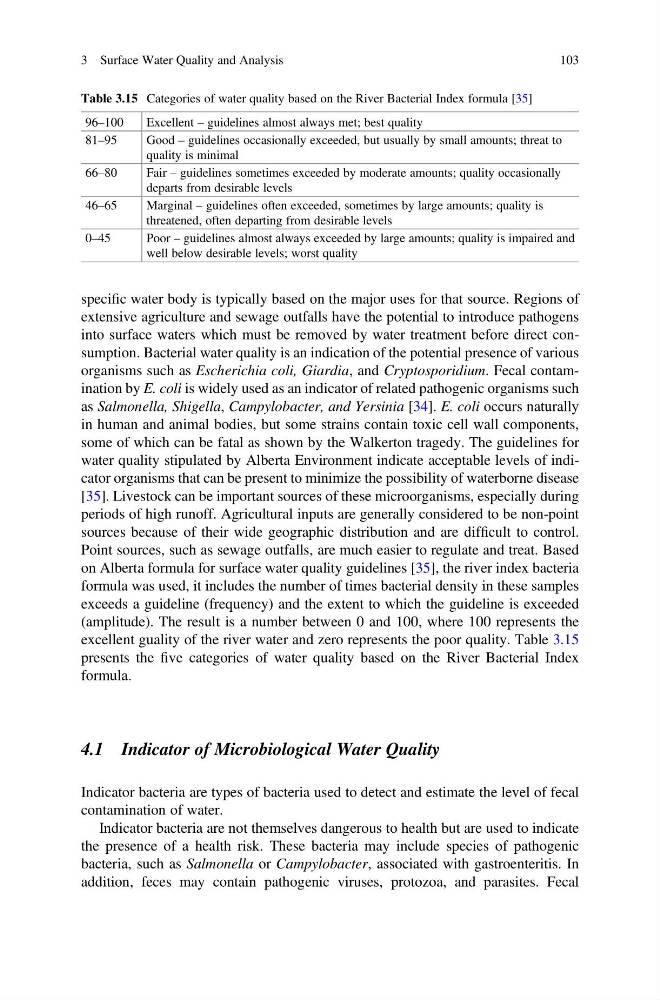
excellent guality of the river water and zero represents the poor quality. Table 3.15
presents the five categories of water quality based on the River Bacterial Index
formula.
4.1 Indicator of Microbiological Water Quality
Indicator bacteria are types of bacteria used to detect and estimate the level of fecal
contamination of water.
Indicator bacteria are not themselves dangerous to health but are used to indicate
the presence of a health risk. These bacteria may include species of pathogenic
bacteria, such as Salmonella or Campylobacter, associated with gastroenteritis. In
addition, feces may contain pathogenic viruses, protozoa, and parasites. Fecal
Table 3.15 Categories of water quality based on the River Bacterial Index formula [35]
96–100
Excellent – guidelines almost always met; best quality
81–95
Good – guidelines occasionally exceeded, but usually by small amounts; threat to
quality is minimal
66–80
Fair – guidelines sometimes exceeded by moderate amounts; quality occasionally
departs from desirable levels
46–65
Marginal – guidelines often exceeded, sometimes by large amounts; quality is
threatened, often departing from desirable levels
0–45
Poor – guidelines almost always exceeded by large amounts; quality is impaired and
well below desirable levels; worst quality
3 Surface Water Quality and Analysis
103
extensive agriculture and sewage outfalls have the potential to introduce pathogens
into surface waters which must be removed by water treatment before direct consumption. Bacterial water quality is an indication of the potential presence of various
organisms such as Escherichia coli, Giardia, and Cryptosporidium. Fecal contamination by E. coli is widely used as an indicator of related pathogenic organisms such
as Salmonella, Shigella, Campylobacter, and Yersinia [34]. E. coli occurs naturally
in human and animal bodies, but some strains contain toxic cell wall components,
some of which can be fatal as shown by the Walkerton tragedy. The guidelines for
water quality stipulated by Alberta Environment indicate acceptable levels of indicator organisms that can be present to minimize the possibility of waterborne disease
[35]. Livestock can be important sources of these microorganisms, especially during
periods of high runoff. Agricultural inputs are generally considered to be non-point
sources because of their wide geographic distribution and are difficult to control.
Point sources, such as sewage outfalls, are much easier to regulate and treat. Based
on Alberta formula for surface water quality guidelines [35], the river index bacteria
formula was used, it includes the number of times bacterial density in these samples
exceeds a guideline (frequency) and the extent to which the guideline is exceeded
(amplitude). The result is a number between 0 and 100, where 100 represents the
excellent guality of the river water and zero represents the poor quality. Table 3.15
presents the five categories of water quality based on the River Bacterial Index
formula.
4.1 Indicator of Microbiological Water Quality
Indicator bacteria are types of bacteria used to detect and estimate the level of fecal
contamination of water.
Indicator bacteria are not themselves dangerous to health but are used to indicate
the presence of a health risk. These bacteria may include species of pathogenic
bacteria, such as Salmonella or Campylobacter, associated with gastroenteritis. In
addition, feces may contain pathogenic viruses, protozoa, and parasites. Fecal
Table 3.15 Categories of water quality based on the River Bacterial Index formula [35]
96–100
Excellent – guidelines almost always met; best quality
81–95
Good – guidelines occasionally exceeded, but usually by small amounts; threat to
quality is minimal
66–80
Fair – guidelines sometimes exceeded by moderate amounts; quality occasionally
departs from desirable levels
46–65
Marginal – guidelines often exceeded, sometimes by large amounts; quality is
threatened, often departing from desirable levels
0–45
Poor – guidelines almost always exceeded by large amounts; quality is impaired and
well below desirable levels; worst quality
3 Surface Water Quality and Analysis
103