

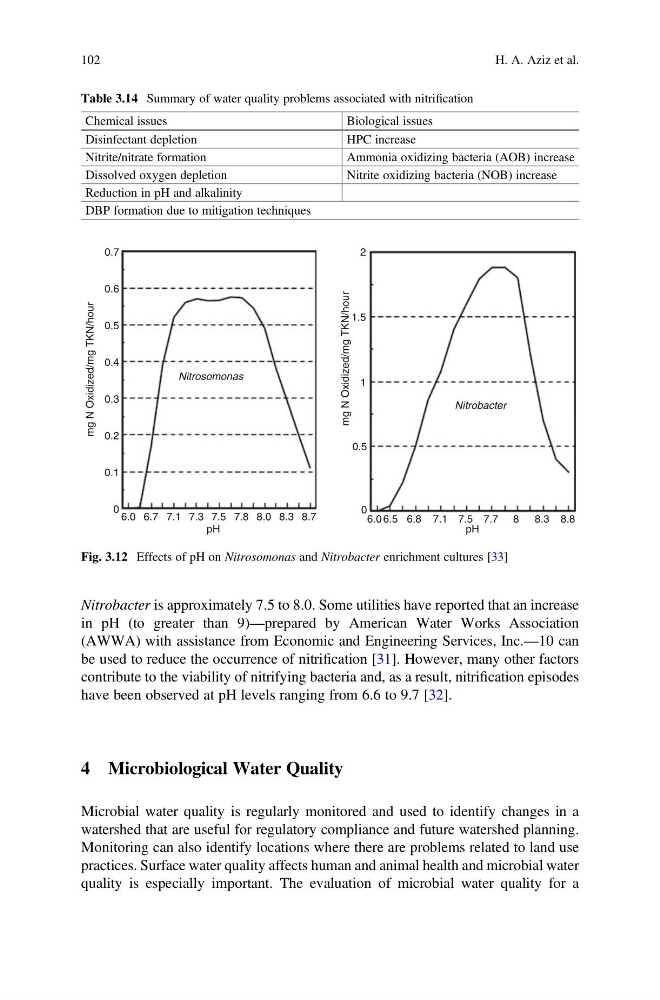
Nitrobacter is approximately 7.5 to 8.0. Some utilities have reported that an increase
in pH (to greater than 9)—prepared by American Water Works Association
(AWWA) with assistance from Economic and Engineering Services, Inc.—10 can
be used to reduce the occurrence of nitrification [31]. However, many other factors
contribute to the viability of nitrifying bacteria and, as a result, nitrification episodes
have been observed at pH levels ranging from 6.6 to 9.7 [32].
4 Microbiological Water Quality
Microbial water quality is regularly monitored and used to identify changes in a
watershed that are useful for regulatory compliance and future watershed planning.
Monitoring can also identify locations where there are problems related to land use
practices. Surface water quality affects human and animal health and microbial water
quality is especially important. The evaluation of microbial water quality for a
Table 3.14 Summary of water quality problems associated with nitrification
Chemical issues
Biological issues
Disinfectant depletion
HPC increase
Nitrite/nitrate formation
Ammonia oxidizing bacteria (AOB) increase
Dissolved oxygen depletion
Nitrite oxidizing bacteria (NOB) increase
Reduction in pH and alkalinity
DBP formation due to mitigation techniques
0.7
2
1.5
1
0.5
Nitrobacter
Nitrosomonas
0
0.6
0.5
mg N Oxidized/mg TKN/hour
mg N Oxidized/mg TKN/hour
0.4
0.3
0.2
0.1
0 6.0
6.0 6.5 6.8 7.1 7.5 7.7 8 8.3 8.8
6.7 7.1 7.3 7.5
pH
pH
7.8 8.0 8.3 8.7
Fig. 3.12 Effects of pH on Nitrosomonas and Nitrobacter enrichment cultures [33]
102
H. A. Aziz et al.
in pH (to greater than 9)—prepared by American Water Works Association
(AWWA) with assistance from Economic and Engineering Services, Inc.—10 can
be used to reduce the occurrence of nitrification [31]. However, many other factors
contribute to the viability of nitrifying bacteria and, as a result, nitrification episodes
have been observed at pH levels ranging from 6.6 to 9.7 [32].
4 Microbiological Water Quality
Microbial water quality is regularly monitored and used to identify changes in a
watershed that are useful for regulatory compliance and future watershed planning.
Monitoring can also identify locations where there are problems related to land use
practices. Surface water quality affects human and animal health and microbial water
quality is especially important. The evaluation of microbial water quality for a
Table 3.14 Summary of water quality problems associated with nitrification
Chemical issues
Biological issues
Disinfectant depletion
HPC increase
Nitrite/nitrate formation
Ammonia oxidizing bacteria (AOB) increase
Dissolved oxygen depletion
Nitrite oxidizing bacteria (NOB) increase
Reduction in pH and alkalinity
DBP formation due to mitigation techniques
0.7
2
1.5
1
0.5
Nitrobacter
Nitrosomonas
0
0.6
0.5
mg N Oxidized/mg TKN/hour
mg N Oxidized/mg TKN/hour
0.4
0.3
0.2
0.1
0 6.0
6.0 6.5 6.8 7.1 7.5 7.7 8 8.3 8.8
6.7 7.1 7.3 7.5
pH
pH
7.8 8.0 8.3 8.7
Fig. 3.12 Effects of pH on Nitrosomonas and Nitrobacter enrichment cultures [33]
102
H. A. Aziz et al.