

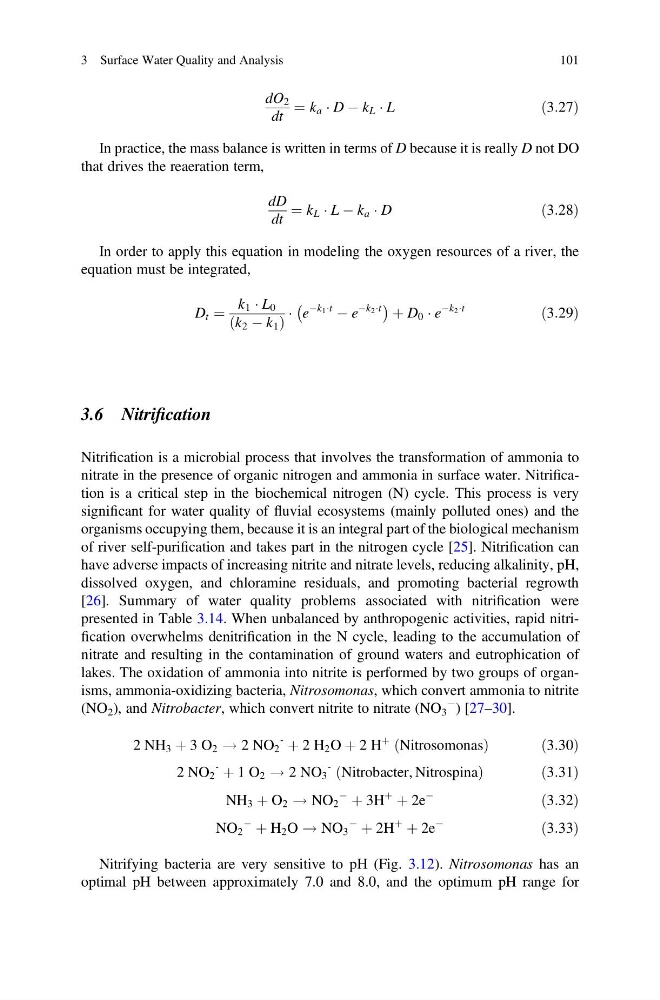
dO 2
dt
¼ k a Á D À k L Á L
ð3:27Þ
In practice, the mass balance is written in terms of D because it is really D not DO
that drives the reaeration term,
dD
dt
¼ k L Á L À k a Á D
ð3:28Þ
In order to apply this equation in modeling the oxygen resources of a river, the
equation must be integrated,
D t ¼
k 1 Á L 0
k 2 À k 1
ð
Þ
Á e
Àk 1 Át
À e
Àk 2 Át
À
Á þ D 0 Á e
Àk 2 Át
ð3:29Þ
3.6 Nitrification
Nitrification is a microbial process that involves the transformation of ammonia to
nitrate in the presence of organic nitrogen and ammonia in surface water. Nitrification is a critical step in the biochemical nitrogen (N) cycle. This process is very
significant for water quality of fluvial ecosystems (mainly polluted ones) and the
organisms occupying them, because it is an integral part of the biological mechanism
of river self-purification and takes part in the nitrogen cycle [25]. Nitrification can
have adverse impacts of increasing nitrite and nitrate levels, reducing alkalinity, pH,
dissolved oxygen, and chloramine residuals, and promoting bacterial regrowth
[26]. Summary of water quality problems associated with nitrification were
presented in Table 3.14. When unbalanced by anthropogenic activities, rapid nitrification overwhelms denitrification in the N cycle, leading to the accumulation of
nitrate and resulting in the contamination of ground waters and eutrophication of
lakes. The oxidation of ammonia into nitrite is performed by two groups of organisms, ammonia-oxidizing bacteria, Nitrosomonas, which convert ammonia to nitrite
(NO 2 ), and Nitrobacter, which convert nitrite to nitrate (NO 3
À ) [27–30].
2 NH 3 þ 3 O 2 ! 2 NO 2
‐
þ 2 H 2 O þ 2 H
þ Nitrosomonas
ð
Þ
ð 3:30Þ
2 NO 2
‐
þ 1 O 2 ! 2 NO 3
‐ Nitrobacter, Nitrospina
ð
Þ
ð 3:31Þ
NH 3 þ O 2 ! NO 2
À
þ 3H
þ
þ 2e
À
ð3:32Þ
NO 2
À
þ H 2 O ! NO 3
À
þ 2H
þ
þ 2e
À
ð3:33Þ
Nitrifying bacteria are very sensitive to pH (Fig. 3.12). Nitrosomonas has an
optimal pH between approximately 7.0 and 8.0, and the optimum pH range for
3 Surface Water Quality and Analysis
101
dt
¼ k a Á D À k L Á L
ð3:27Þ
In practice, the mass balance is written in terms of D because it is really D not DO
that drives the reaeration term,
dD
dt
¼ k L Á L À k a Á D
ð3:28Þ
In order to apply this equation in modeling the oxygen resources of a river, the
equation must be integrated,
D t ¼
k 1 Á L 0
k 2 À k 1
ð
Þ
Á e
Àk 1 Át
À e
Àk 2 Át
À
Á þ D 0 Á e
Àk 2 Át
ð3:29Þ
3.6 Nitrification
Nitrification is a microbial process that involves the transformation of ammonia to
nitrate in the presence of organic nitrogen and ammonia in surface water. Nitrification is a critical step in the biochemical nitrogen (N) cycle. This process is very
significant for water quality of fluvial ecosystems (mainly polluted ones) and the
organisms occupying them, because it is an integral part of the biological mechanism
of river self-purification and takes part in the nitrogen cycle [25]. Nitrification can
have adverse impacts of increasing nitrite and nitrate levels, reducing alkalinity, pH,
dissolved oxygen, and chloramine residuals, and promoting bacterial regrowth
[26]. Summary of water quality problems associated with nitrification were
presented in Table 3.14. When unbalanced by anthropogenic activities, rapid nitrification overwhelms denitrification in the N cycle, leading to the accumulation of
nitrate and resulting in the contamination of ground waters and eutrophication of
lakes. The oxidation of ammonia into nitrite is performed by two groups of organisms, ammonia-oxidizing bacteria, Nitrosomonas, which convert ammonia to nitrite
(NO 2 ), and Nitrobacter, which convert nitrite to nitrate (NO 3
À ) [27–30].
2 NH 3 þ 3 O 2 ! 2 NO 2
‐
þ 2 H 2 O þ 2 H
þ Nitrosomonas
ð
Þ
ð 3:30Þ
2 NO 2
‐
þ 1 O 2 ! 2 NO 3
‐ Nitrobacter, Nitrospina
ð
Þ
ð 3:31Þ
NH 3 þ O 2 ! NO 2
À
þ 3H
þ
þ 2e
À
ð3:32Þ
NO 2
À
þ H 2 O ! NO 3
À
þ 2H
þ
þ 2e
À
ð3:33Þ
Nitrifying bacteria are very sensitive to pH (Fig. 3.12). Nitrosomonas has an
optimal pH between approximately 7.0 and 8.0, and the optimum pH range for
3 Surface Water Quality and Analysis
101