

3.4 Oxygen Percent Saturation and Temperature
Oxygen saturation levels indicate how much biological processes have affected the
water recently. Community respiration, mainly by bacteria, reduces oxygen concentrations. The high water temperature and decomposable organic matter and other
bacterial substrates in the water are the main factors for dissolved oxygen consumption and reduction. Phytoplankton photosynthesis, plus some contribution from
photosynthesis of submersed plants and benthic algae around the shallow edges of
a lake or pond, can increase oxygen concentrations above saturated levels, but only
during the day when photosynthesis is occurring. Oxygen percent saturation compares an observed oxygen concentration to the absolute solubility of oxygen at a
particular water temperature. This index often takes into account barometric pressure
and salinity effects at the measurement site, but usually ignores effects of water
pressure at depths below a lake or stream surface. Solubility of gases increases by an
amount equal to the surface saturation concentration for about every 10 m increase in
depth.
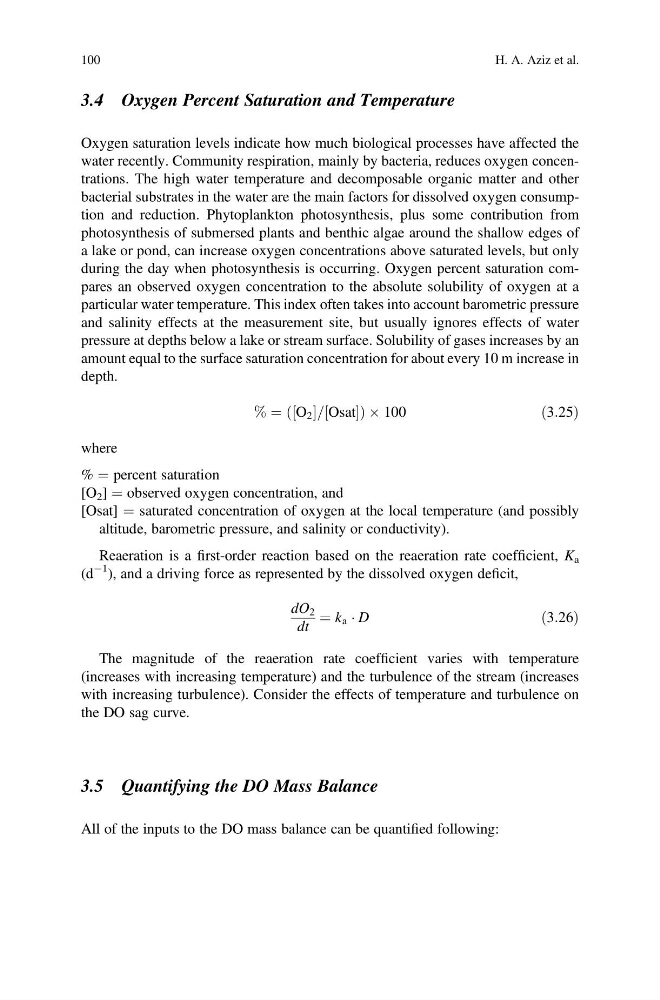
% ¼ O 2
½ = Osat
½
ð
ÞÂ100
ð3:25Þ
where
% ¼ percent saturation
[O 2 ] ¼ observed oxygen concentration, and
[Osat] ¼ saturated concentration of oxygen at the local temperature (and possibly
altitude, barometric pressure, and salinity or conductivity).
Reaeration is a first-order reaction based on the reaeration rate coefficient, K a
(d
À1 ), and a driving force as represented by the dissolved oxygen deficit,
dO 2
dt
¼ k a Á D
ð3:26Þ
The magnitude of the reaeration rate coefficient varies with temperature
(increases with increasing temperature) and the turbulence of the stream (increases
with increasing turbulence). Consider the effects of temperature and turbulence on
the DO sag curve.
3.5 Quantifying the DO Mass Balance
All of the inputs to the DO mass balance can be quantified following:
100
H. A. Aziz et al.
Oxygen saturation levels indicate how much biological processes have affected the
water recently. Community respiration, mainly by bacteria, reduces oxygen concentrations. The high water temperature and decomposable organic matter and other
bacterial substrates in the water are the main factors for dissolved oxygen consumption and reduction. Phytoplankton photosynthesis, plus some contribution from
photosynthesis of submersed plants and benthic algae around the shallow edges of
a lake or pond, can increase oxygen concentrations above saturated levels, but only
during the day when photosynthesis is occurring. Oxygen percent saturation compares an observed oxygen concentration to the absolute solubility of oxygen at a
particular water temperature. This index often takes into account barometric pressure
and salinity effects at the measurement site, but usually ignores effects of water
pressure at depths below a lake or stream surface. Solubility of gases increases by an
amount equal to the surface saturation concentration for about every 10 m increase in
depth.
% ¼ O 2
½ = Osat
½
ð
ÞÂ100
ð3:25Þ
where
% ¼ percent saturation
[O 2 ] ¼ observed oxygen concentration, and
[Osat] ¼ saturated concentration of oxygen at the local temperature (and possibly
altitude, barometric pressure, and salinity or conductivity).
Reaeration is a first-order reaction based on the reaeration rate coefficient, K a
(d
À1 ), and a driving force as represented by the dissolved oxygen deficit,
dO 2
dt
¼ k a Á D
ð3:26Þ
The magnitude of the reaeration rate coefficient varies with temperature
(increases with increasing temperature) and the turbulence of the stream (increases
with increasing turbulence). Consider the effects of temperature and turbulence on
the DO sag curve.
3.5 Quantifying the DO Mass Balance
All of the inputs to the DO mass balance can be quantified following:
100
H. A. Aziz et al.