

dL
dt
¼
ÀkXL
K s þ L
ffi
ÀkX
K s
!
L ffi Àk ox L
ð3:19Þ
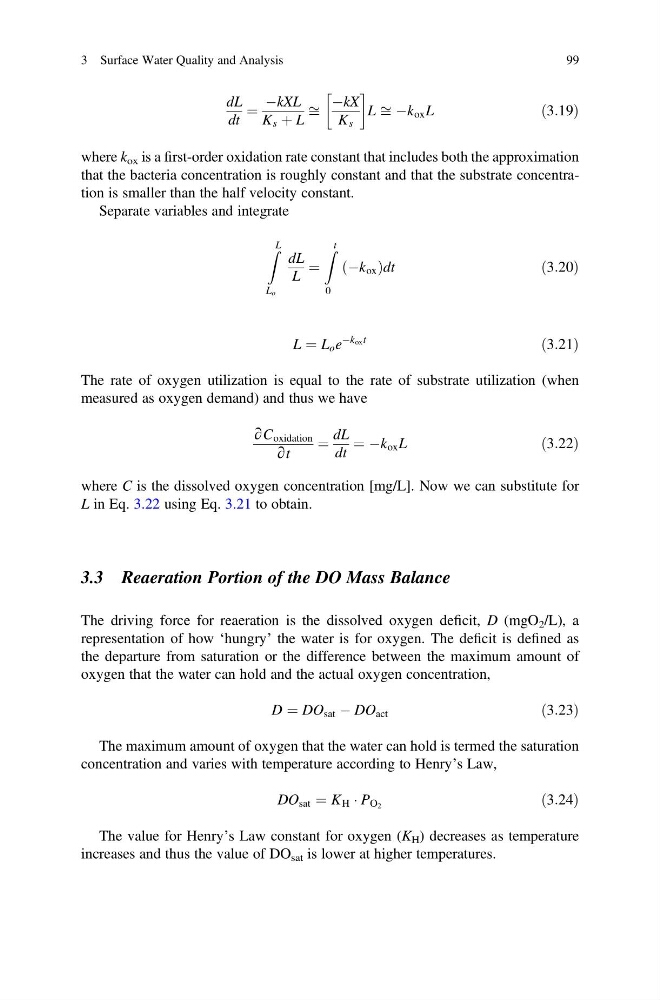
where k ox is a first-order oxidation rate constant that includes both the approximation
that the bacteria concentration is roughly constant and that the substrate concentration is smaller than the half velocity constant.
Separate variables and integrate
Z L
L o
dL
L
¼
Z t
0
Àk ox
ð
Þdt
ð3:20Þ
L ¼ L o e
Àk ox t
ð3:21Þ
The rate of oxygen utilization is equal to the rate of substrate utilization (when
measured as oxygen demand) and thus we have
∂C oxidation
∂t
¼
dL
dt
¼ Àk ox L
ð3:22Þ
where C is the dissolved oxygen concentration [mg/L]. Now we can substitute for
L in Eq. 3.22 using Eq. 3.21 to obtain.
3.3 Reaeration Portion of the DO Mass Balance
The driving force for reaeration is the dissolved oxygen deficit, D (mgO 2 /L), a
representation of how ‘hungry’ the water is for oxygen. The deficit is defined as
the departure from saturation or the difference between the maximum amount of
oxygen that the water can hold and the actual oxygen concentration,
D ¼ DO sat À DO act
ð3:23Þ
The maximum amount of oxygen that the water can hold is termed the saturation
concentration and varies with temperature according to Henry’s Law,
DO sat ¼ K H Á P O 2
ð3:24Þ
The value for Henry’s Law constant for oxygen (K H ) decreases as temperature
increases and thus the value of DO sat is lower at higher temperatures.
3 Surface Water Quality and Analysis
99
dt
¼
ÀkXL
K s þ L
ffi
ÀkX
K s
!
L ffi Àk ox L
ð3:19Þ
where k ox is a first-order oxidation rate constant that includes both the approximation
that the bacteria concentration is roughly constant and that the substrate concentration is smaller than the half velocity constant.
Separate variables and integrate
Z L
L o
dL
L
¼
Z t
0
Àk ox
ð
Þdt
ð3:20Þ
L ¼ L o e
Àk ox t
ð3:21Þ
The rate of oxygen utilization is equal to the rate of substrate utilization (when
measured as oxygen demand) and thus we have
∂C oxidation
∂t
¼
dL
dt
¼ Àk ox L
ð3:22Þ
where C is the dissolved oxygen concentration [mg/L]. Now we can substitute for
L in Eq. 3.22 using Eq. 3.21 to obtain.
3.3 Reaeration Portion of the DO Mass Balance
The driving force for reaeration is the dissolved oxygen deficit, D (mgO 2 /L), a
representation of how ‘hungry’ the water is for oxygen. The deficit is defined as
the departure from saturation or the difference between the maximum amount of
oxygen that the water can hold and the actual oxygen concentration,
D ¼ DO sat À DO act
ð3:23Þ
The maximum amount of oxygen that the water can hold is termed the saturation
concentration and varies with temperature according to Henry’s Law,
DO sat ¼ K H Á P O 2
ð3:24Þ
The value for Henry’s Law constant for oxygen (K H ) decreases as temperature
increases and thus the value of DO sat is lower at higher temperatures.
3 Surface Water Quality and Analysis
99