

K 2 is the reaeration rate, usually in d
À1 .
L a is the initial oxygen demand of organic matter in the water, also called the
ultimate BOD (BOD at time t ¼ infinity). The unit of is
g
m 3
 Ã
.
L t is the oxygen demand remaining at time t.
D a is the initial oxygen deficit
g
m 3
 Ã
.
t is the elapsed time, usually [d].
The relationship for the change in oxygen concentration due to oxidation of
organics should be developed first. The rate that oxygen is used will be proportional
to the rate that substrate (or biochemical oxygen demand) is oxidized. The rate of
substrate utilization by bacteria is given by the Monod relationship
dL
dt
¼
ÀkLX
K s þ L
ð3:18Þ
where L is substrate concentration expressed as oxygen demand or BODL [mg/L],
k is the maximum specific substrate utilization rate, K s is the half velocity constant,
and X is the concentration of bacteria. However, the concentration of bacteria is a
function of the substrate concentration and thus application of the Monod equation to
a polluted river is not trivial. Often the bacterial concentration remains relatively
constant. If the half velocity concentration is large relative to the concentration of
substrate we obtain
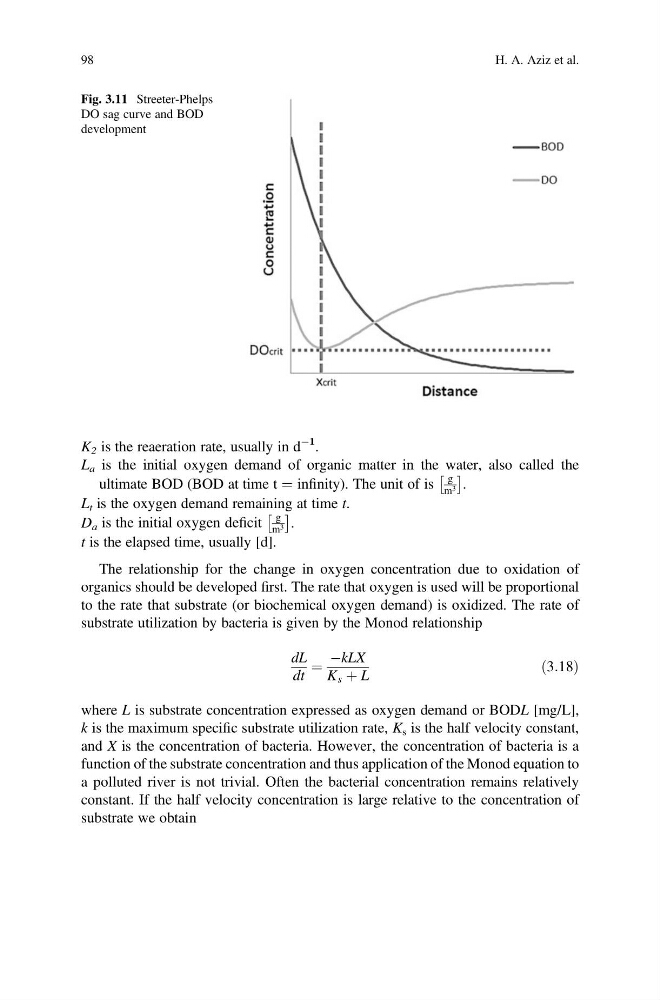
Fig. 3.11 Streeter-Phelps
DO sag curve and BOD
development
98
H. A. Aziz et al.
À1 .
L a is the initial oxygen demand of organic matter in the water, also called the
ultimate BOD (BOD at time t ¼ infinity). The unit of is
g
m 3
 Ã
.
L t is the oxygen demand remaining at time t.
D a is the initial oxygen deficit
g
m 3
 Ã
.
t is the elapsed time, usually [d].
The relationship for the change in oxygen concentration due to oxidation of
organics should be developed first. The rate that oxygen is used will be proportional
to the rate that substrate (or biochemical oxygen demand) is oxidized. The rate of
substrate utilization by bacteria is given by the Monod relationship
dL
dt
¼
ÀkLX
K s þ L
ð3:18Þ
where L is substrate concentration expressed as oxygen demand or BODL [mg/L],
k is the maximum specific substrate utilization rate, K s is the half velocity constant,
and X is the concentration of bacteria. However, the concentration of bacteria is a
function of the substrate concentration and thus application of the Monod equation to
a polluted river is not trivial. Often the bacterial concentration remains relatively
constant. If the half velocity concentration is large relative to the concentration of
substrate we obtain
Fig. 3.11 Streeter-Phelps
DO sag curve and BOD
development
98
H. A. Aziz et al.