

material can enter the environment from many sources including waste water
treatment plants, livestock or poultry manure, sanitary landfills, septic systems,
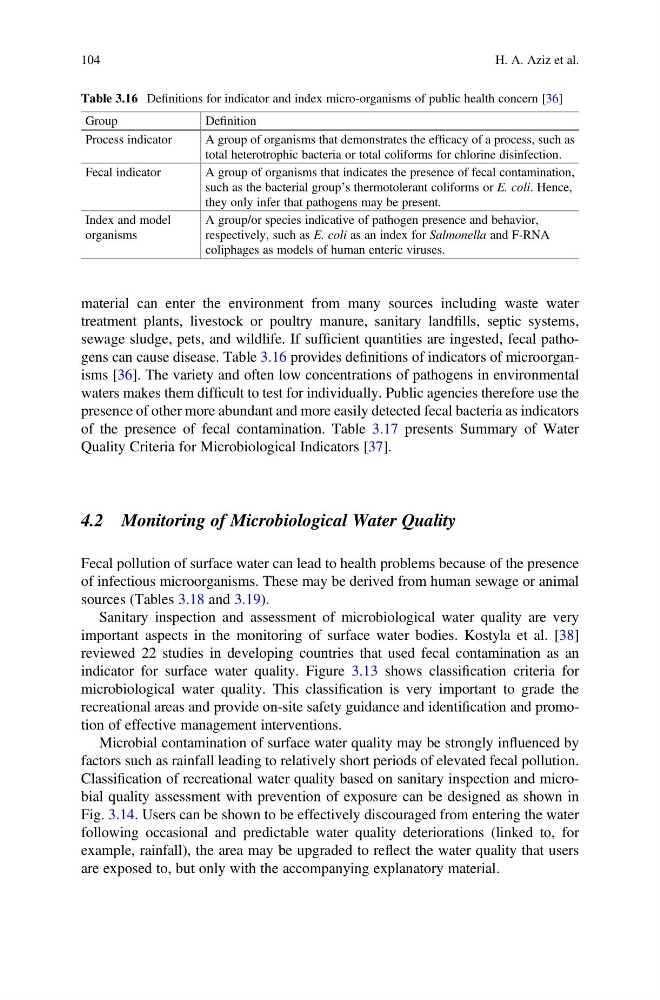
sewage sludge, pets, and wildlife. If sufficient quantities are ingested, fecal pathogens can cause disease. Table 3.16 provides definitions of indicators of microorganisms [36]. The variety and often low concentrations of pathogens in environmental
waters makes them difficult to test for individually. Public agencies therefore use the
presence of other more abundant and more easily detected fecal bacteria as indicators
of the presence of fecal contamination. Table 3.17 presents Summary of Water
Quality Criteria for Microbiological Indicators [37].
4.2 Monitoring of Microbiological Water Quality
Fecal pollution of surface water can lead to health problems because of the presence
of infectious microorganisms. These may be derived from human sewage or animal
sources (Tables 3.18 and 3.19).
Sanitary inspection and assessment of microbiological water quality are very
important aspects in the monitoring of surface water bodies. Kostyla et al. [38]
reviewed 22 studies in developing countries that used fecal contamination as an
indicator for surface water quality. Figure 3.13 shows classification criteria for
microbiological water quality. This classification is very important to grade the
recreational areas and provide on-site safety guidance and identification and promotion of effective management interventions.
Microbial contamination of surface water quality may be strongly influenced by
factors such as rainfall leading to relatively short periods of elevated fecal pollution.
Classification of recreational water quality based on sanitary inspection and microbial quality assessment with prevention of exposure can be designed as shown in
Fig. 3.14. Users can be shown to be effectively discouraged from entering the water
following occasional and predictable water quality deteriorations (linked to, for
example, rainfall), the area may be upgraded to reflect the water quality that users
are exposed to, but only with the accompanying explanatory material.
Table 3.16 Definitions for indicator and index micro-organisms of public health concern [36]
Group
Definition
Process indicator
A group of organisms that demonstrates the efficacy of a process, such as
total heterotrophic bacteria or total coliforms for chlorine disinfection.
Fecal indicator
A group of organisms that indicates the presence of fecal contamination,
such as the bacterial group’s thermotolerant coliforms or E. coli. Hence,
they only infer that pathogens may be present.
Index and model
organisms
A group/or species indicative of pathogen presence and behavior,
respectively, such as E. coli as an index for Salmonella and F-RNA
coliphages as models of human enteric viruses.
104
H. A. Aziz et al.
treatment plants, livestock or poultry manure, sanitary landfills, septic systems,
sewage sludge, pets, and wildlife. If sufficient quantities are ingested, fecal pathogens can cause disease. Table 3.16 provides definitions of indicators of microorganisms [36]. The variety and often low concentrations of pathogens in environmental
waters makes them difficult to test for individually. Public agencies therefore use the
presence of other more abundant and more easily detected fecal bacteria as indicators
of the presence of fecal contamination. Table 3.17 presents Summary of Water
Quality Criteria for Microbiological Indicators [37].
4.2 Monitoring of Microbiological Water Quality
Fecal pollution of surface water can lead to health problems because of the presence
of infectious microorganisms. These may be derived from human sewage or animal
sources (Tables 3.18 and 3.19).
Sanitary inspection and assessment of microbiological water quality are very
important aspects in the monitoring of surface water bodies. Kostyla et al. [38]
reviewed 22 studies in developing countries that used fecal contamination as an
indicator for surface water quality. Figure 3.13 shows classification criteria for
microbiological water quality. This classification is very important to grade the
recreational areas and provide on-site safety guidance and identification and promotion of effective management interventions.
Microbial contamination of surface water quality may be strongly influenced by
factors such as rainfall leading to relatively short periods of elevated fecal pollution.
Classification of recreational water quality based on sanitary inspection and microbial quality assessment with prevention of exposure can be designed as shown in
Fig. 3.14. Users can be shown to be effectively discouraged from entering the water
following occasional and predictable water quality deteriorations (linked to, for
example, rainfall), the area may be upgraded to reflect the water quality that users
are exposed to, but only with the accompanying explanatory material.
Table 3.16 Definitions for indicator and index micro-organisms of public health concern [36]
Group
Definition
Process indicator
A group of organisms that demonstrates the efficacy of a process, such as
total heterotrophic bacteria or total coliforms for chlorine disinfection.
Fecal indicator
A group of organisms that indicates the presence of fecal contamination,
such as the bacterial group’s thermotolerant coliforms or E. coli. Hence,
they only infer that pathogens may be present.
Index and model
organisms
A group/or species indicative of pathogen presence and behavior,
respectively, such as E. coli as an index for Salmonella and F-RNA
coliphages as models of human enteric viruses.
104
H. A. Aziz et al.