

3.3.4 Determination of Potential-Driven Structural Changes
in Protein Films: In Situ PM IRRAS
Adsorption of proteins on solid surfaces from their aqueous solutions has an
important biological and technological meaning [118, 119]. The conformation and
secondary structure of proteins in adsorbed state and in solution phase are often
different [119, 120]. PM IRRAS with electrochemical control was used to study the
potential (surface charge) dependent changes in the orientation and structure of
collagen molecules adsorbed on the Au electrode surface [46, 48]. Collagen is the
most abundant protein in the animal kingdom. A collagen molecule is composed of
three coiled α-helical polypeptide chains [121, 122]. A large fraction of the polypeptide chain contains a repeat unit composed of glycine-proline-hydroxyproline
amino and imino acids [123]. Glycine occupies each third position in the polypeptide
chain of collagen while proline and hydroxyproline may be replaced by ionisable
amino acids such as lysine, arginine, glutamic or aspartic acid [124, 125]. Charged
residues are distributed unevenly along the collagen molecule. Collagen type I
molecules were self-assembled on the Au electrode surface [46]. Figure 3.27a
shows the electrochemical characteristic of the collagen film. The charge densitypotential plot shows two adsorption states of collagen on the Au surface: state I and
state II.
One adsorption state is observed at positive charges (~3 μC cm
À2 ; state II) and the
second at negative charges (~ À15 μC cm
À2 , state I) accumulated on the Au
electrode surface (Fig. 3.27a). At E < À0.7 V and σ M < À20 μC cm
À2 the surface
charge density of the unmodified and modified Au electrodes are the same. It
suggests either the desorption of the protein from the surface or flow of electrolyte
into the film. Interestingly, the PM IRRA spectra in the amide I
0 mode of collagen
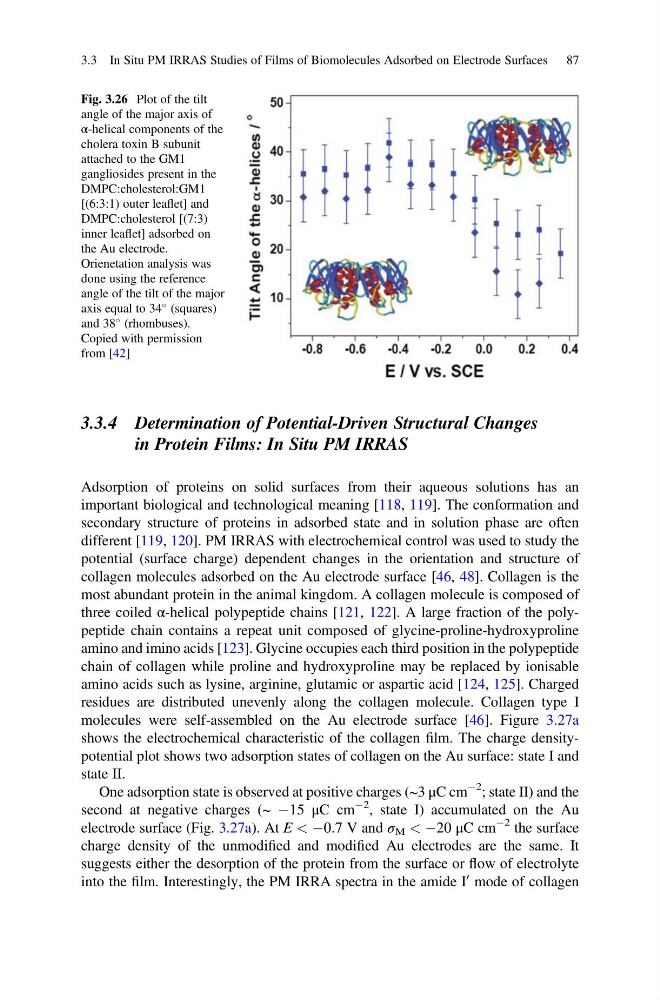
Fig. 3.26 Plot of the tilt
angle of the major axis of
α-helical components of the
cholera toxin B subunit
attached to the GM1
gangliosides present in the
DMPC:cholesterol:GM1
[(6:3:1) outer leaflet] and
DMPC:cholesterol [(7:3)
inner leaflet] adsorbed on
the Au electrode.
Orienetation analysis was
done using the reference
angle of the tilt of the major
axis equal to 34
(squares)
and 38
(rhombuses).
Copied with permission
from [42]
3.3 In Situ PM IRRAS Studies of Films of Biomolecules Adsorbed on Electrode Surfaces 87
in Protein Films: In Situ PM IRRAS
Adsorption of proteins on solid surfaces from their aqueous solutions has an
important biological and technological meaning [118, 119]. The conformation and
secondary structure of proteins in adsorbed state and in solution phase are often
different [119, 120]. PM IRRAS with electrochemical control was used to study the
potential (surface charge) dependent changes in the orientation and structure of
collagen molecules adsorbed on the Au electrode surface [46, 48]. Collagen is the
most abundant protein in the animal kingdom. A collagen molecule is composed of
three coiled α-helical polypeptide chains [121, 122]. A large fraction of the polypeptide chain contains a repeat unit composed of glycine-proline-hydroxyproline
amino and imino acids [123]. Glycine occupies each third position in the polypeptide
chain of collagen while proline and hydroxyproline may be replaced by ionisable
amino acids such as lysine, arginine, glutamic or aspartic acid [124, 125]. Charged
residues are distributed unevenly along the collagen molecule. Collagen type I
molecules were self-assembled on the Au electrode surface [46]. Figure 3.27a
shows the electrochemical characteristic of the collagen film. The charge densitypotential plot shows two adsorption states of collagen on the Au surface: state I and
state II.
One adsorption state is observed at positive charges (~3 μC cm
À2 ; state II) and the
second at negative charges (~ À15 μC cm
À2 , state I) accumulated on the Au
electrode surface (Fig. 3.27a). At E < À0.7 V and σ M < À20 μC cm
À2 the surface
charge density of the unmodified and modified Au electrodes are the same. It
suggests either the desorption of the protein from the surface or flow of electrolyte
into the film. Interestingly, the PM IRRA spectra in the amide I
0 mode of collagen
Fig. 3.26 Plot of the tilt
angle of the major axis of
α-helical components of the
cholera toxin B subunit
attached to the GM1
gangliosides present in the
DMPC:cholesterol:GM1
[(6:3:1) outer leaflet] and
DMPC:cholesterol [(7:3)
inner leaflet] adsorbed on
the Au electrode.
Orienetation analysis was
done using the reference
angle of the tilt of the major
axis equal to 34
(squares)
and 38
(rhombuses).
Copied with permission
from [42]
3.3 In Situ PM IRRAS Studies of Films of Biomolecules Adsorbed on Electrode Surfaces 87