

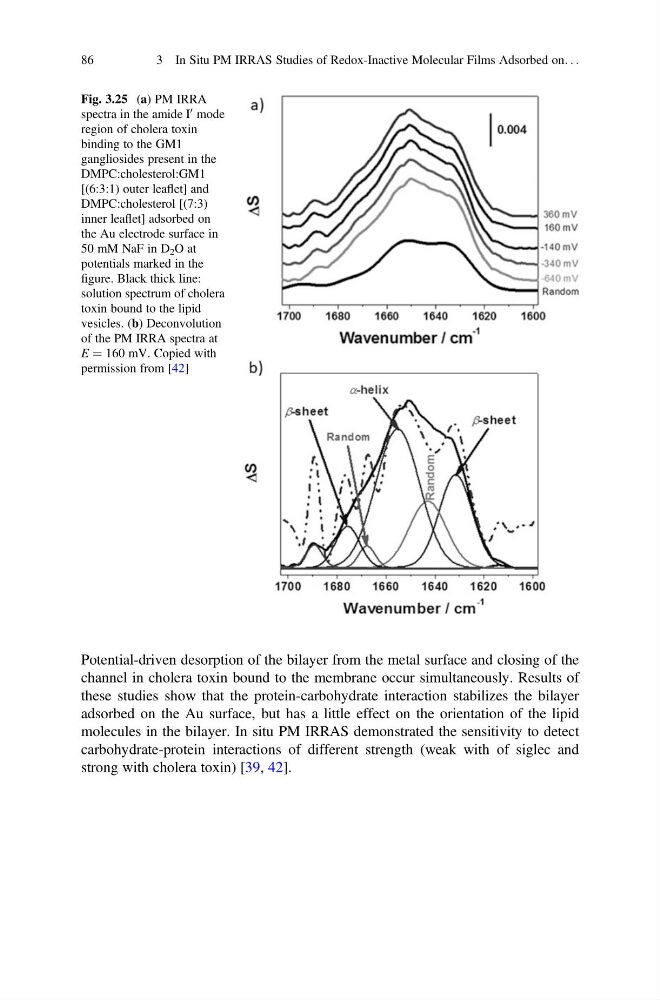
Potential-driven desorption of the bilayer from the metal surface and closing of the
channel in cholera toxin bound to the membrane occur simultaneously. Results of
these studies show that the protein-carbohydrate interaction stabilizes the bilayer
adsorbed on the Au surface, but has a little effect on the orientation of the lipid
molecules in the bilayer. In situ PM IRRAS demonstrated the sensitivity to detect
carbohydrate-protein interactions of different strength (weak with of siglec and
strong with cholera toxin) [39, 42].
Fig. 3.25 (a) PM IRRA
spectra in the amide I
0 mode
region of cholera toxin
binding to the GM1
gangliosides present in the
DMPC:cholesterol:GM1
[(6:3:1) outer leaflet] and
DMPC:cholesterol [(7:3)
inner leaflet] adsorbed on
the Au electrode surface in
50 mM NaF in D 2 O at
potentials marked in the
figure. Black thick line:
solution spectrum of cholera
toxin bound to the lipid
vesicles. (b) Deconvolution
of the PM IRRA spectra at
E ¼ 160 mV. Copied with
permission from [42]
86
3 In Situ PM IRRAS Studies of Redox-Inactive Molecular Films Adsorbed on. . .
channel in cholera toxin bound to the membrane occur simultaneously. Results of
these studies show that the protein-carbohydrate interaction stabilizes the bilayer
adsorbed on the Au surface, but has a little effect on the orientation of the lipid
molecules in the bilayer. In situ PM IRRAS demonstrated the sensitivity to detect
carbohydrate-protein interactions of different strength (weak with of siglec and
strong with cholera toxin) [39, 42].
Fig. 3.25 (a) PM IRRA
spectra in the amide I
0 mode
region of cholera toxin
binding to the GM1
gangliosides present in the
DMPC:cholesterol:GM1
[(6:3:1) outer leaflet] and
DMPC:cholesterol [(7:3)
inner leaflet] adsorbed on
the Au electrode surface in
50 mM NaF in D 2 O at
potentials marked in the
figure. Black thick line:
solution spectrum of cholera
toxin bound to the lipid
vesicles. (b) Deconvolution
of the PM IRRA spectra at
E ¼ 160 mV. Copied with
permission from [42]
86
3 In Situ PM IRRAS Studies of Redox-Inactive Molecular Films Adsorbed on. . .