

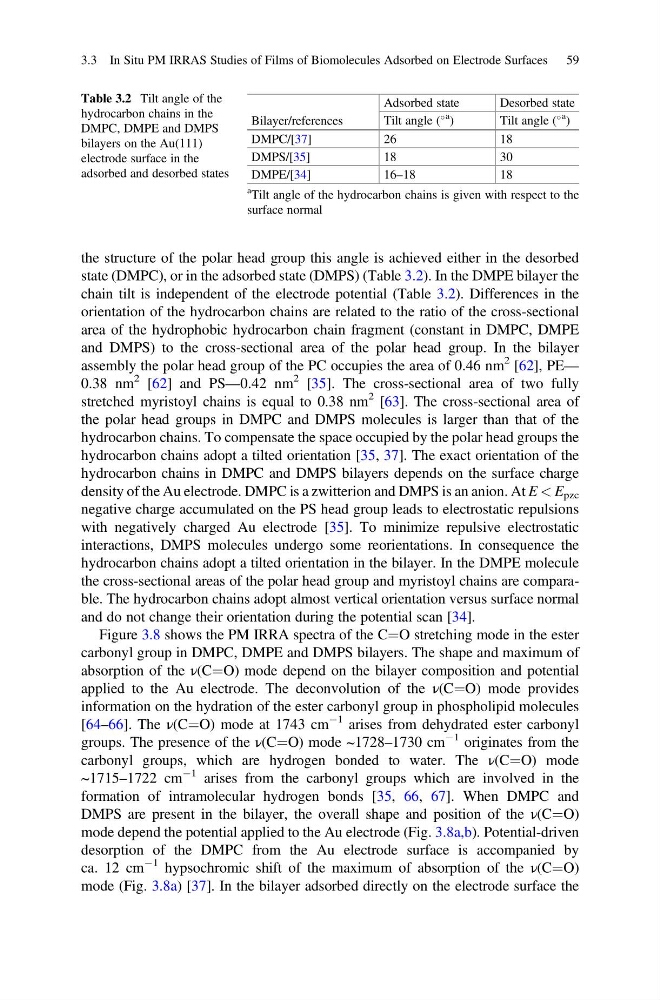
the structure of the polar head group this angle is achieved either in the desorbed
state (DMPC), or in the adsorbed state (DMPS) (Table 3.2). In the DMPE bilayer the
chain tilt is independent of the electrode potential (Table 3.2). Differences in the
orientation of the hydrocarbon chains are related to the ratio of the cross-sectional
area of the hydrophobic hydrocarbon chain fragment (constant in DMPC, DMPE
and DMPS) to the cross-sectional area of the polar head group. In the bilayer
assembly the polar head group of the PC occupies the area of 0.46 nm
2 [62], PE—
0.38 nm
2 [62] and PS—0.42 nm
2 [35]. The cross-sectional area of two fully
stretched myristoyl chains is equal to 0.38 nm
2 [63]. The cross-sectional area of
the polar head groups in DMPC and DMPS molecules is larger than that of the
hydrocarbon chains. To compensate the space occupied by the polar head groups the
hydrocarbon chains adopt a tilted orientation [35, 37]. The exact orientation of the
hydrocarbon chains in DMPC and DMPS bilayers depends on the surface charge
density of the Au electrode. DMPC is a zwitterion and DMPS is an anion. At E < E pzc
negative charge accumulated on the PS head group leads to electrostatic repulsions
with negatively charged Au electrode [35]. To minimize repulsive electrostatic
interactions, DMPS molecules undergo some reorientations. In consequence the
hydrocarbon chains adopt a tilted orientation in the bilayer. In the DMPE molecule
the cross-sectional areas of the polar head group and myristoyl chains are comparable. The hydrocarbon chains adopt almost vertical orientation versus surface normal
and do not change their orientation during the potential scan [34].
Figure 3.8 shows the PM IRRA spectra of the C¼O stretching mode in the ester
carbonyl group in DMPC, DMPE and DMPS bilayers. The shape and maximum of
absorption of the ν(C¼O) mode depend on the bilayer composition and potential
applied to the Au electrode. The deconvolution of the ν(C¼O) mode provides
information on the hydration of the ester carbonyl group in phospholipid molecules
[64–66]. The ν(C¼O) mode at 1743 cm
À1 arises from dehydrated ester carbonyl
groups. The presence of the ν(C¼O) mode ~1728–1730 cm
À1 originates from the
carbonyl groups, which are hydrogen bonded to water. The ν(C¼O) mode
~1715–1722 cm
À1 arises from the carbonyl groups which are involved in the
formation of intramolecular hydrogen bonds [35, 66, 67]. When DMPC and
DMPS are present in the bilayer, the overall shape and position of the ν(C¼O)
mode depend the potential applied to the Au electrode (Fig. 3.8a,b). Potential-driven
desorption of the DMPC from the Au electrode surface is accompanied by
ca. 12 cm
À1 hypsochromic shift of the maximum of absorption of the ν(C¼O)
mode (Fig. 3.8a) [37]. In the bilayer adsorbed directly on the electrode surface the
Table 3.2 Tilt angle of the
hydrocarbon chains in the
DMPC, DMPE and DMPS
bilayers on the Au(111)
electrode surface in the
adsorbed and desorbed states
Bilayer/references
Adsorbed state
Desorbed state
Tilt angle (
a )
Tilt angle (
a )
DMPC/[37]
2 6
1 8
DMPS/[35]
1 8
3 0
DMPE/[34]
1 6 –18
18
a Tilt angle of the hydrocarbon chains is given with respect to the
surface normal
3.3 In Situ PM IRRAS Studies of Films of Biomolecules Adsorbed on Electrode Surfaces 59
state (DMPC), or in the adsorbed state (DMPS) (Table 3.2). In the DMPE bilayer the
chain tilt is independent of the electrode potential (Table 3.2). Differences in the
orientation of the hydrocarbon chains are related to the ratio of the cross-sectional
area of the hydrophobic hydrocarbon chain fragment (constant in DMPC, DMPE
and DMPS) to the cross-sectional area of the polar head group. In the bilayer
assembly the polar head group of the PC occupies the area of 0.46 nm
2 [62], PE—
0.38 nm
2 [62] and PS—0.42 nm
2 [35]. The cross-sectional area of two fully
stretched myristoyl chains is equal to 0.38 nm
2 [63]. The cross-sectional area of
the polar head groups in DMPC and DMPS molecules is larger than that of the
hydrocarbon chains. To compensate the space occupied by the polar head groups the
hydrocarbon chains adopt a tilted orientation [35, 37]. The exact orientation of the
hydrocarbon chains in DMPC and DMPS bilayers depends on the surface charge
density of the Au electrode. DMPC is a zwitterion and DMPS is an anion. At E < E pzc
negative charge accumulated on the PS head group leads to electrostatic repulsions
with negatively charged Au electrode [35]. To minimize repulsive electrostatic
interactions, DMPS molecules undergo some reorientations. In consequence the
hydrocarbon chains adopt a tilted orientation in the bilayer. In the DMPE molecule
the cross-sectional areas of the polar head group and myristoyl chains are comparable. The hydrocarbon chains adopt almost vertical orientation versus surface normal
and do not change their orientation during the potential scan [34].
Figure 3.8 shows the PM IRRA spectra of the C¼O stretching mode in the ester
carbonyl group in DMPC, DMPE and DMPS bilayers. The shape and maximum of
absorption of the ν(C¼O) mode depend on the bilayer composition and potential
applied to the Au electrode. The deconvolution of the ν(C¼O) mode provides
information on the hydration of the ester carbonyl group in phospholipid molecules
[64–66]. The ν(C¼O) mode at 1743 cm
À1 arises from dehydrated ester carbonyl
groups. The presence of the ν(C¼O) mode ~1728–1730 cm
À1 originates from the
carbonyl groups, which are hydrogen bonded to water. The ν(C¼O) mode
~1715–1722 cm
À1 arises from the carbonyl groups which are involved in the
formation of intramolecular hydrogen bonds [35, 66, 67]. When DMPC and
DMPS are present in the bilayer, the overall shape and position of the ν(C¼O)
mode depend the potential applied to the Au electrode (Fig. 3.8a,b). Potential-driven
desorption of the DMPC from the Au electrode surface is accompanied by
ca. 12 cm
À1 hypsochromic shift of the maximum of absorption of the ν(C¼O)
mode (Fig. 3.8a) [37]. In the bilayer adsorbed directly on the electrode surface the
Table 3.2 Tilt angle of the
hydrocarbon chains in the
DMPC, DMPE and DMPS
bilayers on the Au(111)
electrode surface in the
adsorbed and desorbed states
Bilayer/references
Adsorbed state
Desorbed state
Tilt angle (
a )
Tilt angle (
a )
DMPC/[37]
2 6
1 8
DMPS/[35]
1 8
3 0
DMPE/[34]
1 6 –18
18
a Tilt angle of the hydrocarbon chains is given with respect to the
surface normal
3.3 In Situ PM IRRAS Studies of Films of Biomolecules Adsorbed on Electrode Surfaces 59