

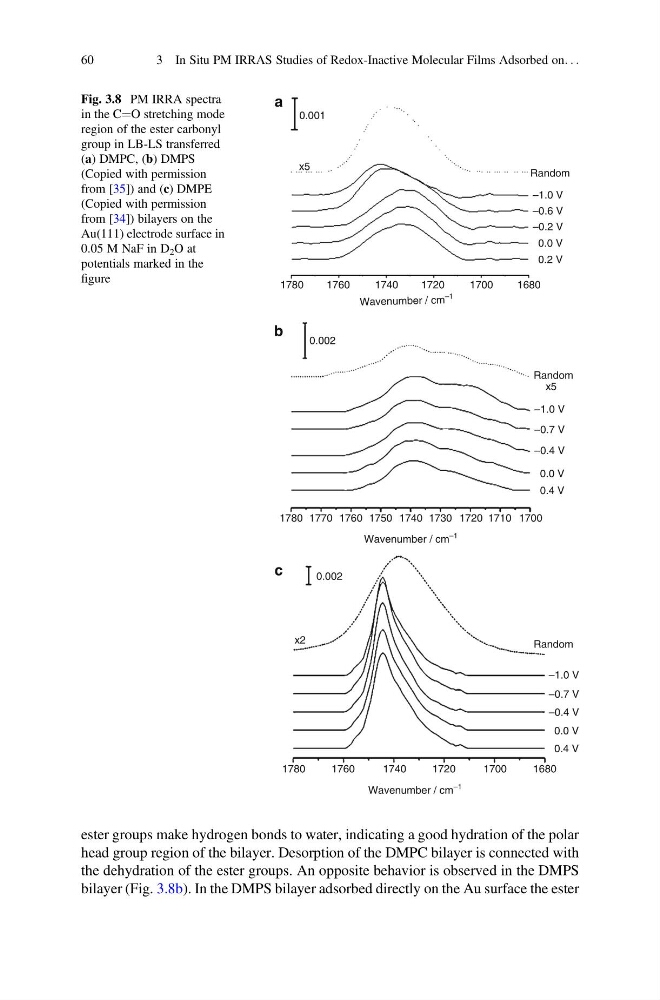
ester groups make hydrogen bonds to water, indicating a good hydration of the polar
head group region of the bilayer. Desorption of the DMPC bilayer is connected with
the dehydration of the ester groups. An opposite behavior is observed in the DMPS
bilayer (Fig. 3.8b). In the DMPS bilayer adsorbed directly on the Au surface the ester
x5
x5
x2
Wavenumber / cm
–1
1680
1700
1740
1760
0.002
1780
1720
1780 1770 1760 1750 1740 1730 1720 1710 1700
0.002
Wavenumber / cm
–1
Random
Random
Random
0.001
a
b
c
–1.0 V
–0.6 V
–0.2 V
0.0 V
0.2 V
–1.0 V
–0.7 V
–0.4 V
0.0 V
0.4 V
Wavenumber / cm
–1
1680
1700
1720
1740
1760
1780
–1.0 V
–0.7 V
–0.4 V
0.0 V
0.4 V
Fig. 3.8 PM IRRA spectra
in the C¼O stretching mode
region of the ester carbonyl
group in LB-LS transferred
(a) DMPC, (b) DMPS
(Copied with permission
from [35]) and (c) DMPE
(Copied with permission
from [34]) bilayers on the
Au(111) electrode surface in
0.05 M NaF in D 2 O at
potentials marked in the
figure
60
3 In Situ PM IRRAS Studies of Redox-Inactive Molecular Films Adsorbed on. . .
head group region of the bilayer. Desorption of the DMPC bilayer is connected with
the dehydration of the ester groups. An opposite behavior is observed in the DMPS
bilayer (Fig. 3.8b). In the DMPS bilayer adsorbed directly on the Au surface the ester
x5
x5
x2
Wavenumber / cm
–1
1680
1700
1740
1760
0.002
1780
1720
1780 1770 1760 1750 1740 1730 1720 1710 1700
0.002
Wavenumber / cm
–1
Random
Random
Random
0.001
a
b
c
–1.0 V
–0.6 V
–0.2 V
0.0 V
0.2 V
–1.0 V
–0.7 V
–0.4 V
0.0 V
0.4 V
Wavenumber / cm
–1
1680
1700
1720
1740
1760
1780
–1.0 V
–0.7 V
–0.4 V
0.0 V
0.4 V
Fig. 3.8 PM IRRA spectra
in the C¼O stretching mode
region of the ester carbonyl
group in LB-LS transferred
(a) DMPC, (b) DMPS
(Copied with permission
from [35]) and (c) DMPE
(Copied with permission
from [34]) bilayers on the
Au(111) electrode surface in
0.05 M NaF in D 2 O at
potentials marked in the
figure
60
3 In Situ PM IRRAS Studies of Redox-Inactive Molecular Films Adsorbed on. . .