

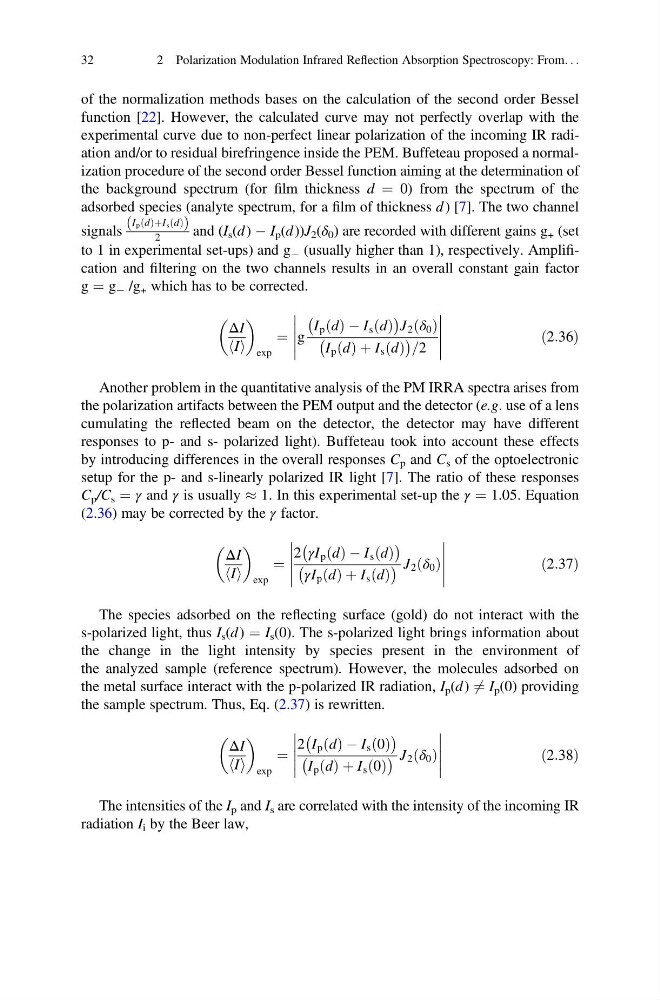
of the normalization methods bases on the calculation of the second order Bessel
function [22]. However, the calculated curve may not perfectly overlap with the
experimental curve due to non-perfect linear polarization of the incoming IR radiation and/or to residual birefringence inside the PEM. Buffeteau proposed a normalization procedure of the second order Bessel function aiming at the determination of
the background spectrum (for film thickness d ¼ 0) from the spectrum of the
adsorbed species (analyte spectrum, for a film of thickness d ) [7]. The two channel
signals
I p d
ð ÞþI s d
ð Þ
ð
Þ
2
and (I s (d ) À I p (d ))J 2 (δ 0 ) are recorded with different gains g + (set
to 1 in experimental set-ups) and g À (usually higher than 1), respectively. Amplification and filtering on the two channels results in an overall constant gain factor
g ¼ g À /g + which has to be corrected.
ΔI
I
h i
exp
¼ g
I p d
ð Þ À I s d
ð Þ
À
Á
J 2 δ 0
ð Þ
I p d
ð Þ þ I s d
ð Þ
À
Á =2
ð2:36Þ
Another problem in the quantitative analysis of the PM IRRA spectra arises from
the polarization artifacts between the PEM output and the detector (e.g. use of a lens
cumulating the reflected beam on the detector, the detector may have different
responses to p- and s- polarized light). Buffeteau took into account these effects
by introducing differences in the overall responses C p and C s of the optoelectronic
setup for the p- and s-linearly polarized IR light [7]. The ratio of these responses
C p /C s ¼ γ and γ is usually % 1. In this experimental set-up the γ ¼ 1.05. Equation
(2.36) may be corrected by the γ factor.
ΔI
I
h i
exp
¼
2 γI p d
ð Þ À I s d
ð Þ
À
Á
γI p d
ð Þ þ I s d
ð Þ
À
ÁJ 2 δ 0
ð Þ
ð2:37Þ
The species adsorbed on the reflecting surface (gold) do not interact with the
s-polarized light, thus I s (d ) ¼ I s (0). The s-polarized light brings information about
the change in the light intensity by species present in the environment of
the analyzed sample (reference spectrum). However, the molecules adsorbed on
the metal surface interact with the p-polarized IR radiation, I p (d ) 6 ¼ I p (0) providing
the sample spectrum. Thus, Eq. (2.37) is rewritten.
ΔI
I
h i
exp
¼
2 I p d
ð Þ À I s 0
ð Þ
À
Á
I p d
ð Þ þ I s 0
ð Þ
À
ÁJ 2 δ 0
ð Þ
ð2:38Þ
The intensities of the I p and I s are correlated with the intensity of the incoming IR
radiation I i by the Beer law,
32
2 Polarization Modulation Infrared Reflection Absorption Spectroscopy: From. . .
function [22]. However, the calculated curve may not perfectly overlap with the
experimental curve due to non-perfect linear polarization of the incoming IR radiation and/or to residual birefringence inside the PEM. Buffeteau proposed a normalization procedure of the second order Bessel function aiming at the determination of
the background spectrum (for film thickness d ¼ 0) from the spectrum of the
adsorbed species (analyte spectrum, for a film of thickness d ) [7]. The two channel
signals
I p d
ð ÞþI s d
ð Þ
ð
Þ
2
and (I s (d ) À I p (d ))J 2 (δ 0 ) are recorded with different gains g + (set
to 1 in experimental set-ups) and g À (usually higher than 1), respectively. Amplification and filtering on the two channels results in an overall constant gain factor
g ¼ g À /g + which has to be corrected.
ΔI
I
h i
exp
¼ g
I p d
ð Þ À I s d
ð Þ
À
Á
J 2 δ 0
ð Þ
I p d
ð Þ þ I s d
ð Þ
À
Á =2
ð2:36Þ
Another problem in the quantitative analysis of the PM IRRA spectra arises from
the polarization artifacts between the PEM output and the detector (e.g. use of a lens
cumulating the reflected beam on the detector, the detector may have different
responses to p- and s- polarized light). Buffeteau took into account these effects
by introducing differences in the overall responses C p and C s of the optoelectronic
setup for the p- and s-linearly polarized IR light [7]. The ratio of these responses
C p /C s ¼ γ and γ is usually % 1. In this experimental set-up the γ ¼ 1.05. Equation
(2.36) may be corrected by the γ factor.
ΔI
I
h i
exp
¼
2 γI p d
ð Þ À I s d
ð Þ
À
Á
γI p d
ð Þ þ I s d
ð Þ
À
ÁJ 2 δ 0
ð Þ
ð2:37Þ
The species adsorbed on the reflecting surface (gold) do not interact with the
s-polarized light, thus I s (d ) ¼ I s (0). The s-polarized light brings information about
the change in the light intensity by species present in the environment of
the analyzed sample (reference spectrum). However, the molecules adsorbed on
the metal surface interact with the p-polarized IR radiation, I p (d ) 6 ¼ I p (0) providing
the sample spectrum. Thus, Eq. (2.37) is rewritten.
ΔI
I
h i
exp
¼
2 I p d
ð Þ À I s 0
ð Þ
À
Á
I p d
ð Þ þ I s 0
ð Þ
À
ÁJ 2 δ 0
ð Þ
ð2:38Þ
The intensities of the I p and I s are correlated with the intensity of the incoming IR
radiation I i by the Beer law,
32
2 Polarization Modulation Infrared Reflection Absorption Spectroscopy: From. . .