

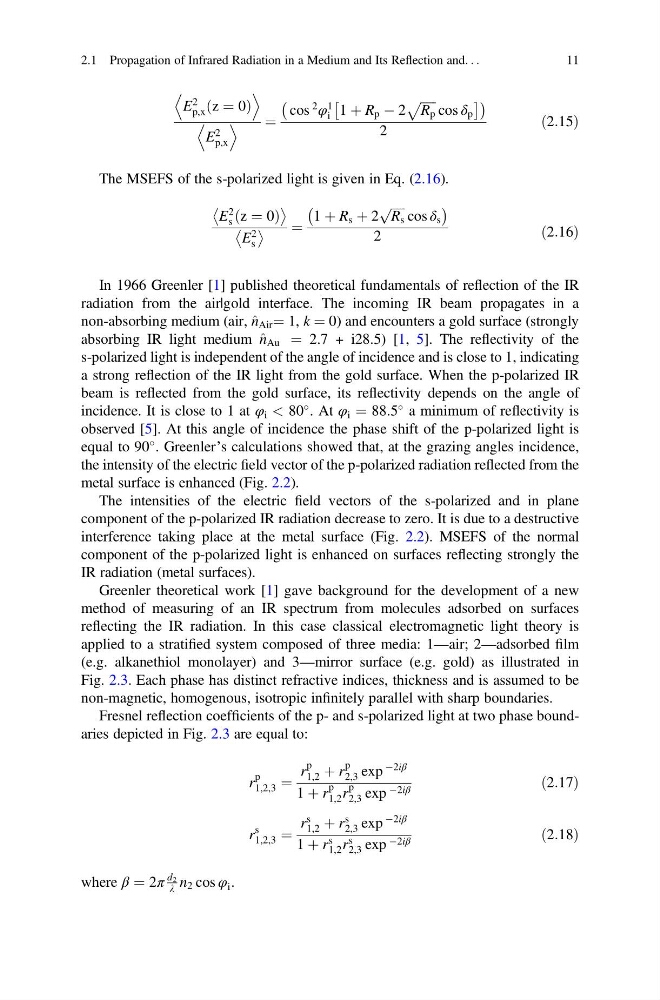
E
2
p,x z ¼ 0
ð
Þ
D
E
E
2
p,x
D
E
¼
cos
2
φ
1
i 1 þ R p À 2
ffiffiffiffiffi
R p
p
cos δ p
Â
Ã
À
Á
2
ð2:15Þ
The MSEFS of the s-polarized light is given in Eq. (2.16).
E
2
s z ¼ 0
ð
Þ
E
2
s
¼
1 þ R s þ 2
ffiffiffiffi ffi
R s
p
cos δ s
À
Á
2
ð2:16Þ
In 1966 Greenler [1] published theoretical fundamentals of reflection of the IR
radiation from the air|gold interface. The incoming IR beam propagates in a
non-absorbing medium (air, ^ n Air ¼ 1, k ¼ 0) and encounters a gold surface (strongly
absorbing IR light medium ^ n Au ¼ 2.7 + i28.5) [1, 5]. The reflectivity of the
s-polarized light is independent of the angle of incidence and is close to 1, indicating
a strong reflection of the IR light from the gold surface. When the p-polarized IR
beam is reflected from the gold surface, its reflectivity depends on the angle of
incidence. It is close to 1 at φ i < 80
. At φ i ¼ 88.5
a minimum of reflectivity is
observed [5]. At this angle of incidence the phase shift of the p-polarized light is
equal to 90
. Greenler’s calculations showed that, at the grazing angles incidence,
the intensity of the electric field vector of the p-polarized radiation reflected from the
metal surface is enhanced (Fig. 2.2).
The intensities of the electric field vectors of the s-polarized and in plane
component of the p-polarized IR radiation decrease to zero. It is due to a destructive
interference taking place at the metal surface (Fig. 2.2). MSEFS of the normal
component of the p-polarized light is enhanced on surfaces reflecting strongly the
IR radiation (metal surfaces).
Greenler theoretical work [1] gave background for the development of a new
method of measuring of an IR spectrum from molecules adsorbed on surfaces
reflecting the IR radiation. In this case classical electromagnetic light theory is
applied to a stratified system composed of three media: 1—air; 2—adsorbed film
(e.g. alkanethiol monolayer) and 3—mirror surface (e.g. gold) as illustrated in
Fig. 2.3. Each phase has distinct refractive indices, thickness and is assumed to be
non-magnetic, homogenous, isotropic infinitely parallel with sharp boundaries.
Fresnel reflection coefficients of the p- and s-polarized light at two phase boundaries depicted in Fig. 2.3 are equal to:
r
p
1,2,3 ¼
r
p
1,2 þ r
p
2,3 exp
À2iβ
1 þ r
p
1,2 r
p
2,3 exp À2iβ
ð2:17Þ
r
s
1,2,3 ¼
r
s
1,2 þ r
s
2,3 exp
À2iβ
1 þ r s
1,2 r s
2,3 exp À2iβ
ð2:18Þ
where β ¼ 2π
d 2
λ n 2 cos φ i .
2.1 Propagation of Infrared Radiation in a Medium and Its Reflection and. . .
11
2
p,x z ¼ 0
ð
Þ
D
E
E
2
p,x
D
E
¼
cos
2
φ
1
i 1 þ R p À 2
ffiffiffiffiffi
R p
p
cos δ p
Â
Ã
À
Á
2
ð2:15Þ
The MSEFS of the s-polarized light is given in Eq. (2.16).
E
2
s z ¼ 0
ð
Þ
E
2
s
¼
1 þ R s þ 2
ffiffiffiffi ffi
R s
p
cos δ s
À
Á
2
ð2:16Þ
In 1966 Greenler [1] published theoretical fundamentals of reflection of the IR
radiation from the air|gold interface. The incoming IR beam propagates in a
non-absorbing medium (air, ^ n Air ¼ 1, k ¼ 0) and encounters a gold surface (strongly
absorbing IR light medium ^ n Au ¼ 2.7 + i28.5) [1, 5]. The reflectivity of the
s-polarized light is independent of the angle of incidence and is close to 1, indicating
a strong reflection of the IR light from the gold surface. When the p-polarized IR
beam is reflected from the gold surface, its reflectivity depends on the angle of
incidence. It is close to 1 at φ i < 80
. At φ i ¼ 88.5
a minimum of reflectivity is
observed [5]. At this angle of incidence the phase shift of the p-polarized light is
equal to 90
. Greenler’s calculations showed that, at the grazing angles incidence,
the intensity of the electric field vector of the p-polarized radiation reflected from the
metal surface is enhanced (Fig. 2.2).
The intensities of the electric field vectors of the s-polarized and in plane
component of the p-polarized IR radiation decrease to zero. It is due to a destructive
interference taking place at the metal surface (Fig. 2.2). MSEFS of the normal
component of the p-polarized light is enhanced on surfaces reflecting strongly the
IR radiation (metal surfaces).
Greenler theoretical work [1] gave background for the development of a new
method of measuring of an IR spectrum from molecules adsorbed on surfaces
reflecting the IR radiation. In this case classical electromagnetic light theory is
applied to a stratified system composed of three media: 1—air; 2—adsorbed film
(e.g. alkanethiol monolayer) and 3—mirror surface (e.g. gold) as illustrated in
Fig. 2.3. Each phase has distinct refractive indices, thickness and is assumed to be
non-magnetic, homogenous, isotropic infinitely parallel with sharp boundaries.
Fresnel reflection coefficients of the p- and s-polarized light at two phase boundaries depicted in Fig. 2.3 are equal to:
r
p
1,2,3 ¼
r
p
1,2 þ r
p
2,3 exp
À2iβ
1 þ r
p
1,2 r
p
2,3 exp À2iβ
ð2:17Þ
r
s
1,2,3 ¼
r
s
1,2 þ r
s
2,3 exp
À2iβ
1 þ r s
1,2 r s
2,3 exp À2iβ
ð2:18Þ
where β ¼ 2π
d 2
λ n 2 cos φ i .
2.1 Propagation of Infrared Radiation in a Medium and Its Reflection and. . .
11