

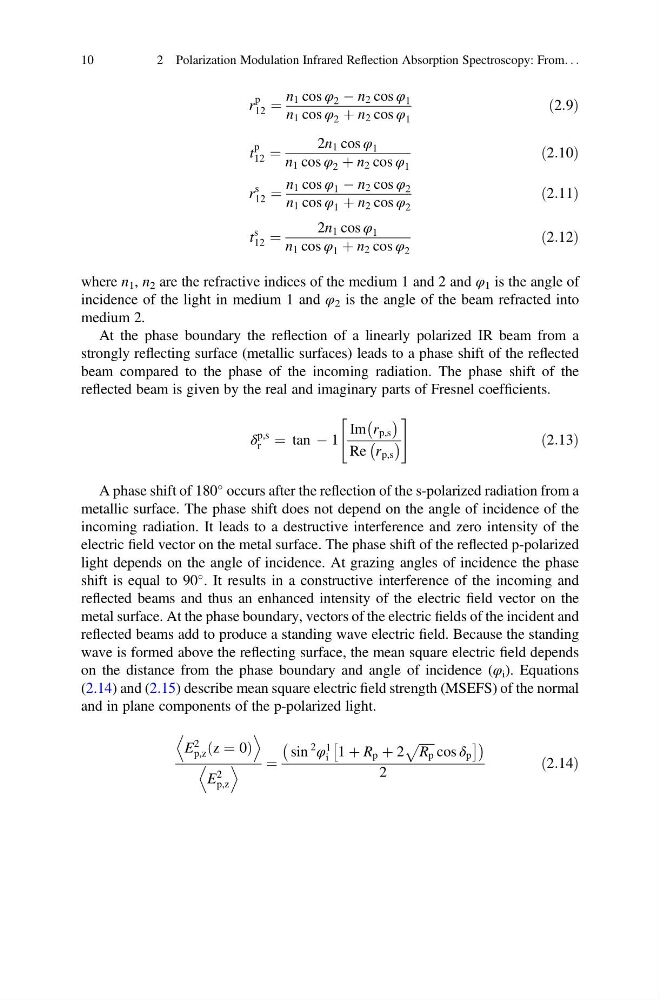
r
p
12 ¼
n 1 cos φ 2 À n 2 cos φ 1
n 1 cos φ 2 þ n 2 cos φ 1
ð2:9Þ
t
p
12 ¼
2n 1 cos φ 1
n 1 cos φ 2 þ n 2 cos φ 1
ð2:10Þ
r
s
12 ¼
n 1 cos φ 1 À n 2 cos φ 2
n 1 cos φ 1 þ n 2 cos φ 2
ð2:11Þ
t
s
12 ¼
2n 1 cos φ 1
n 1 cos φ 1 þ n 2 cos φ 2
ð2:12Þ
where n 1 , n 2 are the refractive indices of the medium 1 and 2 and φ 1 is the angle of
incidence of the light in medium 1 and φ 2 is the angle of the beam refracted into
medium 2.
At the phase boundary the reflection of a linearly polarized IR beam from a
strongly reflecting surface (metallic surfaces) leads to a phase shift of the reflected
beam compared to the phase of the incoming radiation. The phase shift of the
reflected beam is given by the real and imaginary parts of Fresnel coefficients.
δ
p,s
r ¼ tan À 1
Im r p,s
À Á
Re r p,s
À Á
"
#
ð2:13Þ
A phase shift of 180
occurs after the reflection of the s-polarized radiation from a
metallic surface. The phase shift does not depend on the angle of incidence of the
incoming radiation. It leads to a destructive interference and zero intensity of the
electric field vector on the metal surface. The phase shift of the reflected p-polarized
light depends on the angle of incidence. At grazing angles of incidence the phase
shift is equal to 90
. It results in a constructive interference of the incoming and
reflected beams and thus an enhanced intensity of the electric field vector on the
metal surface. At the phase boundary, vectors of the electric fields of the incident and
reflected beams add to produce a standing wave electric field. Because the standing
wave is formed above the reflecting surface, the mean square electric field depends
on the distance from the phase boundary and angle of incidence (φ i ). Equations
(2.14) and (2.15) describe mean square electric field strength (MSEFS) of the normal
and in plane components of the p-polarized light.
E
2
p,z z ¼ 0
ð
Þ
D
E
E
2
p,z
D
E
¼
sin
2
φ
1
i 1 þ R p þ 2
ffiffiffiffiffi
R p
p
cos δ p
Â
Ã
À
Á
2
ð2:14Þ
10
2 Polarization Modulation Infrared Reflection Absorption Spectroscopy: From. . .
p
12 ¼
n 1 cos φ 2 À n 2 cos φ 1
n 1 cos φ 2 þ n 2 cos φ 1
ð2:9Þ
t
p
12 ¼
2n 1 cos φ 1
n 1 cos φ 2 þ n 2 cos φ 1
ð2:10Þ
r
s
12 ¼
n 1 cos φ 1 À n 2 cos φ 2
n 1 cos φ 1 þ n 2 cos φ 2
ð2:11Þ
t
s
12 ¼
2n 1 cos φ 1
n 1 cos φ 1 þ n 2 cos φ 2
ð2:12Þ
where n 1 , n 2 are the refractive indices of the medium 1 and 2 and φ 1 is the angle of
incidence of the light in medium 1 and φ 2 is the angle of the beam refracted into
medium 2.
At the phase boundary the reflection of a linearly polarized IR beam from a
strongly reflecting surface (metallic surfaces) leads to a phase shift of the reflected
beam compared to the phase of the incoming radiation. The phase shift of the
reflected beam is given by the real and imaginary parts of Fresnel coefficients.
δ
p,s
r ¼ tan À 1
Im r p,s
À Á
Re r p,s
À Á
"
#
ð2:13Þ
A phase shift of 180
occurs after the reflection of the s-polarized radiation from a
metallic surface. The phase shift does not depend on the angle of incidence of the
incoming radiation. It leads to a destructive interference and zero intensity of the
electric field vector on the metal surface. The phase shift of the reflected p-polarized
light depends on the angle of incidence. At grazing angles of incidence the phase
shift is equal to 90
. It results in a constructive interference of the incoming and
reflected beams and thus an enhanced intensity of the electric field vector on the
metal surface. At the phase boundary, vectors of the electric fields of the incident and
reflected beams add to produce a standing wave electric field. Because the standing
wave is formed above the reflecting surface, the mean square electric field depends
on the distance from the phase boundary and angle of incidence (φ i ). Equations
(2.14) and (2.15) describe mean square electric field strength (MSEFS) of the normal
and in plane components of the p-polarized light.
E
2
p,z z ¼ 0
ð
Þ
D
E
E
2
p,z
D
E
¼
sin
2
φ
1
i 1 þ R p þ 2
ffiffiffiffiffi
R p
p
cos δ p
Â
Ã
À
Á
2
ð2:14Þ
10
2 Polarization Modulation Infrared Reflection Absorption Spectroscopy: From. . .