

weak enhancement of the electric field vector of the p-polarized light reflected from
the GC surface, the acquirement of the PM IRRA spectra from the GCE requires the
presence of thick molecular films on the electrode surface. Theory for the background correction of the PM IRRA spectra, described in Sect. 2.4 [24–26], is not
applicable to films, which thickness is larger than 40 nm and/or to films containing
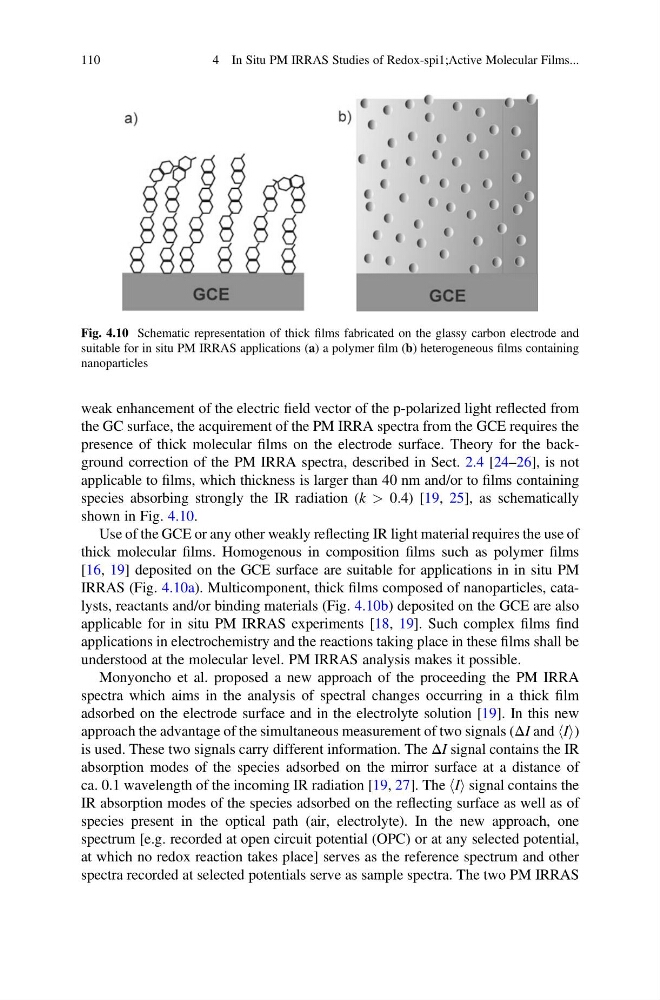
species absorbing strongly the IR radiation (k > 0.4) [19, 25], as schematically
shown in Fig. 4.10.
Use of the GCE or any other weakly reflecting IR light material requires the use of
thick molecular films. Homogenous in composition films such as polymer films
[16, 19] deposited on the GCE surface are suitable for applications in in situ PM
IRRAS (Fig. 4.10a). Multicomponent, thick films composed of nanoparticles, catalysts, reactants and/or binding materials (Fig. 4.10b) deposited on the GCE are also
applicable for in situ PM IRRAS experiments [18, 19]. Such complex films find
applications in electrochemistry and the reactions taking place in these films shall be
understood at the molecular level. PM IRRAS analysis makes it possible.
Monyoncho et al. proposed a new approach of the proceeding the PM IRRA
spectra which aims in the analysis of spectral changes occurring in a thick film
adsorbed on the electrode surface and in the electrolyte solution [19]. In this new
approach the advantage of the simultaneous measurement of two signals (ΔI and hIi)
is used. These two signals carry different information. The ΔI signal contains the IR
absorption modes of the species adsorbed on the mirror surface at a distance of
ca. 0.1 wavelength of the incoming IR radiation [19, 27]. The hIi signal contains the
IR absorption modes of the species adsorbed on the reflecting surface as well as of
species present in the optical path (air, electrolyte). In the new approach, one
spectrum [e.g. recorded at open circuit potential (OPC) or at any selected potential,
at which no redox reaction takes place] serves as the reference spectrum and other
spectra recorded at selected potentials serve as sample spectra. The two PM IRRAS
Fig. 4.10 Schematic representation of thick films fabricated on the glassy carbon electrode and
suitable for in situ PM IRRAS applications (a) a polymer film (b) heterogeneous films containing
nanoparticles
110
4 In Situ PM IRRAS Studies of Redox-spi1;Active Molecular Films...
the GC surface, the acquirement of the PM IRRA spectra from the GCE requires the
presence of thick molecular films on the electrode surface. Theory for the background correction of the PM IRRA spectra, described in Sect. 2.4 [24–26], is not
applicable to films, which thickness is larger than 40 nm and/or to films containing
species absorbing strongly the IR radiation (k > 0.4) [19, 25], as schematically
shown in Fig. 4.10.
Use of the GCE or any other weakly reflecting IR light material requires the use of
thick molecular films. Homogenous in composition films such as polymer films
[16, 19] deposited on the GCE surface are suitable for applications in in situ PM
IRRAS (Fig. 4.10a). Multicomponent, thick films composed of nanoparticles, catalysts, reactants and/or binding materials (Fig. 4.10b) deposited on the GCE are also
applicable for in situ PM IRRAS experiments [18, 19]. Such complex films find
applications in electrochemistry and the reactions taking place in these films shall be
understood at the molecular level. PM IRRAS analysis makes it possible.
Monyoncho et al. proposed a new approach of the proceeding the PM IRRA
spectra which aims in the analysis of spectral changes occurring in a thick film
adsorbed on the electrode surface and in the electrolyte solution [19]. In this new
approach the advantage of the simultaneous measurement of two signals (ΔI and hIi)
is used. These two signals carry different information. The ΔI signal contains the IR
absorption modes of the species adsorbed on the mirror surface at a distance of
ca. 0.1 wavelength of the incoming IR radiation [19, 27]. The hIi signal contains the
IR absorption modes of the species adsorbed on the reflecting surface as well as of
species present in the optical path (air, electrolyte). In the new approach, one
spectrum [e.g. recorded at open circuit potential (OPC) or at any selected potential,
at which no redox reaction takes place] serves as the reference spectrum and other
spectra recorded at selected potentials serve as sample spectra. The two PM IRRAS
Fig. 4.10 Schematic representation of thick films fabricated on the glassy carbon electrode and
suitable for in situ PM IRRAS applications (a) a polymer film (b) heterogeneous films containing
nanoparticles
110
4 In Situ PM IRRAS Studies of Redox-spi1;Active Molecular Films...