

Fig. 4.8a confirm that plumbagin is present in the film on the GCE surface. The two
strong IR absorption modes at 1669 cm
À1 and 1646 cm
À1 arise from the ν(C¼O)
mode in free and hydrogen bonded carbonyl groups in the quinone residue, respectively. The aromatic rings give IR absorption modes at 1615, 1590 and 1565 cm
À1 .
The absorption mode at 1462 cm
À1 arises from the δ as (CH 3 ) and at 1378 and
1363 cm
À1 from the δ s (CH 3 ) mode.
Surprisingly, in the first negative going potential scan, at reduction potentials, no
decrease in the intensity of the ν(C¼O) mode in the ketone carbonyl group is
observed (Fig. 4.8a). Electrochemical studies indicate that only a few % of Q
moieties in the polymer film are redox active. This amount of reacting quinone
moieties is too low to be detected in the PM IRRAS experiment performed on the
GCE surface. Consecutive reduction and oxidation of the poly(PLG) film leads to
large spectral changes (Fig. 4.8b). Two new IR absorption modes appear in the
spectra. These modes are ascribed to the ν as (COO
À ) (at 1526 cm
À1 ) and ν s (COO
À )
(1409 cm
À1 ) modes. Simultaneously the intensities of the ν(C¼O) and ν(CC) modes
in the aromatic ring decrease, suggesting time—and potential-dependent
reorientation of the monomers in the pol(PLG) film. The appearance of new IR
absorption modes confirms that carboxylate groups are formed in the polymer film,
indicating that parallel to the oxidation of QH 2 other oxidation reaction(Às) take
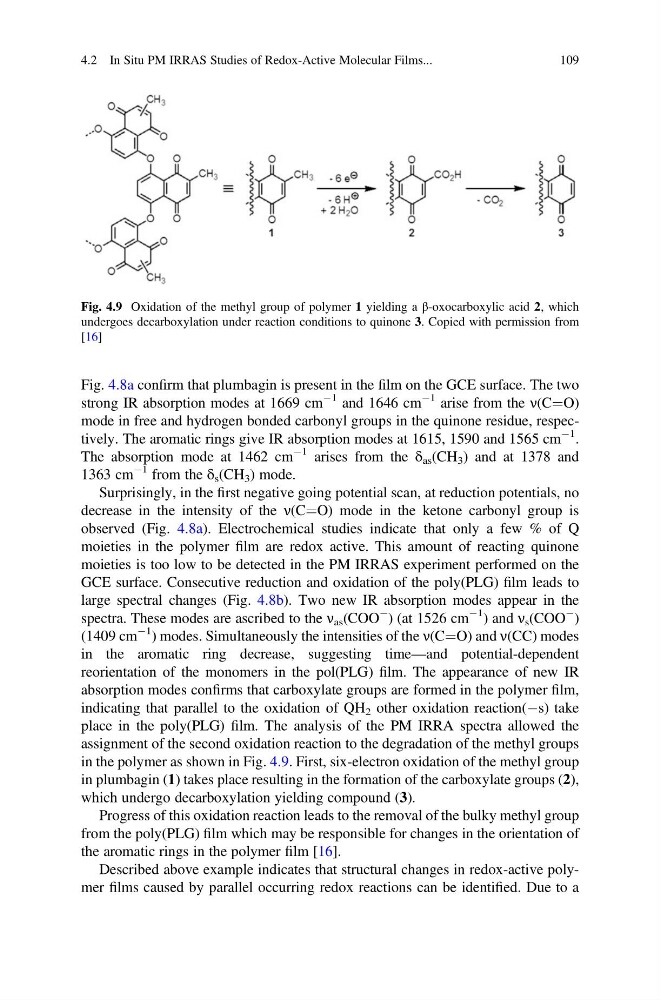
place in the poly(PLG) film. The analysis of the PM IRRA spectra allowed the
assignment of the second oxidation reaction to the degradation of the methyl groups
in the polymer as shown in Fig. 4.9. First, six-electron oxidation of the methyl group
in plumbagin (1) takes place resulting in the formation of the carboxylate groups (2),
which undergo decarboxylation yielding compound (3).
Progress of this oxidation reaction leads to the removal of the bulky methyl group
from the poly(PLG) film which may be responsible for changes in the orientation of
the aromatic rings in the polymer film [16].
Described above example indicates that structural changes in redox-active polymer films caused by parallel occurring redox reactions can be identified. Due to a
Fig. 4.9 Oxidation of the methyl group of polymer 1 yielding a β-oxocarboxylic acid 2, which
undergoes decarboxylation under reaction conditions to quinone 3. Copied with permission from
[16]
4.2 In Situ PM IRRAS Studies of Redox-Active Molecular Films...
109
strong IR absorption modes at 1669 cm
À1 and 1646 cm
À1 arise from the ν(C¼O)
mode in free and hydrogen bonded carbonyl groups in the quinone residue, respectively. The aromatic rings give IR absorption modes at 1615, 1590 and 1565 cm
À1 .
The absorption mode at 1462 cm
À1 arises from the δ as (CH 3 ) and at 1378 and
1363 cm
À1 from the δ s (CH 3 ) mode.
Surprisingly, in the first negative going potential scan, at reduction potentials, no
decrease in the intensity of the ν(C¼O) mode in the ketone carbonyl group is
observed (Fig. 4.8a). Electrochemical studies indicate that only a few % of Q
moieties in the polymer film are redox active. This amount of reacting quinone
moieties is too low to be detected in the PM IRRAS experiment performed on the
GCE surface. Consecutive reduction and oxidation of the poly(PLG) film leads to
large spectral changes (Fig. 4.8b). Two new IR absorption modes appear in the
spectra. These modes are ascribed to the ν as (COO
À ) (at 1526 cm
À1 ) and ν s (COO
À )
(1409 cm
À1 ) modes. Simultaneously the intensities of the ν(C¼O) and ν(CC) modes
in the aromatic ring decrease, suggesting time—and potential-dependent
reorientation of the monomers in the pol(PLG) film. The appearance of new IR
absorption modes confirms that carboxylate groups are formed in the polymer film,
indicating that parallel to the oxidation of QH 2 other oxidation reaction(Às) take
place in the poly(PLG) film. The analysis of the PM IRRA spectra allowed the
assignment of the second oxidation reaction to the degradation of the methyl groups
in the polymer as shown in Fig. 4.9. First, six-electron oxidation of the methyl group
in plumbagin (1) takes place resulting in the formation of the carboxylate groups (2),
which undergo decarboxylation yielding compound (3).
Progress of this oxidation reaction leads to the removal of the bulky methyl group
from the poly(PLG) film which may be responsible for changes in the orientation of
the aromatic rings in the polymer film [16].
Described above example indicates that structural changes in redox-active polymer films caused by parallel occurring redox reactions can be identified. Due to a
Fig. 4.9 Oxidation of the methyl group of polymer 1 yielding a β-oxocarboxylic acid 2, which
undergoes decarboxylation under reaction conditions to quinone 3. Copied with permission from
[16]
4.2 In Situ PM IRRAS Studies of Redox-Active Molecular Films...
109