

electrolyte solution. In acidic D 2 O solution the following mechanism of the reduction of quinone in poly(PLG) was found [16].
Q þ e
À
⇄ Q
• À
ð4:4Þ
Q
•
þ D
þ
chemical step
ð
Þ !
rds QD
•
ð4:5Þ
QD
•
þ e
À
þ D
þ
! QD 2
ð4:6Þ
Briefly, one fast electron reduction of Q takes place before the rate determining
step (rds) of the reduction reaction (Eq. 4.4). The dependence of the potential of the
reduction peak on pD indicates that one chemical step involving reaction with
deuterium ions and two electron transfers contribute to the overall reduction reaction. The diffusion of D
+ ions to the redox active centers present inside of the poly
(PLG) film can be too slow to provide a sufficient concentration of D
+ during the
reduction reaction. The source of D
+ ions originates from an unknown chemical step
(Eq.4.5) which takes place after the transfer of the first electron. In the next step, in
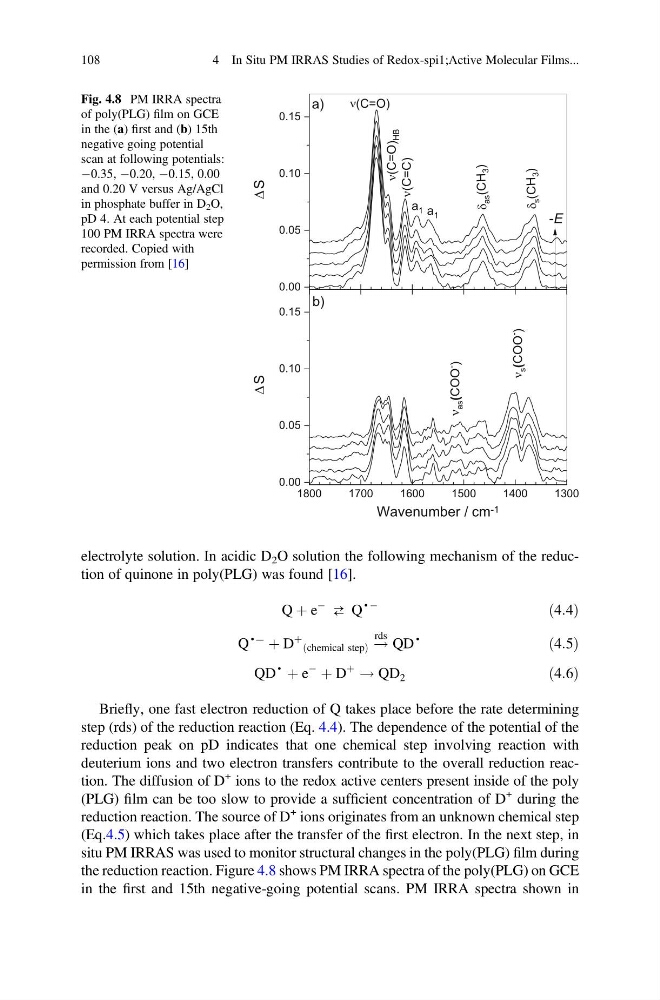
situ PM IRRAS was used to monitor structural changes in the poly(PLG) film during
the reduction reaction. Figure 4.8 shows PM IRRA spectra of the poly(PLG) on GCE
in the first and 15th negative-going potential scans. PM IRRA spectra shown in
0.00
0.05
0.10
0.15
1800
1700
1600
1500
1400
1300
0.00
0.05
0.10
0.15
S
a)
-E
S
Wavenumber / cm -1
b)
(C=O)
(C=O)
HB
(C=C)
as
(CH 3
)
s
(CH 3
)
a 1
a 1
as (COO
-
)
s (COO
-
)
Fig. 4.8 PM IRRA spectra
of poly(PLG) film on GCE
in the (a) first and (b) 15th
negative going potential
scan at following potentials:
À0.35, À0.20, À0.15, 0.00
and 0.20 V versus Ag/AgCl
in phosphate buffer in D 2 O,
pD 4. At each potential step
100 PM IRRA spectra were
recorded. Copied with
permission from [16]
108
4 In Situ PM IRRAS Studies of Redox-spi1;Active Molecular Films...
Q þ e
À
⇄ Q
• À
ð4:4Þ
Q
•
þ D
þ
chemical step
ð
Þ !
rds QD
•
ð4:5Þ
QD
•
þ e
À
þ D
þ
! QD 2
ð4:6Þ
Briefly, one fast electron reduction of Q takes place before the rate determining
step (rds) of the reduction reaction (Eq. 4.4). The dependence of the potential of the
reduction peak on pD indicates that one chemical step involving reaction with
deuterium ions and two electron transfers contribute to the overall reduction reaction. The diffusion of D
+ ions to the redox active centers present inside of the poly
(PLG) film can be too slow to provide a sufficient concentration of D
+ during the
reduction reaction. The source of D
+ ions originates from an unknown chemical step
(Eq.4.5) which takes place after the transfer of the first electron. In the next step, in
situ PM IRRAS was used to monitor structural changes in the poly(PLG) film during
the reduction reaction. Figure 4.8 shows PM IRRA spectra of the poly(PLG) on GCE
in the first and 15th negative-going potential scans. PM IRRA spectra shown in
0.00
0.05
0.10
0.15
1800
1700
1600
1500
1400
1300
0.00
0.05
0.10
0.15
S
a)
-E
S
Wavenumber / cm -1
b)
(C=O)
(C=O)
HB
(C=C)
as
(CH 3
)
s
(CH 3
)
a 1
a 1
as (COO
-
)
s (COO
-
)
Fig. 4.8 PM IRRA spectra
of poly(PLG) film on GCE
in the (a) first and (b) 15th
negative going potential
scan at following potentials:
À0.35, À0.20, À0.15, 0.00
and 0.20 V versus Ag/AgCl
in phosphate buffer in D 2 O,
pD 4. At each potential step
100 PM IRRA spectra were
recorded. Copied with
permission from [16]
108
4 In Situ PM IRRAS Studies of Redox-spi1;Active Molecular Films...