

glassy carbon to PM IRRAS studies of films, which are significantly ticker than
monomolecular films [16–19].
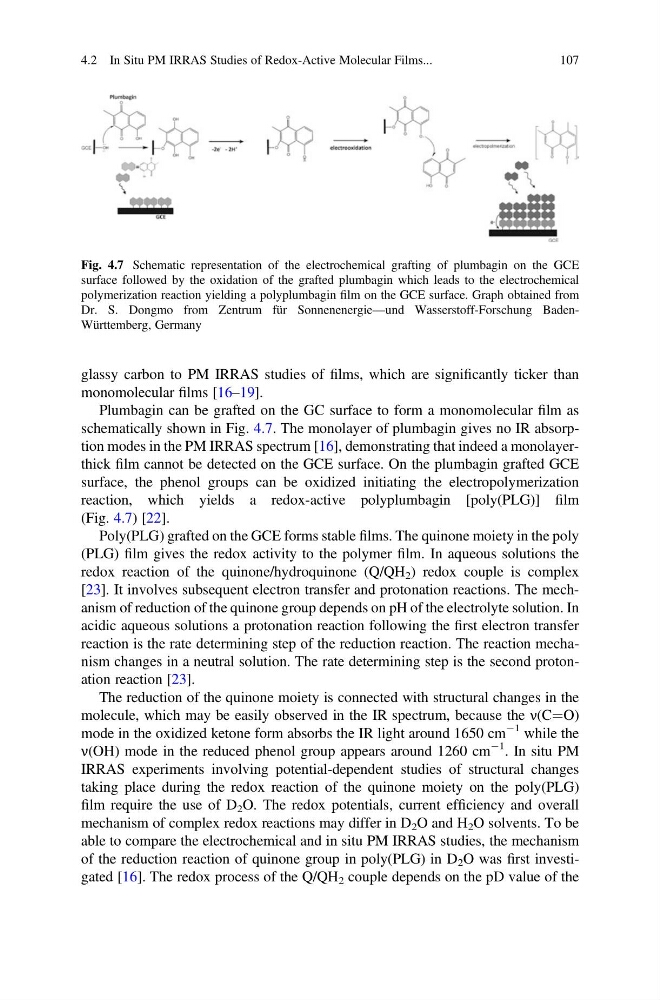
Plumbagin can be grafted on the GC surface to form a monomolecular film as
schematically shown in Fig. 4.7. The monolayer of plumbagin gives no IR absorption modes in the PM IRRAS spectrum [16], demonstrating that indeed a monolayerthick film cannot be detected on the GCE surface. On the plumbagin grafted GCE
surface, the phenol groups can be oxidized initiating the electropolymerization
reaction, which yields a redox-active polyplumbagin [poly(PLG)] film
(Fig. 4.7) [22].
Poly(PLG) grafted on the GCE forms stable films. The quinone moiety in the poly
(PLG) film gives the redox activity to the polymer film. In aqueous solutions the
redox reaction of the quinone/hydroquinone (Q/QH 2 ) redox couple is complex
[23]. It involves subsequent electron transfer and protonation reactions. The mechanism of reduction of the quinone group depends on pH of the electrolyte solution. In
acidic aqueous solutions a protonation reaction following the first electron transfer
reaction is the rate determining step of the reduction reaction. The reaction mechanism changes in a neutral solution. The rate determining step is the second protonation reaction [23].
The reduction of the quinone moiety is connected with structural changes in the
molecule, which may be easily observed in the IR spectrum, because the ν(C¼O)
mode in the oxidized ketone form absorbs the IR light around 1650 cm
À1 while the
ν(OH) mode in the reduced phenol group appears around 1260 cm
À1 . In situ PM
IRRAS experiments involving potential-dependent studies of structural changes
taking place during the redox reaction of the quinone moiety on the poly(PLG)
film require the use of D 2 O. The redox potentials, current efficiency and overall
mechanism of complex redox reactions may differ in D 2 O and H 2 O solvents. To be
able to compare the electrochemical and in situ PM IRRAS studies, the mechanism
of the reduction reaction of quinone group in poly(PLG) in D 2 O was first investigated [16]. The redox process of the Q/QH 2 couple depends on the pD value of the
Fig. 4.7 Schematic representation of the electrochemical grafting of plumbagin on the GCE
surface followed by the oxidation of the grafted plumbagin which leads to the electrochemical
polymerization reaction yielding a polyplumbagin film on the GCE surface. Graph obtained from
Dr. S. Dongmo from Zentrum für Sonnenenergie—und Wasserstoff-Forschung BadenWürttemberg, Germany
4.2 In Situ PM IRRAS Studies of Redox-Active Molecular Films...
107
monomolecular films [16–19].
Plumbagin can be grafted on the GC surface to form a monomolecular film as
schematically shown in Fig. 4.7. The monolayer of plumbagin gives no IR absorption modes in the PM IRRAS spectrum [16], demonstrating that indeed a monolayerthick film cannot be detected on the GCE surface. On the plumbagin grafted GCE
surface, the phenol groups can be oxidized initiating the electropolymerization
reaction, which yields a redox-active polyplumbagin [poly(PLG)] film
(Fig. 4.7) [22].
Poly(PLG) grafted on the GCE forms stable films. The quinone moiety in the poly
(PLG) film gives the redox activity to the polymer film. In aqueous solutions the
redox reaction of the quinone/hydroquinone (Q/QH 2 ) redox couple is complex
[23]. It involves subsequent electron transfer and protonation reactions. The mechanism of reduction of the quinone group depends on pH of the electrolyte solution. In
acidic aqueous solutions a protonation reaction following the first electron transfer
reaction is the rate determining step of the reduction reaction. The reaction mechanism changes in a neutral solution. The rate determining step is the second protonation reaction [23].
The reduction of the quinone moiety is connected with structural changes in the
molecule, which may be easily observed in the IR spectrum, because the ν(C¼O)
mode in the oxidized ketone form absorbs the IR light around 1650 cm
À1 while the
ν(OH) mode in the reduced phenol group appears around 1260 cm
À1 . In situ PM
IRRAS experiments involving potential-dependent studies of structural changes
taking place during the redox reaction of the quinone moiety on the poly(PLG)
film require the use of D 2 O. The redox potentials, current efficiency and overall
mechanism of complex redox reactions may differ in D 2 O and H 2 O solvents. To be
able to compare the electrochemical and in situ PM IRRAS studies, the mechanism
of the reduction reaction of quinone group in poly(PLG) in D 2 O was first investigated [16]. The redox process of the Q/QH 2 couple depends on the pD value of the
Fig. 4.7 Schematic representation of the electrochemical grafting of plumbagin on the GCE
surface followed by the oxidation of the grafted plumbagin which leads to the electrochemical
polymerization reaction yielding a polyplumbagin film on the GCE surface. Graph obtained from
Dr. S. Dongmo from Zentrum für Sonnenenergie—und Wasserstoff-Forschung BadenWürttemberg, Germany
4.2 In Situ PM IRRAS Studies of Redox-Active Molecular Films...
107