

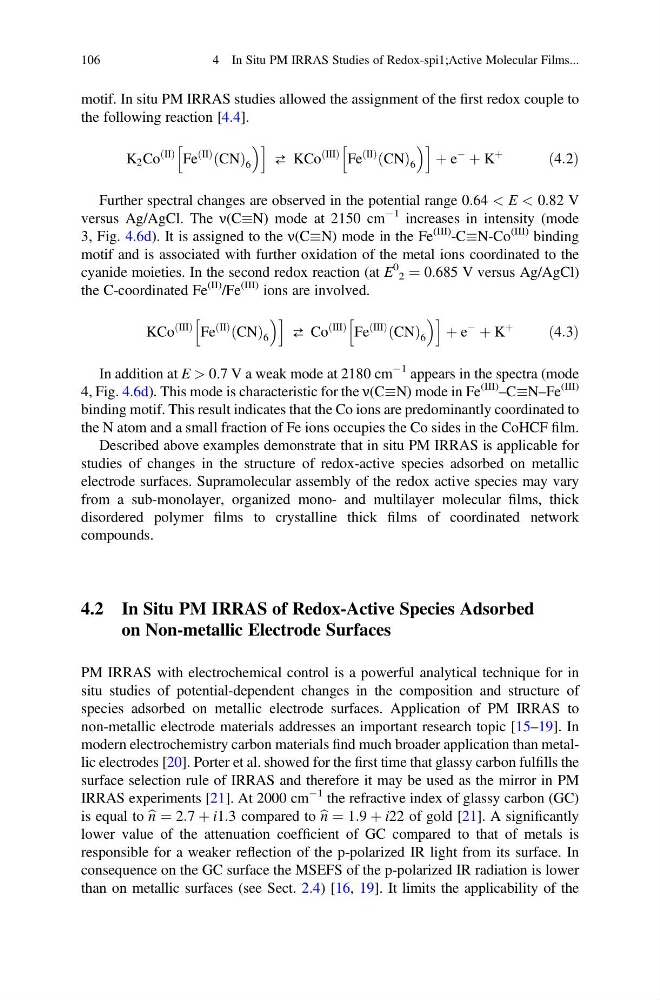
motif. In situ PM IRRAS studies allowed the assignment of the first redox couple to
the following reaction [4.4].
K 2 Co
II
ð Þ Fe
II
ð Þ CN
ð Þ 6
h
i
⇄ KCo
III
ð Þ Fe
II
ð Þ CN
ð Þ 6
h
i
þ e
À
þ K
þ
ð4:2Þ
Further spectral changes are observed in the potential range 0.64 < E < 0.82 V
versus Ag/AgCl. The ν(CN) mode at 2150 cm
À1 increases in intensity (mode
3, Fig. 4.6d). It is assigned to the ν(CN) mode in the Fe
(III) -CN-Co
(III) binding
motif and is associated with further oxidation of the metal ions coordinated to the
cyanide moieties. In the second redox reaction (at E
0
2 ¼ 0.685 V versus Ag/AgCl)
the C-coordinated Fe
(II) /Fe
(III) ions are involved.
KCo
III
ð Þ Fe
II
ð Þ CN
ð Þ 6
h
i
⇄ Co
III
ð Þ Fe
III
ð Þ CN
ð Þ 6
h
i
þ e
À
þ K
þ
ð4:3Þ
In addition at E > 0.7 V a weak mode at 2180 cm
À1 appears in the spectra (mode
4, Fig. 4.6d). This mode is characteristic for the ν(CN) mode in Fe
(III)
–CN–Fe
(III)
binding motif. This result indicates that the Co ions are predominantly coordinated to
the N atom and a small fraction of Fe ions occupies the Co sides in the CoHCF film.
Described above examples demonstrate that in situ PM IRRAS is applicable for
studies of changes in the structure of redox-active species adsorbed on metallic
electrode surfaces. Supramolecular assembly of the redox active species may vary
from a sub-monolayer, organized mono- and multilayer molecular films, thick
disordered polymer films to crystalline thick films of coordinated network
compounds.
4.2 In Situ PM IRRAS of Redox-Active Species Adsorbed
on Non-metallic Electrode Surfaces
PM IRRAS with electrochemical control is a powerful analytical technique for in
situ studies of potential-dependent changes in the composition and structure of
species adsorbed on metallic electrode surfaces. Application of PM IRRAS to
non-metallic electrode materials addresses an important research topic [15–19]. In
modern electrochemistry carbon materials find much broader application than metallic electrodes [20]. Porter et al. showed for the first time that glassy carbon fulfills the
surface selection rule of IRRAS and therefore it may be used as the mirror in PM
IRRAS experiments [21]. At 2000 cm
À1 the refractive index of glassy carbon (GC)
is equal to b n ¼ 2:7 þ i1:3 compared to b n ¼ 1:9 þ i22 of gold [21]. A significantly
lower value of the attenuation coefficient of GC compared to that of metals is
responsible for a weaker reflection of the p-polarized IR light from its surface. In
consequence on the GC surface the MSEFS of the p-polarized IR radiation is lower
than on metallic surfaces (see Sect. 2.4) [16, 19]. It limits the applicability of the
106
4 In Situ PM IRRAS Studies of Redox-spi1;Active Molecular Films...
the following reaction [4.4].
K 2 Co
II
ð Þ Fe
II
ð Þ CN
ð Þ 6
h
i
⇄ KCo
III
ð Þ Fe
II
ð Þ CN
ð Þ 6
h
i
þ e
À
þ K
þ
ð4:2Þ
Further spectral changes are observed in the potential range 0.64 < E < 0.82 V
versus Ag/AgCl. The ν(CN) mode at 2150 cm
À1 increases in intensity (mode
3, Fig. 4.6d). It is assigned to the ν(CN) mode in the Fe
(III) -CN-Co
(III) binding
motif and is associated with further oxidation of the metal ions coordinated to the
cyanide moieties. In the second redox reaction (at E
0
2 ¼ 0.685 V versus Ag/AgCl)
the C-coordinated Fe
(II) /Fe
(III) ions are involved.
KCo
III
ð Þ Fe
II
ð Þ CN
ð Þ 6
h
i
⇄ Co
III
ð Þ Fe
III
ð Þ CN
ð Þ 6
h
i
þ e
À
þ K
þ
ð4:3Þ
In addition at E > 0.7 V a weak mode at 2180 cm
À1 appears in the spectra (mode
4, Fig. 4.6d). This mode is characteristic for the ν(CN) mode in Fe
(III)
–CN–Fe
(III)
binding motif. This result indicates that the Co ions are predominantly coordinated to
the N atom and a small fraction of Fe ions occupies the Co sides in the CoHCF film.
Described above examples demonstrate that in situ PM IRRAS is applicable for
studies of changes in the structure of redox-active species adsorbed on metallic
electrode surfaces. Supramolecular assembly of the redox active species may vary
from a sub-monolayer, organized mono- and multilayer molecular films, thick
disordered polymer films to crystalline thick films of coordinated network
compounds.
4.2 In Situ PM IRRAS of Redox-Active Species Adsorbed
on Non-metallic Electrode Surfaces
PM IRRAS with electrochemical control is a powerful analytical technique for in
situ studies of potential-dependent changes in the composition and structure of
species adsorbed on metallic electrode surfaces. Application of PM IRRAS to
non-metallic electrode materials addresses an important research topic [15–19]. In
modern electrochemistry carbon materials find much broader application than metallic electrodes [20]. Porter et al. showed for the first time that glassy carbon fulfills the
surface selection rule of IRRAS and therefore it may be used as the mirror in PM
IRRAS experiments [21]. At 2000 cm
À1 the refractive index of glassy carbon (GC)
is equal to b n ¼ 2:7 þ i1:3 compared to b n ¼ 1:9 þ i22 of gold [21]. A significantly
lower value of the attenuation coefficient of GC compared to that of metals is
responsible for a weaker reflection of the p-polarized IR light from its surface. In
consequence on the GC surface the MSEFS of the p-polarized IR radiation is lower
than on metallic surfaces (see Sect. 2.4) [16, 19]. It limits the applicability of the
106
4 In Situ PM IRRAS Studies of Redox-spi1;Active Molecular Films...