

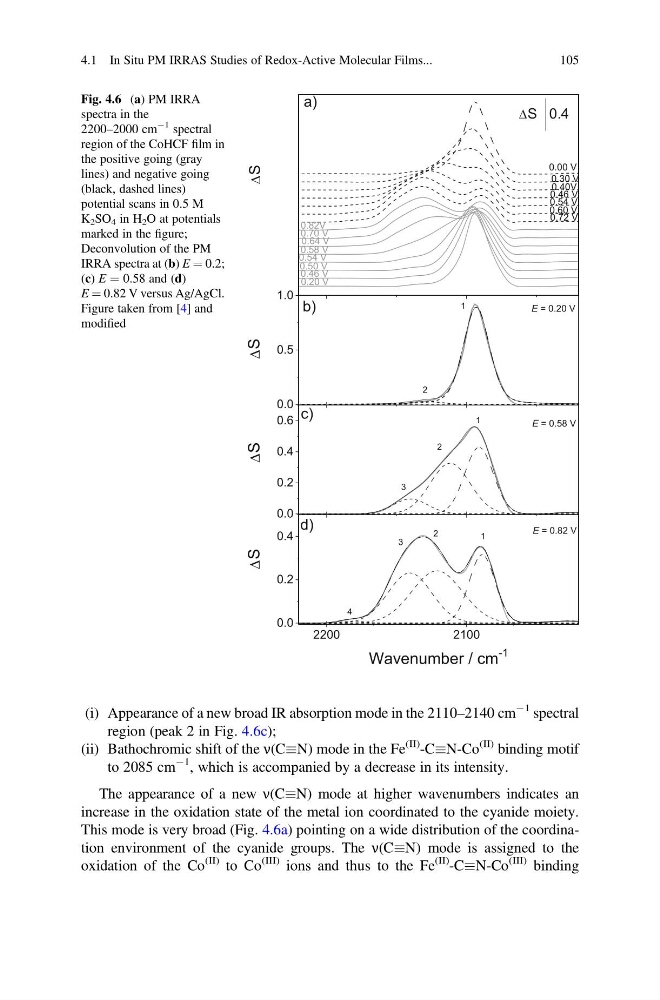
(i) Appearance of a new broad IR absorption mode in the 2110–2140 cm
À1 spectral
region (peak 2 in Fig. 4.6c);
(ii) Bathochromic shift of the ν(CN) mode in the Fe
(II) -CN-Co
(II) binding motif
to 2085 cm
À1 , which is accompanied by a decrease in its intensity.
The appearance of a new ν(CN) mode at higher wavenumbers indicates an
increase in the oxidation state of the metal ion coordinated to the cyanide moiety.
This mode is very broad (Fig. 4.6a) pointing on a wide distribution of the coordination environment of the cyanide groups. The ν(CN) mode is assigned to the
oxidation of the Co
(II) to Co
(III) ions and thus to the Fe
(II) -CN-Co
(III) binding
0.0
0.5
1.0
0.0
0.2
0.4
0.6
2200
2100
0.0
0.2
0.4
S
b)
1
1
1
2
2
E = 0.20 V
E = 0.58 V
E = 0.82 V
2
S
c)
4
3
3
S
Wavenumber / cm
-1
d)
0.46 V
0.40V
0.30 V
0.00 V
0.54 V
0.60 V
0.72 V
0.82V
0.70 V
0.64 V
0.58 V
0.54 V
0.50 V
0.46 V
S
S 0.4
0.20 V
a)
Fig. 4.6 (a) PM IRRA
spectra in the
2200–2000 cm
À1 spectral
region of the CoHCF film in
the positive going (gray
lines) and negative going
(black, dashed lines)
potential scans in 0.5 M
K 2 SO 4 in H 2 O at potentials
marked in the figure;
Deconvolution of the PM
IRRA spectra at (b) E ¼ 0.2;
(c) E ¼ 0.58 and (d)
E ¼ 0.82 V versus Ag/AgCl.
Figure taken from [4] and
modified
4.1 In Situ PM IRRAS Studies of Redox-Active Molecular Films...
105
À1 spectral
region (peak 2 in Fig. 4.6c);
(ii) Bathochromic shift of the ν(CN) mode in the Fe
(II) -CN-Co
(II) binding motif
to 2085 cm
À1 , which is accompanied by a decrease in its intensity.
The appearance of a new ν(CN) mode at higher wavenumbers indicates an
increase in the oxidation state of the metal ion coordinated to the cyanide moiety.
This mode is very broad (Fig. 4.6a) pointing on a wide distribution of the coordination environment of the cyanide groups. The ν(CN) mode is assigned to the
oxidation of the Co
(II) to Co
(III) ions and thus to the Fe
(II) -CN-Co
(III) binding
0.0
0.5
1.0
0.0
0.2
0.4
0.6
2200
2100
0.0
0.2
0.4
S
b)
1
1
1
2
2
E = 0.20 V
E = 0.58 V
E = 0.82 V
2
S
c)
4
3
3
S
Wavenumber / cm
-1
d)
0.46 V
0.40V
0.30 V
0.00 V
0.54 V
0.60 V
0.72 V
0.82V
0.70 V
0.64 V
0.58 V
0.54 V
0.50 V
0.46 V
S
S 0.4
0.20 V
a)
Fig. 4.6 (a) PM IRRA
spectra in the
2200–2000 cm
À1 spectral
region of the CoHCF film in
the positive going (gray
lines) and negative going
(black, dashed lines)
potential scans in 0.5 M
K 2 SO 4 in H 2 O at potentials
marked in the figure;
Deconvolution of the PM
IRRA spectra at (b) E ¼ 0.2;
(c) E ¼ 0.58 and (d)
E ¼ 0.82 V versus Ag/AgCl.
Figure taken from [4] and
modified
4.1 In Situ PM IRRAS Studies of Redox-Active Molecular Films...
105