

PM IRRAS is suitable to monitor the flux of coutnerions compensating the charge
change during the redox reactions.
Coordinated network compounds such as metal hexacyanoferrate films belong to
another kind of redox-active films modifying electrode surfaces. Changes in the
structure and composition of these films, during charge transfer reactions, were
investigated using in situ PM IRRAS [4]. Cobalt hexacyanoferrate films (CoHCF)
were electrochemically produced by cycling the potential of a gold electrode
between 0.0 and 0.9 V versus Ag/AgCl in 0.5 mM K 3 [Fe(CN) 6 ] and 0.5 mM
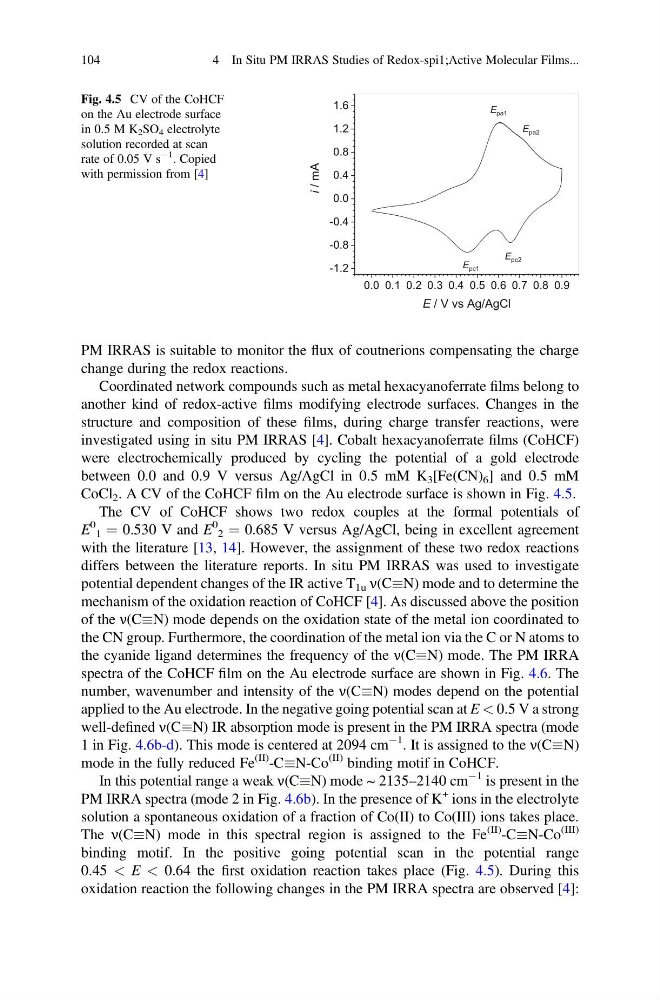
CoCl 2 . A CV of the CoHCF film on the Au electrode surface is shown in Fig. 4.5.
The CV of CoHCF shows two redox couples at the formal potentials of
E
0
1 ¼ 0.530 V and E
0
2 ¼ 0.685 V versus Ag/AgCl, being in excellent agreement
with the literature [13, 14]. However, the assignment of these two redox reactions
differs between the literature reports. In situ PM IRRAS was used to investigate
potential dependent changes of the IR active T 1u ν(CN) mode and to determine the
mechanism of the oxidation reaction of CoHCF [4]. As discussed above the position
of the ν(CN) mode depends on the oxidation state of the metal ion coordinated to
the CN group. Furthermore, the coordination of the metal ion via the C or N atoms to
the cyanide ligand determines the frequency of the ν(CN) mode. The PM IRRA
spectra of the CoHCF film on the Au electrode surface are shown in Fig. 4.6. The
number, wavenumber and intensity of the ν(CN) modes depend on the potential
applied to the Au electrode. In the negative going potential scan at E < 0.5 V a strong
well-defined ν(CN) IR absorption mode is present in the PM IRRA spectra (mode
1 in Fig. 4.6b-d). This mode is centered at 2094 cm
À1 . It is assigned to the ν(CN)
mode in the fully reduced Fe
(II) -CN-Co
(II) binding motif in CoHCF.
In this potential range a weak ν(CN) mode ~ 2135–2140 cm
À1 is present in the
PM IRRA spectra (mode 2 in Fig. 4.6b). In the presence of K
+ ions in the electrolyte
solution a spontaneous oxidation of a fraction of Co(II) to Co(III) ions takes place.
The ν(CN) mode in this spectral region is assigned to the Fe
(II) -CN-Co
(III)
binding motif. In the positive going potential scan in the potential range
0.45 < E < 0.64 the first oxidation reaction takes place (Fig. 4.5). During this
oxidation reaction the following changes in the PM IRRA spectra are observed [4]:
0.0 0.1 0.2 0.3 0.4 0.5 0.6 0.7 0.8 0.9
-1.2
-0.8
-0.4
0.0
0.4
0.8
1.2
1.6
E pa2
E pa1
E pc1
i
A
m
/
E / V vs Ag/AgCl
E pc2
Fig. 4.5 CV of the CoHCF
on the Au electrode surface
in 0.5 M K 2 SO 4 electrolyte
solution recorded at scan
rate of 0.05 V s
À1
. Copied
with permission from [4]
104
4 In Situ PM IRRAS Studies of Redox-spi1;Active Molecular Films...
change during the redox reactions.
Coordinated network compounds such as metal hexacyanoferrate films belong to
another kind of redox-active films modifying electrode surfaces. Changes in the
structure and composition of these films, during charge transfer reactions, were
investigated using in situ PM IRRAS [4]. Cobalt hexacyanoferrate films (CoHCF)
were electrochemically produced by cycling the potential of a gold electrode
between 0.0 and 0.9 V versus Ag/AgCl in 0.5 mM K 3 [Fe(CN) 6 ] and 0.5 mM
CoCl 2 . A CV of the CoHCF film on the Au electrode surface is shown in Fig. 4.5.
The CV of CoHCF shows two redox couples at the formal potentials of
E
0
1 ¼ 0.530 V and E
0
2 ¼ 0.685 V versus Ag/AgCl, being in excellent agreement
with the literature [13, 14]. However, the assignment of these two redox reactions
differs between the literature reports. In situ PM IRRAS was used to investigate
potential dependent changes of the IR active T 1u ν(CN) mode and to determine the
mechanism of the oxidation reaction of CoHCF [4]. As discussed above the position
of the ν(CN) mode depends on the oxidation state of the metal ion coordinated to
the CN group. Furthermore, the coordination of the metal ion via the C or N atoms to
the cyanide ligand determines the frequency of the ν(CN) mode. The PM IRRA
spectra of the CoHCF film on the Au electrode surface are shown in Fig. 4.6. The
number, wavenumber and intensity of the ν(CN) modes depend on the potential
applied to the Au electrode. In the negative going potential scan at E < 0.5 V a strong
well-defined ν(CN) IR absorption mode is present in the PM IRRA spectra (mode
1 in Fig. 4.6b-d). This mode is centered at 2094 cm
À1 . It is assigned to the ν(CN)
mode in the fully reduced Fe
(II) -CN-Co
(II) binding motif in CoHCF.
In this potential range a weak ν(CN) mode ~ 2135–2140 cm
À1 is present in the
PM IRRA spectra (mode 2 in Fig. 4.6b). In the presence of K
+ ions in the electrolyte
solution a spontaneous oxidation of a fraction of Co(II) to Co(III) ions takes place.
The ν(CN) mode in this spectral region is assigned to the Fe
(II) -CN-Co
(III)
binding motif. In the positive going potential scan in the potential range
0.45 < E < 0.64 the first oxidation reaction takes place (Fig. 4.5). During this
oxidation reaction the following changes in the PM IRRA spectra are observed [4]:
0.0 0.1 0.2 0.3 0.4 0.5 0.6 0.7 0.8 0.9
-1.2
-0.8
-0.4
0.0
0.4
0.8
1.2
1.6
E pa2
E pa1
E pc1
i
A
m
/
E / V vs Ag/AgCl
E pc2
Fig. 4.5 CV of the CoHCF
on the Au electrode surface
in 0.5 M K 2 SO 4 electrolyte
solution recorded at scan
rate of 0.05 V s
À1
. Copied
with permission from [4]
104
4 In Situ PM IRRAS Studies of Redox-spi1;Active Molecular Films...