

films at the air|water interface. Amphiphilic redox-active molecules may be transferred from the aqueous surface onto an electrode surface using the LB transfer
[5]. The conditions of the LB transfer allow the selection of the packing density
(surface concentration), orientation of amphiphilic redox-active molecules in LB
films (polar head group turned toward the electrode surface or opposite), and the film
thickness (number of transferred layers). In the five-coordinate iron (III)
metallosurfactant (Fe
(III) L
N2O3 ) the Fe
(III) ion binds to three phenolate groups in
the amphiphilic ligand (inset in Fig. 4.2). Fe
(III) L
N2O3
, when assembled on the gold
electrode surface into thin, uniformly packed LB films, acts as diode-like material
[6–8]. It was observed, that the rectification property disappeared during the potential cycling. Electrochemistry and in situ PM IRRAS were used to study potentialdependent changes in the structure and orientation of Fe
(III) L
N2O3 in LB mono—and
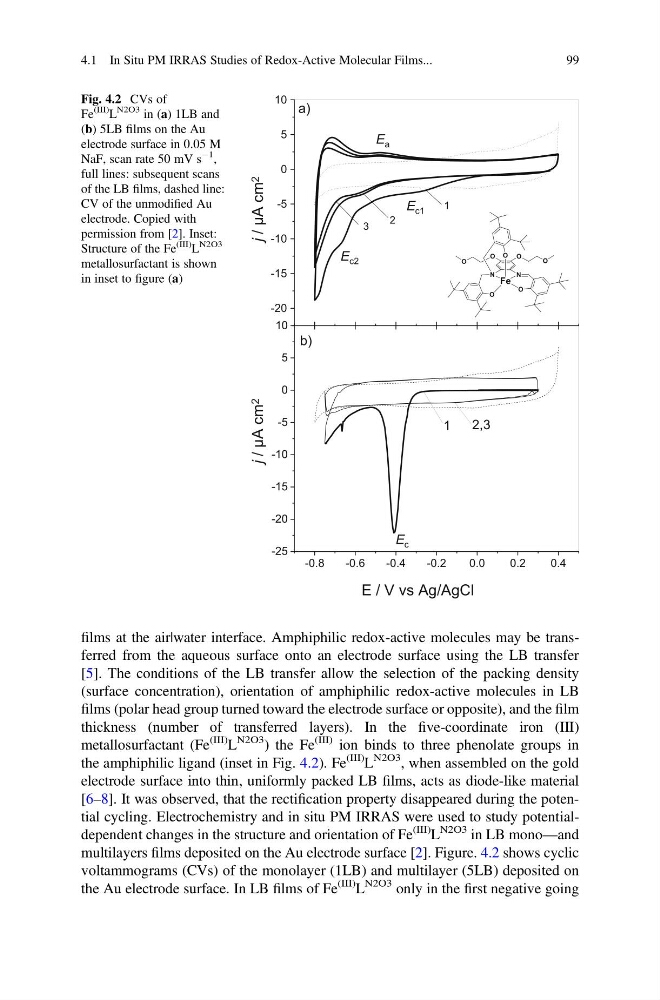
multilayers films deposited on the Au electrode surface [2]. Figure. 4.2 shows cyclic
voltammograms (CVs) of the monolayer (1LB) and multilayer (5LB) deposited on
the Au electrode surface. In LB films of Fe
(III) L
N2O3 only in the first negative going
-0.8
-0.6
-0.4
-0.2
0.0
0.2
0.4
-25
-20
-15
-10
-5
0
5
10
-20
-15
-10
-5
0
5
10
j / µA cm 2
j / µA cm 2
E / V vs Ag/AgCl
E c
b)
1
2,3
a)
E c1
E c2
E a
1
2
3
Fig. 4.2 CVs of
Fe
(III) L
N2O3 in (a) 1LB and
(b) 5LB films on the Au
electrode surface in 0.05 M
NaF, scan rate 50 mV s
À1
,
full lines: subsequent scans
of the LB films, dashed line:
CV of the unmodified Au
electrode. Copied with
permission from [2]. Inset:
Structure of the Fe
(III) L
N2O3
metallosurfactant is shown
in inset to figure (a)
4.1 In Situ PM IRRAS Studies of Redox-Active Molecular Films...
99
[5]. The conditions of the LB transfer allow the selection of the packing density
(surface concentration), orientation of amphiphilic redox-active molecules in LB
films (polar head group turned toward the electrode surface or opposite), and the film
thickness (number of transferred layers). In the five-coordinate iron (III)
metallosurfactant (Fe
(III) L
N2O3 ) the Fe
(III) ion binds to three phenolate groups in
the amphiphilic ligand (inset in Fig. 4.2). Fe
(III) L
N2O3
, when assembled on the gold
electrode surface into thin, uniformly packed LB films, acts as diode-like material
[6–8]. It was observed, that the rectification property disappeared during the potential cycling. Electrochemistry and in situ PM IRRAS were used to study potentialdependent changes in the structure and orientation of Fe
(III) L
N2O3 in LB mono—and
multilayers films deposited on the Au electrode surface [2]. Figure. 4.2 shows cyclic
voltammograms (CVs) of the monolayer (1LB) and multilayer (5LB) deposited on
the Au electrode surface. In LB films of Fe
(III) L
N2O3 only in the first negative going
-0.8
-0.6
-0.4
-0.2
0.0
0.2
0.4
-25
-20
-15
-10
-5
0
5
10
-20
-15
-10
-5
0
5
10
j / µA cm 2
j / µA cm 2
E / V vs Ag/AgCl
E c
b)
1
2,3
a)
E c1
E c2
E a
1
2
3
Fig. 4.2 CVs of
Fe
(III) L
N2O3 in (a) 1LB and
(b) 5LB films on the Au
electrode surface in 0.05 M
NaF, scan rate 50 mV s
À1
,
full lines: subsequent scans
of the LB films, dashed line:
CV of the unmodified Au
electrode. Copied with
permission from [2]. Inset:
Structure of the Fe
(III) L
N2O3
metallosurfactant is shown
in inset to figure (a)
4.1 In Situ PM IRRAS Studies of Redox-Active Molecular Films...
99