

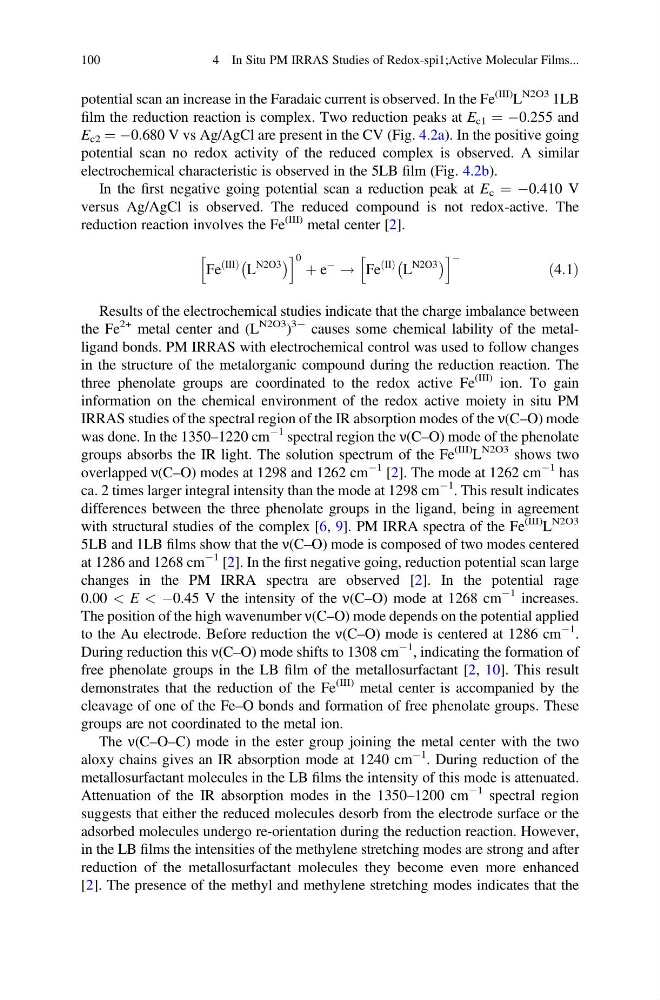
potential scan an increase in the Faradaic current is observed. In the Fe
(III) L
N2O3 1LB
film the reduction reaction is complex. Two reduction peaks at E c1 ¼ À0.255 and
E c2 ¼ À0.680 V vs Ag/AgCl are present in the CV (Fig. 4.2a). In the positive going
potential scan no redox activity of the reduced complex is observed. A similar
electrochemical characteristic is observed in the 5LB film (Fig. 4.2b).
In the first negative going potential scan a reduction peak at E c ¼ À0.410 V
versus Ag/AgCl is observed. The reduced compound is not redox-active. The
reduction reaction involves the Fe
(III) metal center [2].
Fe
III
ð Þ L
N2O3
À
Á
h
i 0 þ e
À
! Fe
II
ð Þ L
N2O3
À
Á
h
i À
ð4:1Þ
Results of the electrochemical studies indicate that the charge imbalance between
the Fe
2+ metal center and (L
N2O3
)
3À causes some chemical lability of the metalligand bonds. PM IRRAS with electrochemical control was used to follow changes
in the structure of the metalorganic compound during the reduction reaction. The
three phenolate groups are coordinated to the redox active Fe
(III) ion. To gain
information on the chemical environment of the redox active moiety in situ PM
IRRAS studies of the spectral region of the IR absorption modes of the ν(C–O) mode
was done. In the 1350–1220 cm
À1 spectral region the ν(C–O) mode of the phenolate
groups absorbs the IR light. The solution spectrum of the Fe
(III) L
N2O3 shows two
overlapped ν(C–O) modes at 1298 and 1262 cm
À1 [2]. The mode at 1262 cm
À1 has
ca. 2 times larger integral intensity than the mode at 1298 cm
À1 . This result indicates
differences between the three phenolate groups in the ligand, being in agreement
with structural studies of the complex [6, 9]. PM IRRA spectra of the Fe
(III) L
N2O3
5LB and 1LB films show that the ν(C–O) mode is composed of two modes centered
at 1286 and 1268 cm
À1 [2]. In the first negative going, reduction potential scan large
changes in the PM IRRA spectra are observed [2]. In the potential rage
0.00 < E < À0.45 V the intensity of the ν(C–O) mode at 1268 cm
À1 increases.
The position of the high wavenumber ν(C–O) mode depends on the potential applied
to the Au electrode. Before reduction the ν(C–O) mode is centered at 1286 cm
À1 .
During reduction this ν(C–O) mode shifts to 1308 cm
À1 , indicating the formation of
free phenolate groups in the LB film of the metallosurfactant [2, 10]. This result
demonstrates that the reduction of the Fe
(III) metal center is accompanied by the
cleavage of one of the Fe–O bonds and formation of free phenolate groups. These
groups are not coordinated to the metal ion.
The ν(C–O–C) mode in the ester group joining the metal center with the two
aloxy chains gives an IR absorption mode at 1240 cm
À1 . During reduction of the
metallosurfactant molecules in the LB films the intensity of this mode is attenuated.
Attenuation of the IR absorption modes in the 1350–1200 cm
À1 spectral region
suggests that either the reduced molecules desorb from the electrode surface or the
adsorbed molecules undergo re-orientation during the reduction reaction. However,
in the LB films the intensities of the methylene stretching modes are strong and after
reduction of the metallosurfactant molecules they become even more enhanced
[2]. The presence of the methyl and methylene stretching modes indicates that the
100
4 In Situ PM IRRAS Studies of Redox-spi1;Active Molecular Films...
(III) L
N2O3 1LB
film the reduction reaction is complex. Two reduction peaks at E c1 ¼ À0.255 and
E c2 ¼ À0.680 V vs Ag/AgCl are present in the CV (Fig. 4.2a). In the positive going
potential scan no redox activity of the reduced complex is observed. A similar
electrochemical characteristic is observed in the 5LB film (Fig. 4.2b).
In the first negative going potential scan a reduction peak at E c ¼ À0.410 V
versus Ag/AgCl is observed. The reduced compound is not redox-active. The
reduction reaction involves the Fe
(III) metal center [2].
Fe
III
ð Þ L
N2O3
À
Á
h
i 0 þ e
À
! Fe
II
ð Þ L
N2O3
À
Á
h
i À
ð4:1Þ
Results of the electrochemical studies indicate that the charge imbalance between
the Fe
2+ metal center and (L
N2O3
)
3À causes some chemical lability of the metalligand bonds. PM IRRAS with electrochemical control was used to follow changes
in the structure of the metalorganic compound during the reduction reaction. The
three phenolate groups are coordinated to the redox active Fe
(III) ion. To gain
information on the chemical environment of the redox active moiety in situ PM
IRRAS studies of the spectral region of the IR absorption modes of the ν(C–O) mode
was done. In the 1350–1220 cm
À1 spectral region the ν(C–O) mode of the phenolate
groups absorbs the IR light. The solution spectrum of the Fe
(III) L
N2O3 shows two
overlapped ν(C–O) modes at 1298 and 1262 cm
À1 [2]. The mode at 1262 cm
À1 has
ca. 2 times larger integral intensity than the mode at 1298 cm
À1 . This result indicates
differences between the three phenolate groups in the ligand, being in agreement
with structural studies of the complex [6, 9]. PM IRRA spectra of the Fe
(III) L
N2O3
5LB and 1LB films show that the ν(C–O) mode is composed of two modes centered
at 1286 and 1268 cm
À1 [2]. In the first negative going, reduction potential scan large
changes in the PM IRRA spectra are observed [2]. In the potential rage
0.00 < E < À0.45 V the intensity of the ν(C–O) mode at 1268 cm
À1 increases.
The position of the high wavenumber ν(C–O) mode depends on the potential applied
to the Au electrode. Before reduction the ν(C–O) mode is centered at 1286 cm
À1 .
During reduction this ν(C–O) mode shifts to 1308 cm
À1 , indicating the formation of
free phenolate groups in the LB film of the metallosurfactant [2, 10]. This result
demonstrates that the reduction of the Fe
(III) metal center is accompanied by the
cleavage of one of the Fe–O bonds and formation of free phenolate groups. These
groups are not coordinated to the metal ion.
The ν(C–O–C) mode in the ester group joining the metal center with the two
aloxy chains gives an IR absorption mode at 1240 cm
À1 . During reduction of the
metallosurfactant molecules in the LB films the intensity of this mode is attenuated.
Attenuation of the IR absorption modes in the 1350–1200 cm
À1 spectral region
suggests that either the reduced molecules desorb from the electrode surface or the
adsorbed molecules undergo re-orientation during the reduction reaction. However,
in the LB films the intensities of the methylene stretching modes are strong and after
reduction of the metallosurfactant molecules they become even more enhanced
[2]. The presence of the methyl and methylene stretching modes indicates that the
100
4 In Situ PM IRRAS Studies of Redox-spi1;Active Molecular Films...