

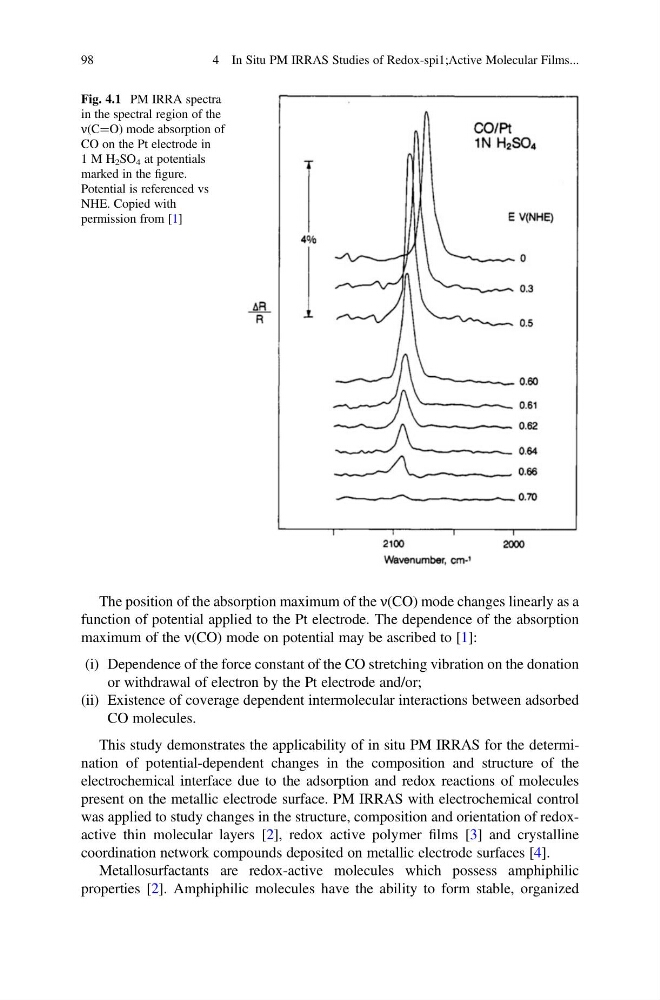
The position of the absorption maximum of the ν(CO) mode changes linearly as a
function of potential applied to the Pt electrode. The dependence of the absorption
maximum of the ν(CO) mode on potential may be ascribed to [1]:
(i) Dependence of the force constant of the CO stretching vibration on the donation
or withdrawal of electron by the Pt electrode and/or;
(ii) Existence of coverage dependent intermolecular interactions between adsorbed
CO molecules.
This study demonstrates the applicability of in situ PM IRRAS for the determination of potential-dependent changes in the composition and structure of the
electrochemical interface due to the adsorption and redox reactions of molecules
present on the metallic electrode surface. PM IRRAS with electrochemical control
was applied to study changes in the structure, composition and orientation of redoxactive thin molecular layers [2], redox active polymer films [3] and crystalline
coordination network compounds deposited on metallic electrode surfaces [4].
Metallosurfactants are redox-active molecules which possess amphiphilic
properties [2]. Amphiphilic molecules have the ability to form stable, organized
Fig. 4.1 PM IRRA spectra
in the spectral region of the
ν(C¼O) mode absorption of
CO on the Pt electrode in
1 M H 2 SO 4 at potentials
marked in the figure.
Potential is referenced vs
NHE. Copied with
permission from [1]
98
4 In Situ PM IRRAS Studies of Redox-spi1;Active Molecular Films...
function of potential applied to the Pt electrode. The dependence of the absorption
maximum of the ν(CO) mode on potential may be ascribed to [1]:
(i) Dependence of the force constant of the CO stretching vibration on the donation
or withdrawal of electron by the Pt electrode and/or;
(ii) Existence of coverage dependent intermolecular interactions between adsorbed
CO molecules.
This study demonstrates the applicability of in situ PM IRRAS for the determination of potential-dependent changes in the composition and structure of the
electrochemical interface due to the adsorption and redox reactions of molecules
present on the metallic electrode surface. PM IRRAS with electrochemical control
was applied to study changes in the structure, composition and orientation of redoxactive thin molecular layers [2], redox active polymer films [3] and crystalline
coordination network compounds deposited on metallic electrode surfaces [4].
Metallosurfactants are redox-active molecules which possess amphiphilic
properties [2]. Amphiphilic molecules have the ability to form stable, organized
Fig. 4.1 PM IRRA spectra
in the spectral region of the
ν(C¼O) mode absorption of
CO on the Pt electrode in
1 M H 2 SO 4 at potentials
marked in the figure.
Potential is referenced vs
NHE. Copied with
permission from [1]
98
4 In Situ PM IRRAS Studies of Redox-spi1;Active Molecular Films...