

374
K. Singhal and A. Kumar
to control the excessive inflammatory response of immune system to combat the
SARS-CoV-2 and finally COVID-19.
Beside all these drugs, corticosteroids such as dexamethasone (DMs) is also
considered as potential weapon against SARS-CoV-2 to accelerate the recovery
rate as it possesses excellent anti-inflammatory property that reduces inflammation
by mimicking anti-inflammatory hormones produced by the SARS-CoV-2 infected
body [3]. Based on several case studies, it has been observed that DMs is suitable only
for critically ill patients, for example, who were already on ventilation or receiving
oxygen [4]. DMs reduces mortality rate of COVID-19 patients as it slows down the
production rate of cytokine storm in the body [5]. To see the benefits of DMs in
reducing the death rate of SARS-CoV-2 patients, WHO is in the process of updating
treatment guidelines to include DMs. Therefore, given the increasing use of DMs in
the treatment of SARS-CoV-2, it is necessary to design the DMs drug in such a way
that it should be low cost, non-hazardous to body, environmentally benign product,
and also the chemical synthesis process of DMs must include less toxic solvents and
catalysts so that we get a novel DMs with minimum side effects.
According to the WHO, DMs has been utilized in medical world since 1960s to
reduce inflammation in several different conditions by dampening down the immune
system. DMs is 9α-fluoro-16α-methylprednisolone drug belongs to glucocorticosteroids (GCs) which are steroid hormones secreted by the adrenal cortex. By the
1960s, to recover various types of joint inflammation, rapid chemical advances have
been carried out in GCs drugs and these advances resulted in several steroid drugs
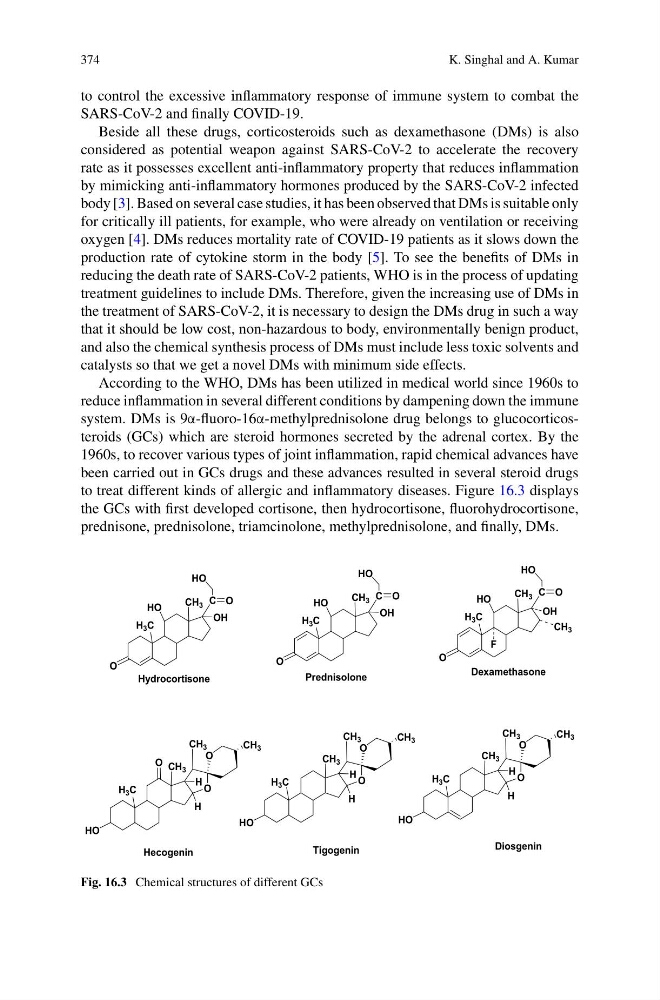
to treat different kinds of allergic and inflammatory diseases. Figure 16.3 displays
the GCs with first developed cortisone, then hydrocortisone, fluorohydrocortisone,
prednisone, prednisolone, triamcinolone, methylprednisolone, and finally, DMs.
O
H 3 C
CH 3 C
HO
OH
O
HO
O
H 3 C
CH 3 C
HO
OH
O
HO
O
H 3 C
CH 3 C
HO
OH
CH 3
O
F
HO
Hydrocortisone
Prednisolone
Dexamethasone
HO
H 3 C
CH 3
H
O
O
O
CH 3
H
CH 3
HO
H 3 C
CH 3
H O
O
CH 3
H
CH 3
HO
H 3 C
CH 3
H O
O
CH 3
H
CH 3
Hecogenin
Tigogenin
Diosgenin
Fig. 16.3 Chemical structures of different GCs
K. Singhal and A. Kumar
to control the excessive inflammatory response of immune system to combat the
SARS-CoV-2 and finally COVID-19.
Beside all these drugs, corticosteroids such as dexamethasone (DMs) is also
considered as potential weapon against SARS-CoV-2 to accelerate the recovery
rate as it possesses excellent anti-inflammatory property that reduces inflammation
by mimicking anti-inflammatory hormones produced by the SARS-CoV-2 infected
body [3]. Based on several case studies, it has been observed that DMs is suitable only
for critically ill patients, for example, who were already on ventilation or receiving
oxygen [4]. DMs reduces mortality rate of COVID-19 patients as it slows down the
production rate of cytokine storm in the body [5]. To see the benefits of DMs in
reducing the death rate of SARS-CoV-2 patients, WHO is in the process of updating
treatment guidelines to include DMs. Therefore, given the increasing use of DMs in
the treatment of SARS-CoV-2, it is necessary to design the DMs drug in such a way
that it should be low cost, non-hazardous to body, environmentally benign product,
and also the chemical synthesis process of DMs must include less toxic solvents and
catalysts so that we get a novel DMs with minimum side effects.
According to the WHO, DMs has been utilized in medical world since 1960s to
reduce inflammation in several different conditions by dampening down the immune
system. DMs is 9α-fluoro-16α-methylprednisolone drug belongs to glucocorticosteroids (GCs) which are steroid hormones secreted by the adrenal cortex. By the
1960s, to recover various types of joint inflammation, rapid chemical advances have
been carried out in GCs drugs and these advances resulted in several steroid drugs
to treat different kinds of allergic and inflammatory diseases. Figure 16.3 displays
the GCs with first developed cortisone, then hydrocortisone, fluorohydrocortisone,
prednisone, prednisolone, triamcinolone, methylprednisolone, and finally, DMs.
O
H 3 C
CH 3 C
HO
OH
O
HO
O
H 3 C
CH 3 C
HO
OH
O
HO
O
H 3 C
CH 3 C
HO
OH
CH 3
O
F
HO
Hydrocortisone
Prednisolone
Dexamethasone
HO
H 3 C
CH 3
H
O
O
O
CH 3
H
CH 3
HO
H 3 C
CH 3
H O
O
CH 3
H
CH 3
HO
H 3 C
CH 3
H O
O
CH 3
H
CH 3
Hecogenin
Tigogenin
Diosgenin
Fig. 16.3 Chemical structures of different GCs