

16 Green Economy Approach to Develop Bioactive …
373
virus and this crown-like appearance of virus particles giving the disease its characteristic name. Transmission electron microscopy (TEM) imaging of SARS CoV-2
reveals about its size which was found to be 75 nm with patchy stain pooling on its
surface and a round peplomeric structure of SARS CoV-2 was also observed [2].
The common symptoms in SARS-CoV-2 infected people are shortness of breath
or difficulty breathing, chest pain, loss of speech, throat irritation, fever, running nose,
dry cough or cough with phlegm, muscle pain, diarrhea and tiredness but recently,
loss of smell and taste are also observed in COVID-19 patients. These symptoms
are due to the entry of SARS-CoV-2 into respiratory mucosa and infecting the cells,
which is sensed by the immune system. It was found that S-protein of SARS-CoV-2
binds to the human angiotensin-converting enzyme 2 (hACE-2), a receptor protein on
the surface of respiratory cell via both clathrin-dependent and-independent endocytosis. However, hACE-2 enzyme is considered as the key functional receptor for the
SARS-CoV-2 and responsible to increase and maintain blood volume in humans. The
binding of S-protein with receptor gives rise to the fusion of viral protein and host cell
membrane that release the nucleoprotein genome into the cytoplasm after S-protein
priming by serine protease and subsequent viral replication has occurred that makes
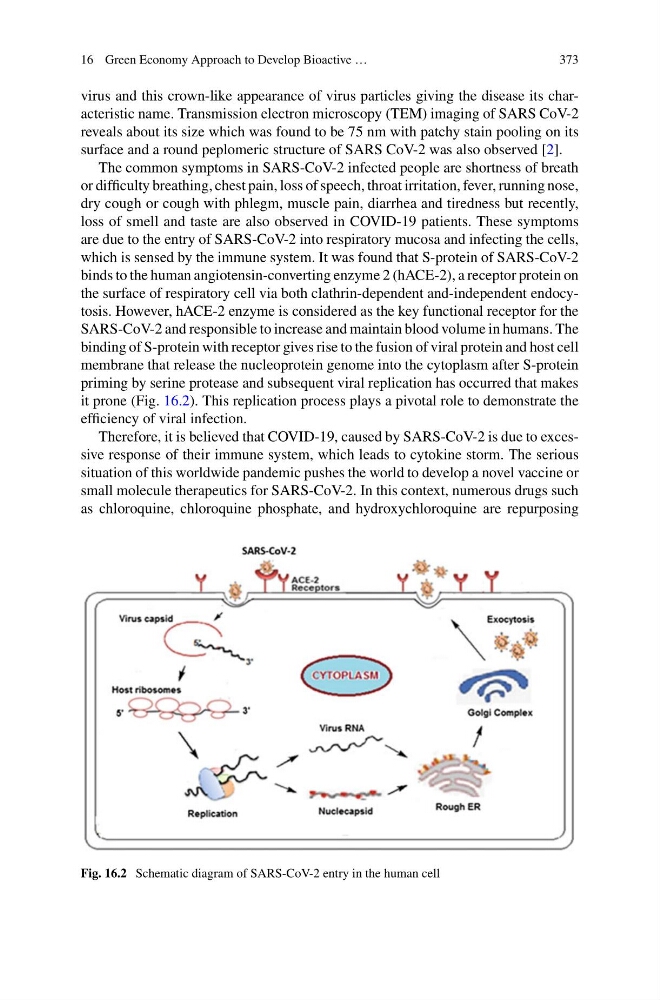
it prone (Fig. 16.2). This replication process plays a pivotal role to demonstrate the
efficiency of viral infection.
Therefore, it is believed that COVID-19, caused by SARS-CoV-2 is due to excessive response of their immune system, which leads to cytokine storm. The serious
situation of this worldwide pandemic pushes the world to develop a novel vaccine or
small molecule therapeutics for SARS-CoV-2. In this context, numerous drugs such
as chloroquine, chloroquine phosphate, and hydroxychloroquine are repurposing
Fig. 16.2 Schematic diagram of SARS-CoV-2 entry in the human cell
373
virus and this crown-like appearance of virus particles giving the disease its characteristic name. Transmission electron microscopy (TEM) imaging of SARS CoV-2
reveals about its size which was found to be 75 nm with patchy stain pooling on its
surface and a round peplomeric structure of SARS CoV-2 was also observed [2].
The common symptoms in SARS-CoV-2 infected people are shortness of breath
or difficulty breathing, chest pain, loss of speech, throat irritation, fever, running nose,
dry cough or cough with phlegm, muscle pain, diarrhea and tiredness but recently,
loss of smell and taste are also observed in COVID-19 patients. These symptoms
are due to the entry of SARS-CoV-2 into respiratory mucosa and infecting the cells,
which is sensed by the immune system. It was found that S-protein of SARS-CoV-2
binds to the human angiotensin-converting enzyme 2 (hACE-2), a receptor protein on
the surface of respiratory cell via both clathrin-dependent and-independent endocytosis. However, hACE-2 enzyme is considered as the key functional receptor for the
SARS-CoV-2 and responsible to increase and maintain blood volume in humans. The
binding of S-protein with receptor gives rise to the fusion of viral protein and host cell
membrane that release the nucleoprotein genome into the cytoplasm after S-protein
priming by serine protease and subsequent viral replication has occurred that makes
it prone (Fig. 16.2). This replication process plays a pivotal role to demonstrate the
efficiency of viral infection.
Therefore, it is believed that COVID-19, caused by SARS-CoV-2 is due to excessive response of their immune system, which leads to cytokine storm. The serious
situation of this worldwide pandemic pushes the world to develop a novel vaccine or
small molecule therapeutics for SARS-CoV-2. In this context, numerous drugs such
as chloroquine, chloroquine phosphate, and hydroxychloroquine are repurposing
Fig. 16.2 Schematic diagram of SARS-CoV-2 entry in the human cell