

372
K. Singhal and A. Kumar
Keywords SARS CoV-2 · Dexamethasone · Green synthesis · Magnetic biochar ·
Magnetic nanoparticles
16.1 Introduction
The outbreak of the seventh coronavirus, i.e. severe acute respiratory syndrome
coronavirus-2 (SARS-CoV-2), known to generate novel coronavirus disease 2019
(COVID-19), has become an irresolvable issue for scientists due to its numerous
severe harmful impacts on living being and world economy as well. The SARSCoV-2 broke out and spread to more than 185 countries since the beginning of
twenty-first century. Novel coronavirus was spread out at the end of 2019 from
Wuhan, China, therefore, WHO referred this virus as 2019-nCoV which is highly
considered as the family of SARS-CoV and hence, 2019-nCoV was further classified
as SARS-CoV-2 by the International Virus Classification Commission (ICTV) [1].
Coronaviruses (CoVs) are classified into four genera: alpha (α), beta (β), gamma
(γ), and delta (δ) and SARS-CoV-2 belongs to β genus coronavirus having a positive
single stranded RNA genome with envelope protein (subgenus sarbecovirus, Orthocoronavirinae subfamily). SARS CoV-2 is a member of Nidovirus family having a
tendency to replicate in the cytoplasm. The source of SARS-CoV-2 is believed to
be bats as natural host because genomic sequencing analysis has revealed that the
sequence of SARS-CoV-2 genome is almost identical as bat CoV RaTG13 genome.
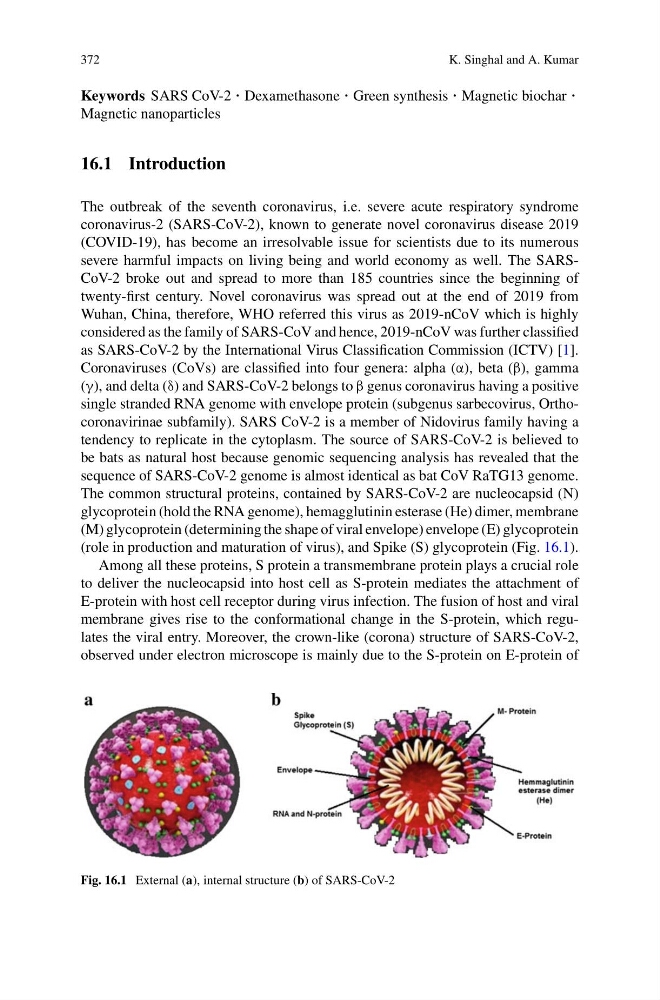
The common structural proteins, contained by SARS-CoV-2 are nucleocapsid (N)
glycoprotein (hold the RNA genome), hemagglutinin esterase (He) dimer, membrane
(M) glycoprotein (determining the shape of viral envelope) envelope (E) glycoprotein
(role in production and maturation of virus), and Spike (S) glycoprotein (Fig. 16.1).
Among all these proteins, S protein a transmembrane protein plays a crucial role
to deliver the nucleocapsid into host cell as S-protein mediates the attachment of
E-protein with host cell receptor during virus infection. The fusion of host and viral
membrane gives rise to the conformational change in the S-protein, which regulates the viral entry. Moreover, the crown-like (corona) structure of SARS-CoV-2,
observed under electron microscope is mainly due to the S-protein on E-protein of
Fig. 16.1 External (a), internal structure (b) of SARS-CoV-2
K. Singhal and A. Kumar
Keywords SARS CoV-2 · Dexamethasone · Green synthesis · Magnetic biochar ·
Magnetic nanoparticles
16.1 Introduction
The outbreak of the seventh coronavirus, i.e. severe acute respiratory syndrome
coronavirus-2 (SARS-CoV-2), known to generate novel coronavirus disease 2019
(COVID-19), has become an irresolvable issue for scientists due to its numerous
severe harmful impacts on living being and world economy as well. The SARSCoV-2 broke out and spread to more than 185 countries since the beginning of
twenty-first century. Novel coronavirus was spread out at the end of 2019 from
Wuhan, China, therefore, WHO referred this virus as 2019-nCoV which is highly
considered as the family of SARS-CoV and hence, 2019-nCoV was further classified
as SARS-CoV-2 by the International Virus Classification Commission (ICTV) [1].
Coronaviruses (CoVs) are classified into four genera: alpha (α), beta (β), gamma
(γ), and delta (δ) and SARS-CoV-2 belongs to β genus coronavirus having a positive
single stranded RNA genome with envelope protein (subgenus sarbecovirus, Orthocoronavirinae subfamily). SARS CoV-2 is a member of Nidovirus family having a
tendency to replicate in the cytoplasm. The source of SARS-CoV-2 is believed to
be bats as natural host because genomic sequencing analysis has revealed that the
sequence of SARS-CoV-2 genome is almost identical as bat CoV RaTG13 genome.
The common structural proteins, contained by SARS-CoV-2 are nucleocapsid (N)
glycoprotein (hold the RNA genome), hemagglutinin esterase (He) dimer, membrane
(M) glycoprotein (determining the shape of viral envelope) envelope (E) glycoprotein
(role in production and maturation of virus), and Spike (S) glycoprotein (Fig. 16.1).
Among all these proteins, S protein a transmembrane protein plays a crucial role
to deliver the nucleocapsid into host cell as S-protein mediates the attachment of
E-protein with host cell receptor during virus infection. The fusion of host and viral
membrane gives rise to the conformational change in the S-protein, which regulates the viral entry. Moreover, the crown-like (corona) structure of SARS-CoV-2,
observed under electron microscope is mainly due to the S-protein on E-protein of
Fig. 16.1 External (a), internal structure (b) of SARS-CoV-2