

5 The Dual Impact of Lockdown on Curbing COVID-19 Spread …
117
β t = Transmission rate.
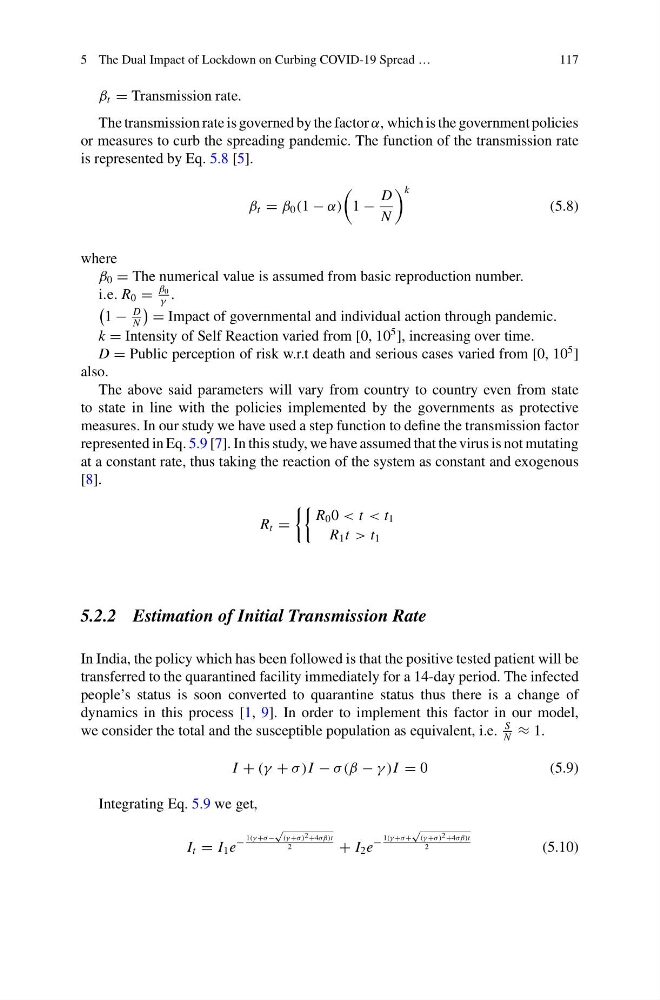
The transmission rate is governed by the factor α, which is the government policies
or measures to curb the spreading pandemic. The function of the transmission rate
is represented by Eq. 5.8 [5].
β t = β 0 (1 − α)
1 −
D
N
k
(5.8)
where
β 0 = The numerical value is assumed from basic reproduction number.
i.e. R 0 =
β 0
γ
.
1 −
D
N
= Impact of governmental and individual action through pandemic.
k = Intensity of Self Reaction varied from [0, 10
5 ], increasing over time.
D = Public perception of risk w.r.t death and serious cases varied from [0, 10
5 ]
also.
The above said parameters will vary from country to country even from state
to state in line with the policies implemented by the governments as protective
measures. In our study we have used a step function to define the transmission factor
represented in Eq. 5.9 [7]. In this study, we have assumed that the virus is not mutating
at a constant rate, thus taking the reaction of the system as constant and exogenous
[8].
R t =
R 0 0 < t < t 1
R 1 t > t 1
5.2.2 Estimation of Initial Transmission Rate
In India, the policy which has been followed is that the positive tested patient will be
transferred to the quarantined facility immediately for a 14-day period. The infected
people’s status is soon converted to quarantine status thus there is a change of
dynamics in this process [1, 9]. In order to implement this factor in our model,
we consider the total and the susceptible population as equivalent, i.e.
S
N
≈ 1.
I + (γ + σ )I − σ (β − γ )I = 0
(5.9)
Integrating Eq. 5.9 we get,
I t = I 1 e
−
1(γ +σ −
√
(γ +σ ) 2 +4σβ)t
2
+ I 2 e
−
1(γ +σ +
√
(γ +σ ) 2 +4σβ)t
2
(5.10)
117
β t = Transmission rate.
The transmission rate is governed by the factor α, which is the government policies
or measures to curb the spreading pandemic. The function of the transmission rate
is represented by Eq. 5.8 [5].
β t = β 0 (1 − α)
1 −
D
N
k
(5.8)
where
β 0 = The numerical value is assumed from basic reproduction number.
i.e. R 0 =
β 0
γ
.
1 −
D
N
= Impact of governmental and individual action through pandemic.
k = Intensity of Self Reaction varied from [0, 10
5 ], increasing over time.
D = Public perception of risk w.r.t death and serious cases varied from [0, 10
5 ]
also.
The above said parameters will vary from country to country even from state
to state in line with the policies implemented by the governments as protective
measures. In our study we have used a step function to define the transmission factor
represented in Eq. 5.9 [7]. In this study, we have assumed that the virus is not mutating
at a constant rate, thus taking the reaction of the system as constant and exogenous
[8].
R t =
R 0 0 < t < t 1
R 1 t > t 1
5.2.2 Estimation of Initial Transmission Rate
In India, the policy which has been followed is that the positive tested patient will be
transferred to the quarantined facility immediately for a 14-day period. The infected
people’s status is soon converted to quarantine status thus there is a change of
dynamics in this process [1, 9]. In order to implement this factor in our model,
we consider the total and the susceptible population as equivalent, i.e.
S
N
≈ 1.
I + (γ + σ )I − σ (β − γ )I = 0
(5.9)
Integrating Eq. 5.9 we get,
I t = I 1 e
−
1(γ +σ −
√
(γ +σ ) 2 +4σβ)t
2
+ I 2 e
−
1(γ +σ +
√
(γ +σ ) 2 +4σβ)t
2
(5.10)