

y=exp(2x)
0
10
20
30
40
50
60
0
0 , 2
0 , 4
0 , 6
0 , 8
1
1 , 2
1 , 4
1 , 6
1 , 8
2
x
y
0
1
2
3
4
5
6
7
8
9
0
0 , 2
0 , 4
0 , 6
0 , 8
1
1 , 2
1 , 4
1 , 6
1 , 8
2
x
y
y=ln(exp (2x))
y=ln(exp(3x))
y=ln(exp(4x))
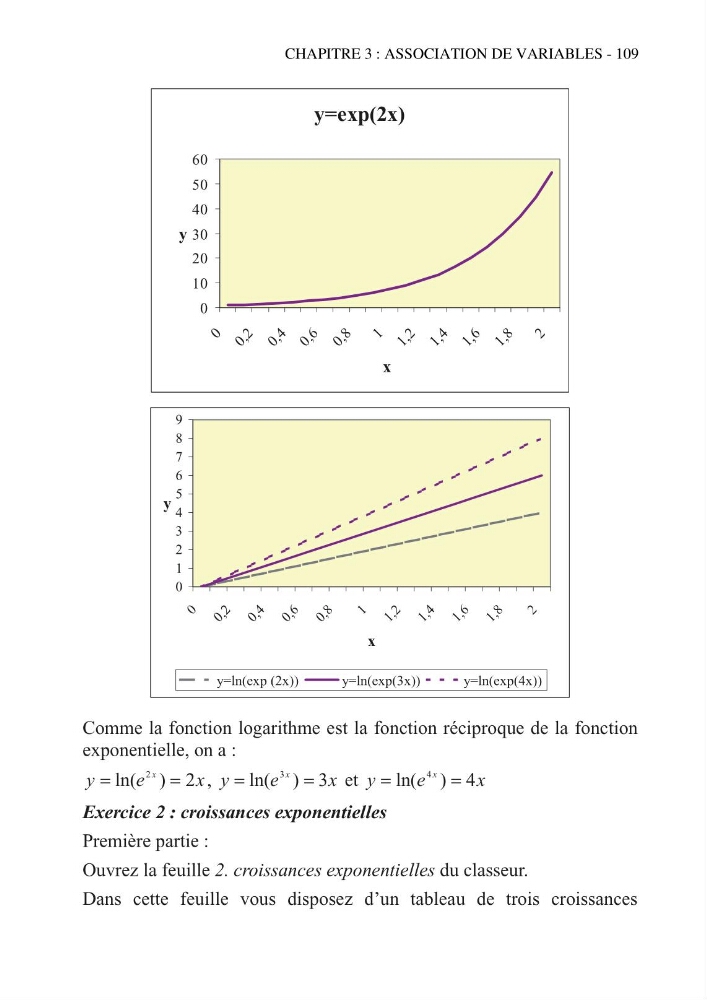
Comme la fonction logarithme est la fonction réciproque de la fonction
exponentielle, on a :
x
e
y
x
2
)
ln(
2
,
x
e
y
x
3
)
ln(
3
et
x
e
y
x
4
)
ln(
4
Exercice 2 : croissances exponentielles
Première partie :
Ouvrez la feuille 2. croissances exponentielles du classeur.
Dans cette feuille vous disposez d’un tableau de trois croissances
CHAPITRE 3 : ASSOCIATION DE VARIABLES - 109
0
10
20
30
40
50
60
0
0 , 2
0 , 4
0 , 6
0 , 8
1
1 , 2
1 , 4
1 , 6
1 , 8
2
x
y
0
1
2
3
4
5
6
7
8
9
0
0 , 2
0 , 4
0 , 6
0 , 8
1
1 , 2
1 , 4
1 , 6
1 , 8
2
x
y
y=ln(exp (2x))
y=ln(exp(3x))
y=ln(exp(4x))
Comme la fonction logarithme est la fonction réciproque de la fonction
exponentielle, on a :
x
e
y
x
2
)
ln(
2
,
x
e
y
x
3
)
ln(
3
et
x
e
y
x
4
)
ln(
4
Exercice 2 : croissances exponentielles
Première partie :
Ouvrez la feuille 2. croissances exponentielles du classeur.
Dans cette feuille vous disposez d’un tableau de trois croissances
CHAPITRE 3 : ASSOCIATION DE VARIABLES - 109