

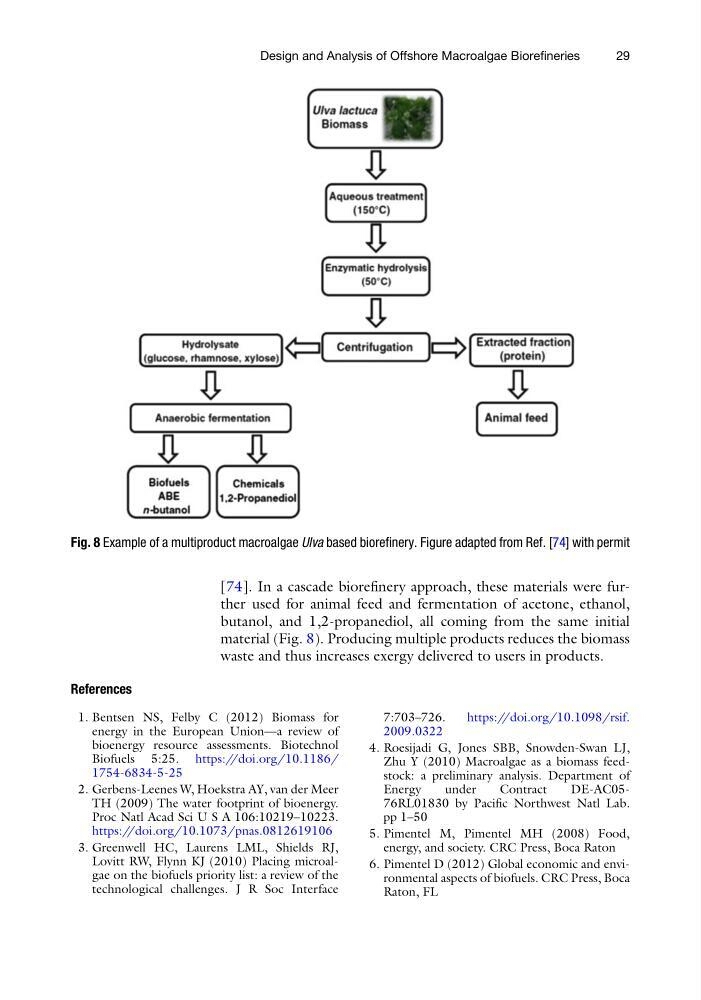
[74]. In a cascade biorefinery approach, these materials were further used for animal feed and fermentation of acetone, ethanol,
butanol, and 1,2-propanediol, all coming from the same initial
material (Fig. 8). Producing multiple products reduces the biomass
waste and thus increases exergy delivered to users in products.
References
1. Bentsen NS, Felby C (2012) Biomass for
energy in the European Union—a review of
bioenergy resource assessments. Biotechnol
Biofuels 5:25. https://doi.org/10.1186/
1754-6834-5-25
2. Gerbens-Leenes W, Hoekstra AY, van der Meer
TH (2009) The water footprint of bioenergy.
Proc Natl Acad Sci U S A 106:10219–10223.
https://doi.org/10.1073/pnas.0812619106
3. Greenwell HC, Laurens LML, Shields RJ,
Lovitt RW, Flynn KJ (2010) Placing microalgae on the biofuels priority list: a review of the
technological challenges. J R Soc Interface
7:703–726.
https://doi.org/10.1098/rsif.
2009.0322
4. Roesijadi G, Jones SBB, Snowden-Swan LJ,
Zhu Y (2010) Macroalgae as a biomass feedstock: a preliminary analysis. Department of
Energy
under
Contract
DE-AC0576RL01830 by Pacific Northwest Natl Lab.
pp 1–50
5. Pimentel M, Pimentel MH (2008) Food,
energy, and society. CRC Press, Boca Raton
6. Pimentel D (2012) Global economic and environmental aspects of biofuels. CRC Press, Boca
Raton, FL
Fig. 8 Example of a multiproduct macroalgae Ulva based biorefinery. Figure adapted from Ref. [74] with permit
Design and Analysis of Offshore Macroalgae Biorefineries
29
butanol, and 1,2-propanediol, all coming from the same initial
material (Fig. 8). Producing multiple products reduces the biomass
waste and thus increases exergy delivered to users in products.
References
1. Bentsen NS, Felby C (2012) Biomass for
energy in the European Union—a review of
bioenergy resource assessments. Biotechnol
Biofuels 5:25. https://doi.org/10.1186/
1754-6834-5-25
2. Gerbens-Leenes W, Hoekstra AY, van der Meer
TH (2009) The water footprint of bioenergy.
Proc Natl Acad Sci U S A 106:10219–10223.
https://doi.org/10.1073/pnas.0812619106
3. Greenwell HC, Laurens LML, Shields RJ,
Lovitt RW, Flynn KJ (2010) Placing microalgae on the biofuels priority list: a review of the
technological challenges. J R Soc Interface
7:703–726.
https://doi.org/10.1098/rsif.
2009.0322
4. Roesijadi G, Jones SBB, Snowden-Swan LJ,
Zhu Y (2010) Macroalgae as a biomass feedstock: a preliminary analysis. Department of
Energy
under
Contract
DE-AC0576RL01830 by Pacific Northwest Natl Lab.
pp 1–50
5. Pimentel M, Pimentel MH (2008) Food,
energy, and society. CRC Press, Boca Raton
6. Pimentel D (2012) Global economic and environmental aspects of biofuels. CRC Press, Boca
Raton, FL
Fig. 8 Example of a multiproduct macroalgae Ulva based biorefinery. Figure adapted from Ref. [74] with permit
Design and Analysis of Offshore Macroalgae Biorefineries
29