

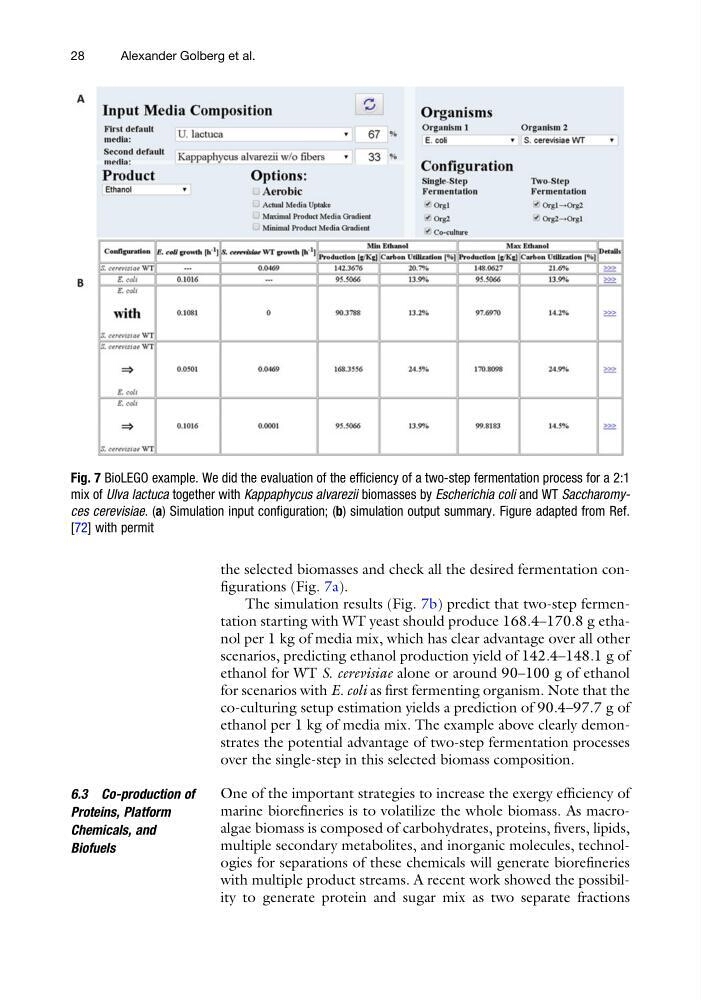
the selected biomasses and check all the desired fermentation configurations (Fig. 7a).
The simulation results (Fig. 7b) predict that two-step fermentation starting with WT yeast should produce 168.4–170.8 g ethanol per 1 kg of media mix, which has clear advantage over all other
scenarios, predicting ethanol production yield of 142.4–148.1 g of
ethanol for WT S. cerevisiae alone or around 90–100 g of ethanol
for scenarios with E. coli as first fermenting organism. Note that the
co-culturing setup estimation yields a prediction of 90.4–97.7 g of
ethanol per 1 kg of media mix. The example above clearly demonstrates the potential advantage of two-step fermentation processes
over the single-step in this selected biomass composition.
6.3 Co-production of
Proteins, Platform
Chemicals, and
Biofuels
One of the important strategies to increase the exergy efficiency of
marine biorefineries is to volatilize the whole biomass. As macroalgae biomass is composed of carbohydrates, proteins, fivers, lipids,
multiple secondary metabolites, and inorganic molecules, technologies for separations of these chemicals will generate biorefineries
with multiple product streams. A recent work showed the possibility to generate protein and sugar mix as two separate fractions
Fig. 7 BioLEGO example. We did the evaluation of the efficiency of a two-step fermentation process for a 2:1
mix of Ulva lactuca together with Kappaphycus alvarezii biomasses by Escherichia coli and WT Saccharomyces cerevisiae. (a) Simulation input configuration; (b) simulation output summary. Figure adapted from Ref.
[72] with permit
28
Alexander Golberg et al.
The simulation results (Fig. 7b) predict that two-step fermentation starting with WT yeast should produce 168.4–170.8 g ethanol per 1 kg of media mix, which has clear advantage over all other
scenarios, predicting ethanol production yield of 142.4–148.1 g of
ethanol for WT S. cerevisiae alone or around 90–100 g of ethanol
for scenarios with E. coli as first fermenting organism. Note that the
co-culturing setup estimation yields a prediction of 90.4–97.7 g of
ethanol per 1 kg of media mix. The example above clearly demonstrates the potential advantage of two-step fermentation processes
over the single-step in this selected biomass composition.
6.3 Co-production of
Proteins, Platform
Chemicals, and
Biofuels
One of the important strategies to increase the exergy efficiency of
marine biorefineries is to volatilize the whole biomass. As macroalgae biomass is composed of carbohydrates, proteins, fivers, lipids,
multiple secondary metabolites, and inorganic molecules, technologies for separations of these chemicals will generate biorefineries
with multiple product streams. A recent work showed the possibility to generate protein and sugar mix as two separate fractions
Fig. 7 BioLEGO example. We did the evaluation of the efficiency of a two-step fermentation process for a 2:1
mix of Ulva lactuca together with Kappaphycus alvarezii biomasses by Escherichia coli and WT Saccharomyces cerevisiae. (a) Simulation input configuration; (b) simulation output summary. Figure adapted from Ref.
[72] with permit
28
Alexander Golberg et al.