

3.3.3 Eco-exergy
Currents
The term eco-exergy was developed in ecology [33]. The concept
of eco-exergy was first applied to ecology in 1970s [34, 35] and the
last four decades led to the formulation of the “maximum exergy
principle in ecology,” which described the formation of biodiverse
communities in terms of thermodynamics [36]. Eco-exergy has
been used in ecology to express emergent properties of ecosystems
arising from self-organization processes in the evolution of their
development [37]. Exergy has also been used as an objective function in ecological models to assess the changes and concentrations
of various species in the ecosystem under stress [36].
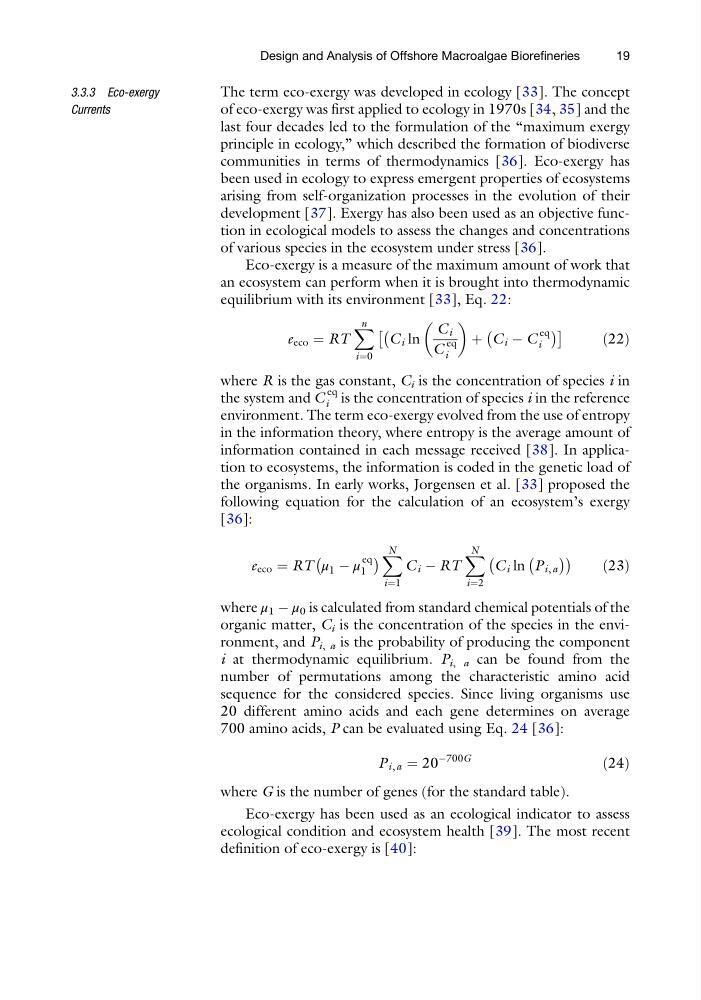
Eco-exergy is a measure of the maximum amount of work that
an ecosystem can perform when it is brought into thermodynamic
equilibrium with its environment [33], Eq. 22:
e eco ¼ RT
X n
i¼0
ÂÀ
C i ln
C i
C
eq
i
þ C i À C
eq
i
À
Á Ã
ð22Þ
where R is the gas constant, C i is the concentration of species i in
the system and C
eq
i is the concentration of species i in the reference
environment. The term eco-exergy evolved from the use of entropy
in the information theory, where entropy is the average amount of
information contained in each message received [38]. In application to ecosystems, the information is coded in the genetic load of
the organisms. In early works, Jorgensen et al. [33] proposed the
following equation for the calculation of an ecosystem’s exergy
[36]:
e eco ¼ RT μ 1 À μ
eq
1
À
Á X N
i¼1
C i À RT
X N
i¼2
C i ln P i, a
À
Á
À
Á
ð23Þ
where μ 1 À μ 0 is calculated from standard chemical potentials of the
organic matter, C i is the concentration of the species in the environment, and P i, a is the probability of producing the component
i at thermodynamic equilibrium. P i, a can be found from the
number of permutations among the characteristic amino acid
sequence for the considered species. Since living organisms use
20 different amino acids and each gene determines on average
700 amino acids, P can be evaluated using Eq. 24 [36]:
P i, a ¼ 20
À700G
ð24Þ
where G is the number of genes (for the standard table).
Eco-exergy has been used as an ecological indicator to assess
ecological condition and ecosystem health [39]. The most recent
definition of eco-exergy is [40]:
Design and Analysis of Offshore Macroalgae Biorefineries
19
Currents
The term eco-exergy was developed in ecology [33]. The concept
of eco-exergy was first applied to ecology in 1970s [34, 35] and the
last four decades led to the formulation of the “maximum exergy
principle in ecology,” which described the formation of biodiverse
communities in terms of thermodynamics [36]. Eco-exergy has
been used in ecology to express emergent properties of ecosystems
arising from self-organization processes in the evolution of their
development [37]. Exergy has also been used as an objective function in ecological models to assess the changes and concentrations
of various species in the ecosystem under stress [36].
Eco-exergy is a measure of the maximum amount of work that
an ecosystem can perform when it is brought into thermodynamic
equilibrium with its environment [33], Eq. 22:
e eco ¼ RT
X n
i¼0
ÂÀ
C i ln
C i
C
eq
i
þ C i À C
eq
i
À
Á Ã
ð22Þ
where R is the gas constant, C i is the concentration of species i in
the system and C
eq
i is the concentration of species i in the reference
environment. The term eco-exergy evolved from the use of entropy
in the information theory, where entropy is the average amount of
information contained in each message received [38]. In application to ecosystems, the information is coded in the genetic load of
the organisms. In early works, Jorgensen et al. [33] proposed the
following equation for the calculation of an ecosystem’s exergy
[36]:
e eco ¼ RT μ 1 À μ
eq
1
À
Á X N
i¼1
C i À RT
X N
i¼2
C i ln P i, a
À
Á
À
Á
ð23Þ
where μ 1 À μ 0 is calculated from standard chemical potentials of the
organic matter, C i is the concentration of the species in the environment, and P i, a is the probability of producing the component
i at thermodynamic equilibrium. P i, a can be found from the
number of permutations among the characteristic amino acid
sequence for the considered species. Since living organisms use
20 different amino acids and each gene determines on average
700 amino acids, P can be evaluated using Eq. 24 [36]:
P i, a ¼ 20
À700G
ð24Þ
where G is the number of genes (for the standard table).
Eco-exergy has been used as an ecological indicator to assess
ecological condition and ecosystem health [39]. The most recent
definition of eco-exergy is [40]:
Design and Analysis of Offshore Macroalgae Biorefineries
19