

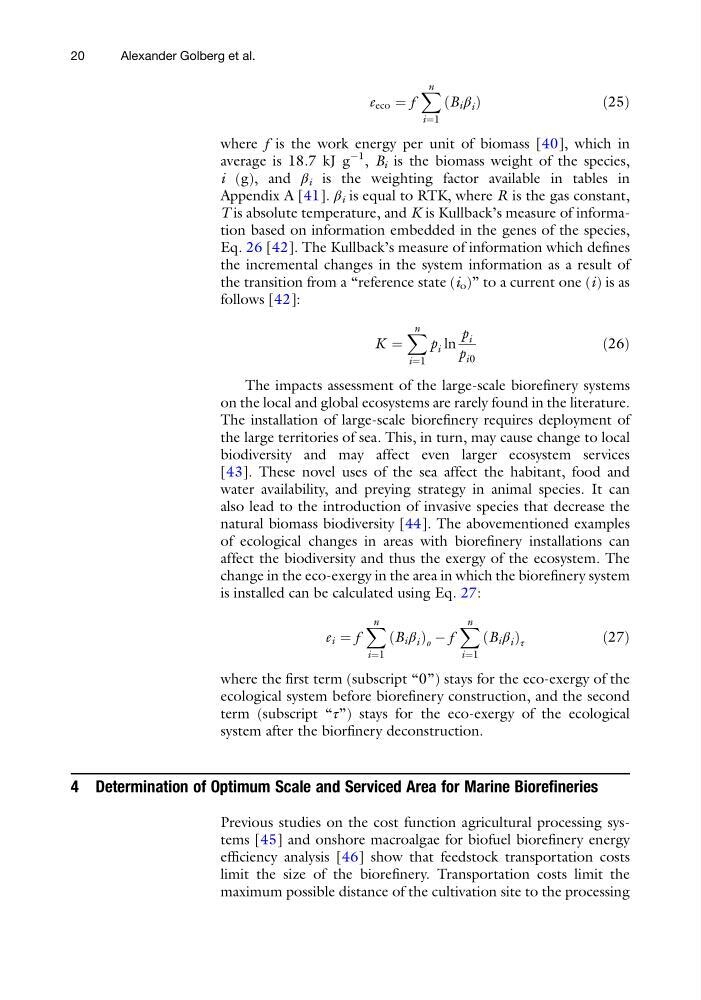
e eco ¼ f
X n
i¼1
B i β i
ð
Þ
ð25Þ
where f is the work energy per unit of biomass [40], which in
average is 18.7 kJ g
À1 , B i is the biomass weight of the species,
i (g), and β i is the weighting factor available in tables in
Appendix A [41]. β i is equal to RTK, where R is the gas constant,
T is absolute temperature, and K is Kullback’s measure of information based on information embedded in the genes of the species,
Eq. 26 [42]. The Kullback’s measure of information which defines
the incremental changes in the system information as a result of
the transition from a “reference state (i o )” to a current one (i) is as
follows [42]:
K ¼
X n
i¼1
p i ln
p i
p i0
ð26Þ
The impacts assessment of the large-scale biorefinery systems
on the local and global ecosystems are rarely found in the literature.
The installation of large-scale biorefinery requires deployment of
the large territories of sea. This, in turn, may cause change to local
biodiversity and may affect even larger ecosystem services
[43]. These novel uses of the sea affect the habitant, food and
water availability, and preying strategy in animal species. It can
also lead to the introduction of invasive species that decrease the
natural biomass biodiversity [44]. The abovementioned examples
of ecological changes in areas with biorefinery installations can
affect the biodiversity and thus the exergy of the ecosystem. The
change in the eco-exergy in the area in which the biorefinery system
is installed can be calculated using Eq. 27:
e i ¼ f
X n
i¼1
B i β i
ð
Þ o À f
X n
i¼1
B i β i
ð
Þ τ
ð27Þ
where the first term (subscript “0”) stays for the eco-exergy of the
ecological system before biorefinery construction, and the second
term (subscript “τ”) stays for the eco-exergy of the ecological
system after the biorfinery deconstruction.
4 Determination of Optimum Scale and Serviced Area for Marine Biorefineries
Previous studies on the cost function agricultural processing systems [45] and onshore macroalgae for biofuel biorefinery energy
efficiency analysis [46] show that feedstock transportation costs
limit the size of the biorefinery. Transportation costs limit the
maximum possible distance of the cultivation site to the processing
20
Alexander Golberg et al.
X n
i¼1
B i β i
ð
Þ
ð25Þ
where f is the work energy per unit of biomass [40], which in
average is 18.7 kJ g
À1 , B i is the biomass weight of the species,
i (g), and β i is the weighting factor available in tables in
Appendix A [41]. β i is equal to RTK, where R is the gas constant,
T is absolute temperature, and K is Kullback’s measure of information based on information embedded in the genes of the species,
Eq. 26 [42]. The Kullback’s measure of information which defines
the incremental changes in the system information as a result of
the transition from a “reference state (i o )” to a current one (i) is as
follows [42]:
K ¼
X n
i¼1
p i ln
p i
p i0
ð26Þ
The impacts assessment of the large-scale biorefinery systems
on the local and global ecosystems are rarely found in the literature.
The installation of large-scale biorefinery requires deployment of
the large territories of sea. This, in turn, may cause change to local
biodiversity and may affect even larger ecosystem services
[43]. These novel uses of the sea affect the habitant, food and
water availability, and preying strategy in animal species. It can
also lead to the introduction of invasive species that decrease the
natural biomass biodiversity [44]. The abovementioned examples
of ecological changes in areas with biorefinery installations can
affect the biodiversity and thus the exergy of the ecosystem. The
change in the eco-exergy in the area in which the biorefinery system
is installed can be calculated using Eq. 27:
e i ¼ f
X n
i¼1
B i β i
ð
Þ o À f
X n
i¼1
B i β i
ð
Þ τ
ð27Þ
where the first term (subscript “0”) stays for the eco-exergy of the
ecological system before biorefinery construction, and the second
term (subscript “τ”) stays for the eco-exergy of the ecological
system after the biorfinery deconstruction.
4 Determination of Optimum Scale and Serviced Area for Marine Biorefineries
Previous studies on the cost function agricultural processing systems [45] and onshore macroalgae for biofuel biorefinery energy
efficiency analysis [46] show that feedstock transportation costs
limit the size of the biorefinery. Transportation costs limit the
maximum possible distance of the cultivation site to the processing
20
Alexander Golberg et al.