

η opt ¼
KE
ÀE
2dK
dη À K
2dE
dη
1=2
ð18Þ
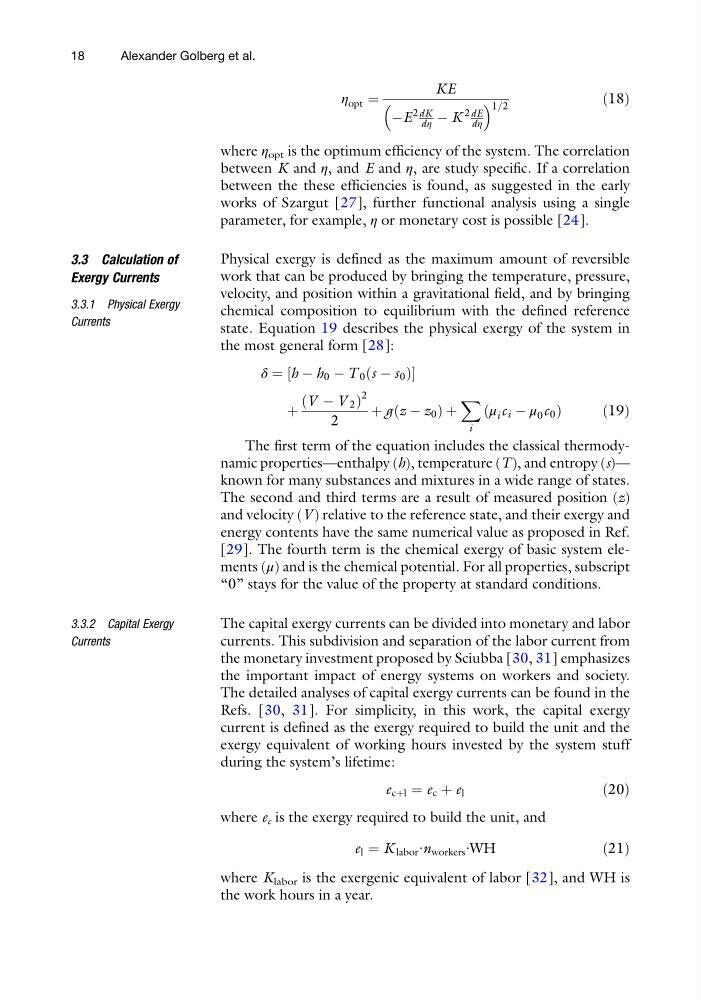
where η opt is the optimum efficiency of the system. The correlation
between K and η, and E and η, are study specific. If a correlation
between the these efficiencies is found, as suggested in the early
works of Szargut [27], further functional analysis using a single
parameter, for example, η or monetary cost is possible [24].
3.3 Calculation of
Exergy Currents
3.3.1 Physical Exergy
Currents
Physical exergy is defined as the maximum amount of reversible
work that can be produced by bringing the temperature, pressure,
velocity, and position within a gravitational field, and by bringing
chemical composition to equilibrium with the defined reference
state. Equation 19 describes the physical exergy of the system in
the most general form [28]:
δ ¼ h À h 0 À T 0 s À s 0
ð
Þ
½
þ
V À V 2
ð
Þ
2
2
þ g z À z 0
ð
Þþ
X
i
μ i c i À μ 0 c 0
ð
Þ
ð 19Þ
The first term of the equation includes the classical thermodynamic properties—enthalpy (h), temperature (T), and entropy (s)—
known for many substances and mixtures in a wide range of states.
The second and third terms are a result of measured position (z)
and velocity (V) relative to the reference state, and their exergy and
energy contents have the same numerical value as proposed in Ref.
[29]. The fourth term is the chemical exergy of basic system elements (μ) and is the chemical potential. For all properties, subscript
“0” stays for the value of the property at standard conditions.
3.3.2 Capital Exergy
Currents
The capital exergy currents can be divided into monetary and labor
currents. This subdivision and separation of the labor current from
the monetary investment proposed by Sciubba [30, 31] emphasizes
the important impact of energy systems on workers and society.
The detailed analyses of capital exergy currents can be found in the
Refs. [30, 31]. For simplicity, in this work, the capital exergy
current is defined as the exergy required to build the unit and the
exergy equivalent of working hours invested by the system stuff
during the system’s lifetime:
e cþl ¼ e c þ e l
ð20Þ
where e c is the exergy required to build the unit, and
e l ¼ K labor ∙n workers ∙WH
ð21Þ
where K labor is the exergenic equivalent of labor [32], and WH is
the work hours in a year.
18
Alexander Golberg et al.
KE
ÀE
2dK
dη À K
2dE
dη
1=2
ð18Þ
where η opt is the optimum efficiency of the system. The correlation
between K and η, and E and η, are study specific. If a correlation
between the these efficiencies is found, as suggested in the early
works of Szargut [27], further functional analysis using a single
parameter, for example, η or monetary cost is possible [24].
3.3 Calculation of
Exergy Currents
3.3.1 Physical Exergy
Currents
Physical exergy is defined as the maximum amount of reversible
work that can be produced by bringing the temperature, pressure,
velocity, and position within a gravitational field, and by bringing
chemical composition to equilibrium with the defined reference
state. Equation 19 describes the physical exergy of the system in
the most general form [28]:
δ ¼ h À h 0 À T 0 s À s 0
ð
Þ
½
þ
V À V 2
ð
Þ
2
2
þ g z À z 0
ð
Þþ
X
i
μ i c i À μ 0 c 0
ð
Þ
ð 19Þ
The first term of the equation includes the classical thermodynamic properties—enthalpy (h), temperature (T), and entropy (s)—
known for many substances and mixtures in a wide range of states.
The second and third terms are a result of measured position (z)
and velocity (V) relative to the reference state, and their exergy and
energy contents have the same numerical value as proposed in Ref.
[29]. The fourth term is the chemical exergy of basic system elements (μ) and is the chemical potential. For all properties, subscript
“0” stays for the value of the property at standard conditions.
3.3.2 Capital Exergy
Currents
The capital exergy currents can be divided into monetary and labor
currents. This subdivision and separation of the labor current from
the monetary investment proposed by Sciubba [30, 31] emphasizes
the important impact of energy systems on workers and society.
The detailed analyses of capital exergy currents can be found in the
Refs. [30, 31]. For simplicity, in this work, the capital exergy
current is defined as the exergy required to build the unit and the
exergy equivalent of working hours invested by the system stuff
during the system’s lifetime:
e cþl ¼ e c þ e l
ð20Þ
where e c is the exergy required to build the unit, and
e l ¼ K labor ∙n workers ∙WH
ð21Þ
where K labor is the exergenic equivalent of labor [32], and WH is
the work hours in a year.
18
Alexander Golberg et al.