

where macroalgae biomass growth rate (μ) is calculated based on its
maximum possible growth rate (μ max ), as a function of light intensity (I), temperature (T), salinity (S) nutrients (N and P for nitrate
and phosphate, respectively), and respiration rate (r resp ).
In this model, we assume that each of the factors has a separate
impact on the biomass growth rate. Therefore, the approximated
function for biomass growth rate appears in Eq. 2:
μ ¼ μ max ∙f I
ð Þ∙f T
ð Þ∙f S
ð Þ∙f N
ð Þ∙f P
ð Þ À r resp
ð2Þ
where μ max (which is a function of the stocking density [10]) is
maximum growth rate, and r resp the respiration rate (d
À1 ) is defined
as [11–13]:
r resp¼ r resp ref θ
T ÀT ref
ð3Þ
where r resp_ref is the maximum respiration rate at reference temperature (T,
C), and θ is the empirical factor. The function f(I, T, S, N,
P) is defined as follows in Eqs. 4–8:
f I
ð Þ ¼
I
I opt
e
1À
I
I opt
ð4Þ
where I is the light intensity at time (t) and I opt is the optimum light
intensity for specific species biomass accumulation.
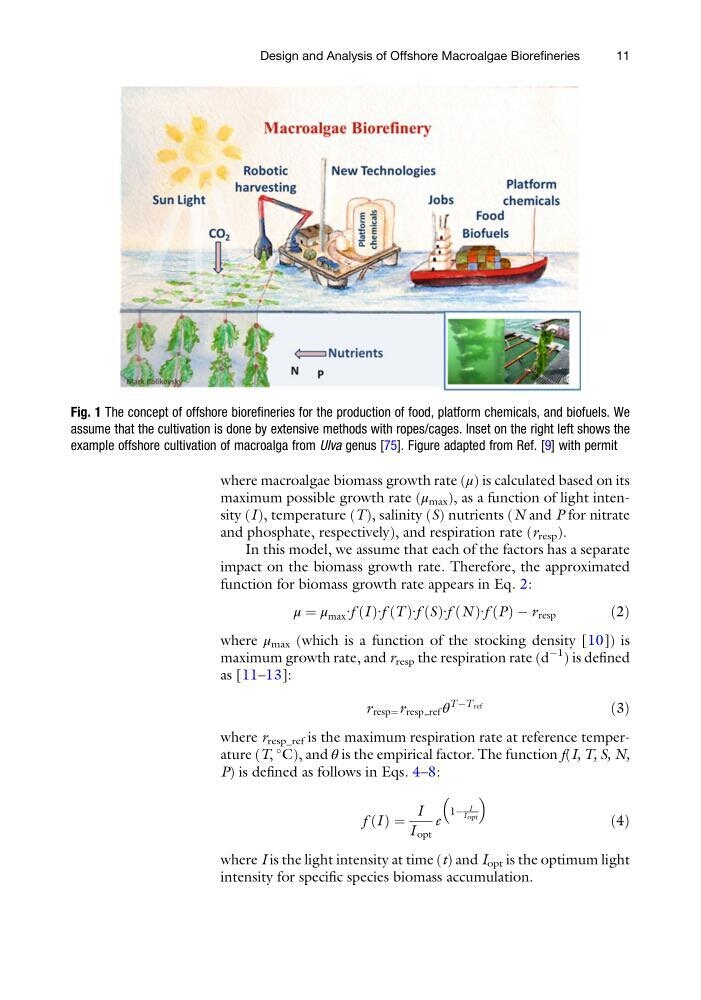
Fig. 1 The concept of offshore biorefineries for the production of food, platform chemicals, and biofuels. We
assume that the cultivation is done by extensive methods with ropes/cages. Inset on the right left shows the
example offshore cultivation of macroalga from Ulva genus [75]. Figure adapted from Ref. [9] with permit
Design and Analysis of Offshore Macroalgae Biorefineries
11
maximum possible growth rate (μ max ), as a function of light intensity (I), temperature (T), salinity (S) nutrients (N and P for nitrate
and phosphate, respectively), and respiration rate (r resp ).
In this model, we assume that each of the factors has a separate
impact on the biomass growth rate. Therefore, the approximated
function for biomass growth rate appears in Eq. 2:
μ ¼ μ max ∙f I
ð Þ∙f T
ð Þ∙f S
ð Þ∙f N
ð Þ∙f P
ð Þ À r resp
ð2Þ
where μ max (which is a function of the stocking density [10]) is
maximum growth rate, and r resp the respiration rate (d
À1 ) is defined
as [11–13]:
r resp¼ r resp ref θ
T ÀT ref
ð3Þ
where r resp_ref is the maximum respiration rate at reference temperature (T,
C), and θ is the empirical factor. The function f(I, T, S, N,
P) is defined as follows in Eqs. 4–8:
f I
ð Þ ¼
I
I opt
e
1À
I
I opt
ð4Þ
where I is the light intensity at time (t) and I opt is the optimum light
intensity for specific species biomass accumulation.
Fig. 1 The concept of offshore biorefineries for the production of food, platform chemicals, and biofuels. We
assume that the cultivation is done by extensive methods with ropes/cages. Inset on the right left shows the
example offshore cultivation of macroalga from Ulva genus [75]. Figure adapted from Ref. [9] with permit
Design and Analysis of Offshore Macroalgae Biorefineries
11