

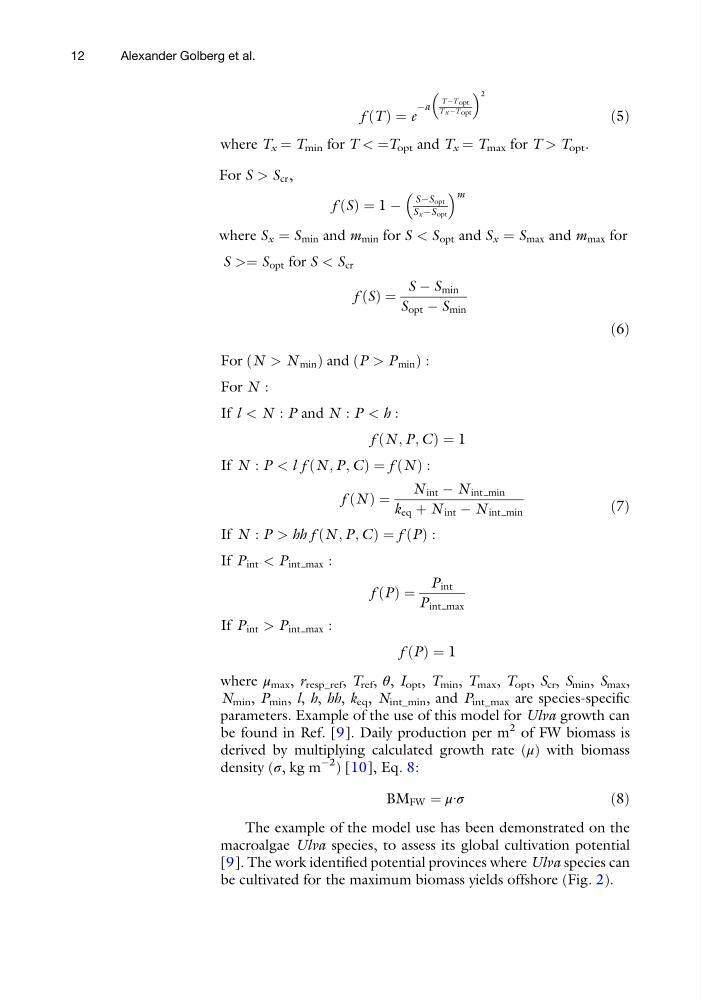
f T
ð Þ ¼ e
Àa
T ÀT opt
T x ÀT opt
2
ð5Þ
where T x ¼ T min for T < ¼T opt and T x ¼ T max for T > T opt .
For S > S cr ,
f S
ð Þ ¼ 1 À
SÀS opt
S x ÀS opt
m
where S x ¼ S min and m min for S < S opt and S x ¼ S max and m max for
S >¼ S opt for S < S cr
f S
ð Þ ¼
S À S min
S opt À S min
ð6Þ
For N > N min
ð
Þand P > P min
ð
Þ:
For N :
If l < N : P and N : P < h :
f N; P; C
ð
Þ¼1
If N : P < l f N ; P; C
ð
Þ¼f N
ð Þ :
f N
ð Þ ¼
N int À N int min
k eq þ N int À N int min
If N : P > hh f N ; P; C
ð
Þ¼f P
ð Þ :
If P int < P int max :
f P
ð Þ ¼
P int
P int max
If P int > P int max :
f P
ð Þ ¼ 1
ð7Þ
where μ max , r resp_ref , T ref , θ, I opt , T min , T max , T opt , S cr , S min , S max ,
N min , P min , l, h, hh, k eq , N int_min , and P int_max are species-specific
parameters. Example of the use of this model for Ulva growth can
be found in Ref. [9]. Daily production per m
2 of FW biomass is
derived by multiplying calculated growth rate (μ) with biomass
density (σ, kg m
À2 ) [10], Eq. 8:
BM FW ¼ μ∙σ
ð8Þ
The example of the model use has been demonstrated on the
macroalgae Ulva species, to assess its global cultivation potential
[9]. The work identified potential provinces where Ulva species can
be cultivated for the maximum biomass yields offshore (Fig. 2).
12
Alexander Golberg et al.
ð Þ ¼ e
Àa
T ÀT opt
T x ÀT opt
2
ð5Þ
where T x ¼ T min for T < ¼T opt and T x ¼ T max for T > T opt .
For S > S cr ,
f S
ð Þ ¼ 1 À
SÀS opt
S x ÀS opt
m
where S x ¼ S min and m min for S < S opt and S x ¼ S max and m max for
S >¼ S opt for S < S cr
f S
ð Þ ¼
S À S min
S opt À S min
ð6Þ
For N > N min
ð
Þand P > P min
ð
Þ:
For N :
If l < N : P and N : P < h :
f N; P; C
ð
Þ¼1
If N : P < l f N ; P; C
ð
Þ¼f N
ð Þ :
f N
ð Þ ¼
N int À N int min
k eq þ N int À N int min
If N : P > hh f N ; P; C
ð
Þ¼f P
ð Þ :
If P int < P int max :
f P
ð Þ ¼
P int
P int max
If P int > P int max :
f P
ð Þ ¼ 1
ð7Þ
where μ max , r resp_ref , T ref , θ, I opt , T min , T max , T opt , S cr , S min , S max ,
N min , P min , l, h, hh, k eq , N int_min , and P int_max are species-specific
parameters. Example of the use of this model for Ulva growth can
be found in Ref. [9]. Daily production per m
2 of FW biomass is
derived by multiplying calculated growth rate (μ) with biomass
density (σ, kg m
À2 ) [10], Eq. 8:
BM FW ¼ μ∙σ
ð8Þ
The example of the model use has been demonstrated on the
macroalgae Ulva species, to assess its global cultivation potential
[9]. The work identified potential provinces where Ulva species can
be cultivated for the maximum biomass yields offshore (Fig. 2).
12
Alexander Golberg et al.