

growth rates. However, the real scale implementation of microalgae
systems for bioenergy and commodity chemicals production is
limited today by costs associated with reactor construction and
maintenance, contamination, and energy required for separation
of these single cell organisms from water [3].
Alternative sources for biorefineries are macroalgae
(or seaweeds). Macroalgae have been harvested throughout the
world as a food source and as a commodity for the production of
hydrocolloids for centuries. However, to date macroalgae still present only a tiny percent of the global biomass supply of ~17 Â 10
6
fresh weight (FW) ton of macroalgae in comparison to 16 Â 10
11
tons of terrestrial crops, grasses, and forests [4–6]. A recent expanding body of evidence suggests that offshore cultivated macroalgae,
which contain very little lignin—a major problem molecule in the
processing of terrestrial biomass—and do not compete with food
crops for arable land or potable water, can provide an alternative
source of biomass for sustainable production of food, chemicals,
and fuels [4, 7, 8].
2 Marine Biorefinery System
Marine biorefinery adheres to the Merriam-Webster dictionary
definition of a system: “a set of interacting or interdependent component parts forming a complex/intricate whole, which property
is different from the properties of its individual components.”
A concept of an offshore marine biorefinery, shown in Fig. 1, is a
complex system. Systematic design of its components requires:
l
Determination of the optimum location
l
System design to function in the chosen location
l
System integration within natural environment
l
Cultivation platform design—upstream processing
l
Conversion processes—downstream processes
l
Analysis of social and environmental impacts
Determination of the optimum marine biorefinery location is
predicated by environmental and socioeconomic conditions. Environmental conditions are numerous and include the conditions for
macroalgae growth and risks. Assessment of offshore locations for
cultivation suitability is an expensive and time-consuming task. For
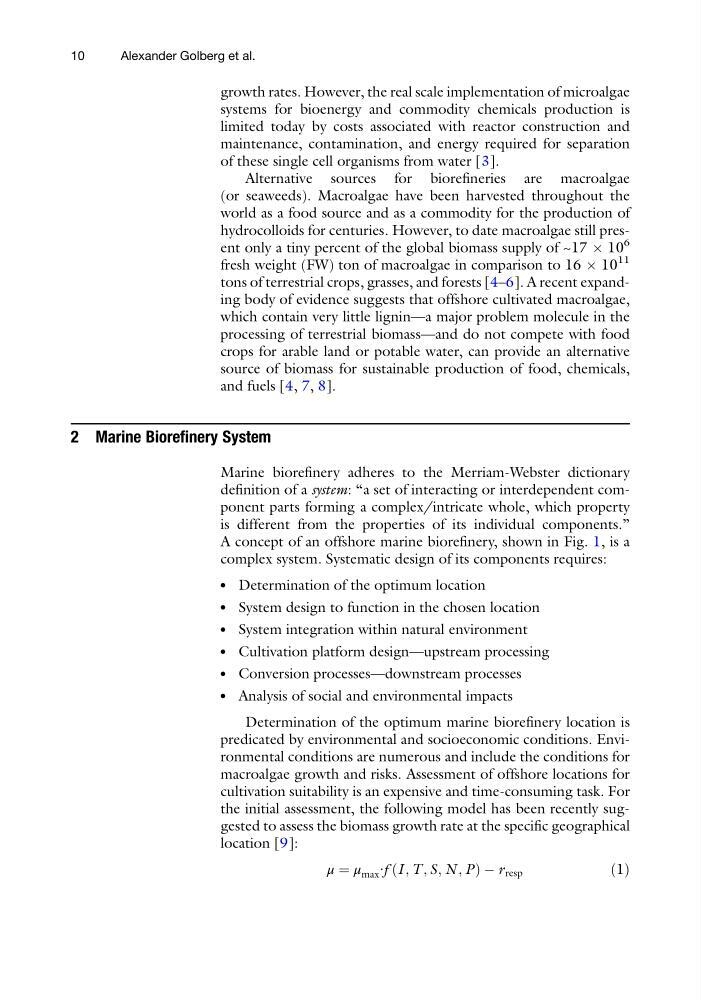
the initial assessment, the following model has been recently suggested to assess the biomass growth rate at the specific geographical
location [9]:
μ ¼ μ max ∙f I; T ; S; N ; P
ð
ÞÀr resp
ð1Þ
10
Alexander Golberg et al.
systems for bioenergy and commodity chemicals production is
limited today by costs associated with reactor construction and
maintenance, contamination, and energy required for separation
of these single cell organisms from water [3].
Alternative sources for biorefineries are macroalgae
(or seaweeds). Macroalgae have been harvested throughout the
world as a food source and as a commodity for the production of
hydrocolloids for centuries. However, to date macroalgae still present only a tiny percent of the global biomass supply of ~17 Â 10
6
fresh weight (FW) ton of macroalgae in comparison to 16 Â 10
11
tons of terrestrial crops, grasses, and forests [4–6]. A recent expanding body of evidence suggests that offshore cultivated macroalgae,
which contain very little lignin—a major problem molecule in the
processing of terrestrial biomass—and do not compete with food
crops for arable land or potable water, can provide an alternative
source of biomass for sustainable production of food, chemicals,
and fuels [4, 7, 8].
2 Marine Biorefinery System
Marine biorefinery adheres to the Merriam-Webster dictionary
definition of a system: “a set of interacting or interdependent component parts forming a complex/intricate whole, which property
is different from the properties of its individual components.”
A concept of an offshore marine biorefinery, shown in Fig. 1, is a
complex system. Systematic design of its components requires:
l
Determination of the optimum location
l
System design to function in the chosen location
l
System integration within natural environment
l
Cultivation platform design—upstream processing
l
Conversion processes—downstream processes
l
Analysis of social and environmental impacts
Determination of the optimum marine biorefinery location is
predicated by environmental and socioeconomic conditions. Environmental conditions are numerous and include the conditions for
macroalgae growth and risks. Assessment of offshore locations for
cultivation suitability is an expensive and time-consuming task. For
the initial assessment, the following model has been recently suggested to assess the biomass growth rate at the specific geographical
location [9]:
μ ¼ μ max ∙f I; T ; S; N ; P
ð
ÞÀr resp
ð1Þ
10
Alexander Golberg et al.