

References
1. Gimpel JA, Henrı ´quez V, Mayfield SP (2015)
In metabolic engineering of eukaryotic microalgae: potential and challenges come with great
diversity. Front Microbiol 6:1376
2. Stephens E et al (2010) An economic and
technical evaluation of microalgal biofuels.
Nat Biotechnol 28(2):126
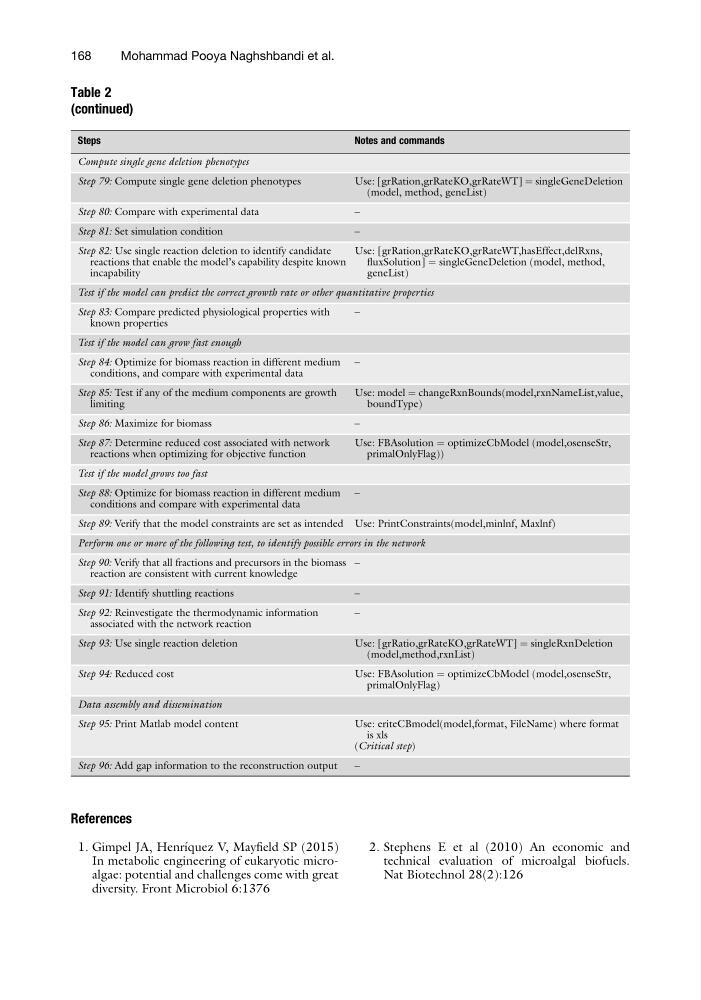
Table 2
(continued)
Steps
Notes and commands
Compute single gene deletion phenotypes
Step 79: Compute single gene deletion phenotypes
Use: [grRation,grRateKO,grRateWT] ¼ singleGeneDeletion
(model, method, geneList)
Step 80: Compare with experimental data
–
Step 81: Set simulation condition
–
Step 82: Use single reaction deletion to identify candidate
reactions that enable the model’s capability despite known
incapability
Use: [grRation,grRateKO,grRateWT,hasEffect,delRxns,
fluxSolution] ¼ singleGeneDeletion (model, method,
geneList)
Test if the model can predict the correct growth rate or other quantitative properties
Step 83: Compare predicted physiological properties with
known properties
–
Test if the model can grow fast enough
Step 84: Optimize for biomass reaction in different medium
conditions, and compare with experimental data
–
Step 85: Test if any of the medium components are growth
limiting
Use: model ¼ changeRxnBounds(model,rxnNameList,value,
boundType)
Step 86: Maximize for biomass
–
Step 87: Determine reduced cost associated with network
reactions when optimizing for objective function
Use: FBAsolution ¼ optimizeCbModel (model,osenseStr,
primalOnlyFlag))
Test if the model grows too fast
Step 88: Optimize for biomass reaction in different medium
conditions and compare with experimental data
–
Step 89: Verify that the model constraints are set as intended Use: PrintConstraints(model,minlnf, Maxlnf)
Perform one or more of the following test, to identify possible errors in the network
Step 90: Verify that all fractions and precursors in the biomass
reaction are consistent with current knowledge
–
Step 91: Identify shuttling reactions
–
Step 92: Reinvestigate the thermodynamic information
associated with the network reaction
–
Step 93: Use single reaction deletion
Use: [grRatio,grRateKO,grRateWT] ¼ singleRxnDeletion
(model,method,rxnList)
Step 94: Reduced cost
Use: FBAsolution ¼ optimizeCbModel (model,osenseStr,
primalOnlyFlag)
Data assembly and dissemination
Step 95: Print Matlab model content
Use: eriteCBmodel(model,format, FileName) where format
is xls
(Critical step)
Step 96: Add gap information to the reconstruction output
–
168
Mohammad Pooya Naghshbandi et al.
1. Gimpel JA, Henrı ´quez V, Mayfield SP (2015)
In metabolic engineering of eukaryotic microalgae: potential and challenges come with great
diversity. Front Microbiol 6:1376
2. Stephens E et al (2010) An economic and
technical evaluation of microalgal biofuels.
Nat Biotechnol 28(2):126
Table 2
(continued)
Steps
Notes and commands
Compute single gene deletion phenotypes
Step 79: Compute single gene deletion phenotypes
Use: [grRation,grRateKO,grRateWT] ¼ singleGeneDeletion
(model, method, geneList)
Step 80: Compare with experimental data
–
Step 81: Set simulation condition
–
Step 82: Use single reaction deletion to identify candidate
reactions that enable the model’s capability despite known
incapability
Use: [grRation,grRateKO,grRateWT,hasEffect,delRxns,
fluxSolution] ¼ singleGeneDeletion (model, method,
geneList)
Test if the model can predict the correct growth rate or other quantitative properties
Step 83: Compare predicted physiological properties with
known properties
–
Test if the model can grow fast enough
Step 84: Optimize for biomass reaction in different medium
conditions, and compare with experimental data
–
Step 85: Test if any of the medium components are growth
limiting
Use: model ¼ changeRxnBounds(model,rxnNameList,value,
boundType)
Step 86: Maximize for biomass
–
Step 87: Determine reduced cost associated with network
reactions when optimizing for objective function
Use: FBAsolution ¼ optimizeCbModel (model,osenseStr,
primalOnlyFlag))
Test if the model grows too fast
Step 88: Optimize for biomass reaction in different medium
conditions and compare with experimental data
–
Step 89: Verify that the model constraints are set as intended Use: PrintConstraints(model,minlnf, Maxlnf)
Perform one or more of the following test, to identify possible errors in the network
Step 90: Verify that all fractions and precursors in the biomass
reaction are consistent with current knowledge
–
Step 91: Identify shuttling reactions
–
Step 92: Reinvestigate the thermodynamic information
associated with the network reaction
–
Step 93: Use single reaction deletion
Use: [grRatio,grRateKO,grRateWT] ¼ singleRxnDeletion
(model,method,rxnList)
Step 94: Reduced cost
Use: FBAsolution ¼ optimizeCbModel (model,osenseStr,
primalOnlyFlag)
Data assembly and dissemination
Step 95: Print Matlab model content
Use: eriteCBmodel(model,format, FileName) where format
is xls
(Critical step)
Step 96: Add gap information to the reconstruction output
–
168
Mohammad Pooya Naghshbandi et al.