

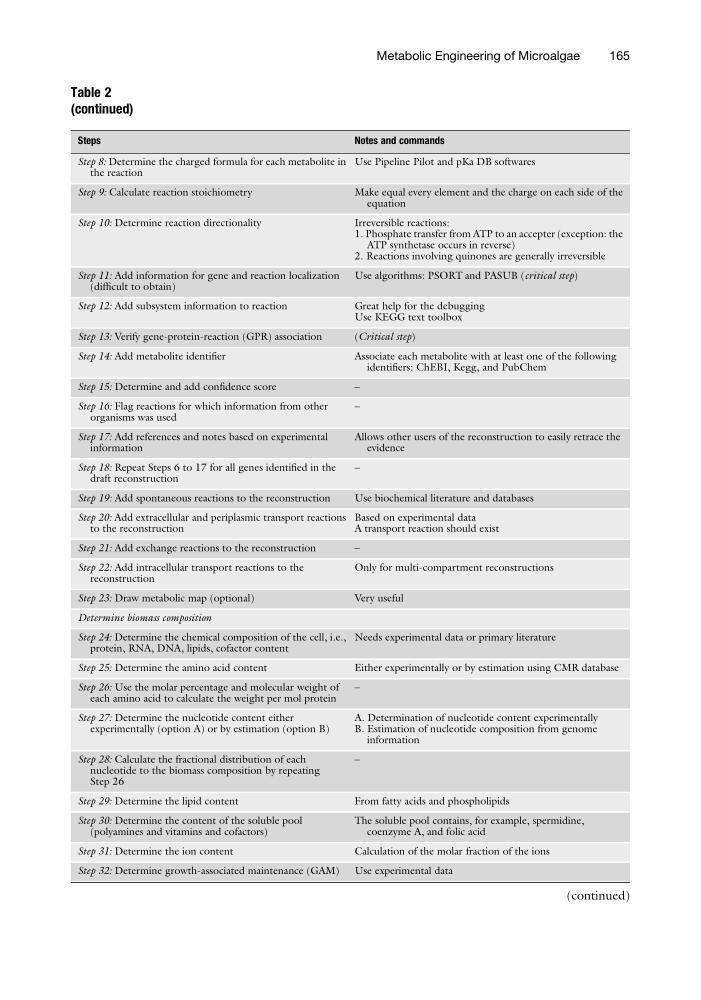
Table 2
(continued)
Steps
Notes and commands
Step 8: Determine the charged formula for each metabolite in
the reaction
Use Pipeline Pilot and pKa DB softwares
Step 9: Calculate reaction stoichiometry
Make equal every element and the charge on each side of the
equation
Step 10: Determine reaction directionality
Irreversible reactions:
1. Phosphate transfer from ATP to an accepter (exception: the
ATP synthetase occurs in reverse)
2. Reactions involving quinones are generally irreversible
Step 11: Add information for gene and reaction localization
(difficult to obtain)
Use algorithms: PSORT and PASUB (critical step)
Step 12: Add subsystem information to reaction
Great help for the debugging
Use KEGG text toolbox
Step 13: Verify gene-protein-reaction (GPR) association
(Critical step)
Step 14: Add metabolite identifier
Associate each metabolite with at least one of the following
identifiers: ChEBI, Kegg, and PubChem
Step 15: Determine and add confidence score
–
Step 16: Flag reactions for which information from other
organisms was used
–
Step 17: Add references and notes based on experimental
information
Allows other users of the reconstruction to easily retrace the
evidence
Step 18: Repeat Steps 6 to 17 for all genes identified in the
draft reconstruction
–
Step 19: Add spontaneous reactions to the reconstruction
Use biochemical literature and databases
Step 20: Add extracellular and periplasmic transport reactions
to the reconstruction
Based on experimental data
A transport reaction should exist
Step 21: Add exchange reactions to the reconstruction
–
Step 22: Add intracellular transport reactions to the
reconstruction
Only for multi-compartment reconstructions
Step 23: Draw metabolic map (optional)
Very useful
Determine biomass composition
Step 24: Determine the chemical composition of the cell, i.e.,
protein, RNA, DNA, lipids, cofactor content
Needs experimental data or primary literature
Step 25: Determine the amino acid content
Either experimentally or by estimation using CMR database
Step 26: Use the molar percentage and molecular weight of
each amino acid to calculate the weight per mol protein
–
Step 27: Determine the nucleotide content either
experimentally (option A) or by estimation (option B)
A. Determination of nucleotide content experimentally
B. Estimation of nucleotide composition from genome
information
Step 28: Calculate the fractional distribution of each
nucleotide to the biomass composition by repeating
Step 26
–
Step 29: Determine the lipid content
From fatty acids and phospholipids
Step 30: Determine the content of the soluble pool
(polyamines and vitamins and cofactors)
The soluble pool contains, for example, spermidine,
coenzyme A, and folic acid
Step 31: Determine the ion content
Calculation of the molar fraction of the ions
Step 32: Determine growth-associated maintenance (GAM) Use experimental data
(continued)
Metabolic Engineering of Microalgae
165
(continued)
Steps
Notes and commands
Step 8: Determine the charged formula for each metabolite in
the reaction
Use Pipeline Pilot and pKa DB softwares
Step 9: Calculate reaction stoichiometry
Make equal every element and the charge on each side of the
equation
Step 10: Determine reaction directionality
Irreversible reactions:
1. Phosphate transfer from ATP to an accepter (exception: the
ATP synthetase occurs in reverse)
2. Reactions involving quinones are generally irreversible
Step 11: Add information for gene and reaction localization
(difficult to obtain)
Use algorithms: PSORT and PASUB (critical step)
Step 12: Add subsystem information to reaction
Great help for the debugging
Use KEGG text toolbox
Step 13: Verify gene-protein-reaction (GPR) association
(Critical step)
Step 14: Add metabolite identifier
Associate each metabolite with at least one of the following
identifiers: ChEBI, Kegg, and PubChem
Step 15: Determine and add confidence score
–
Step 16: Flag reactions for which information from other
organisms was used
–
Step 17: Add references and notes based on experimental
information
Allows other users of the reconstruction to easily retrace the
evidence
Step 18: Repeat Steps 6 to 17 for all genes identified in the
draft reconstruction
–
Step 19: Add spontaneous reactions to the reconstruction
Use biochemical literature and databases
Step 20: Add extracellular and periplasmic transport reactions
to the reconstruction
Based on experimental data
A transport reaction should exist
Step 21: Add exchange reactions to the reconstruction
–
Step 22: Add intracellular transport reactions to the
reconstruction
Only for multi-compartment reconstructions
Step 23: Draw metabolic map (optional)
Very useful
Determine biomass composition
Step 24: Determine the chemical composition of the cell, i.e.,
protein, RNA, DNA, lipids, cofactor content
Needs experimental data or primary literature
Step 25: Determine the amino acid content
Either experimentally or by estimation using CMR database
Step 26: Use the molar percentage and molecular weight of
each amino acid to calculate the weight per mol protein
–
Step 27: Determine the nucleotide content either
experimentally (option A) or by estimation (option B)
A. Determination of nucleotide content experimentally
B. Estimation of nucleotide composition from genome
information
Step 28: Calculate the fractional distribution of each
nucleotide to the biomass composition by repeating
Step 26
–
Step 29: Determine the lipid content
From fatty acids and phospholipids
Step 30: Determine the content of the soluble pool
(polyamines and vitamins and cofactors)
The soluble pool contains, for example, spermidine,
coenzyme A, and folic acid
Step 31: Determine the ion content
Calculation of the molar fraction of the ions
Step 32: Determine growth-associated maintenance (GAM) Use experimental data
(continued)
Metabolic Engineering of Microalgae
165