

3. Carrying out random mutation and selection: unwanted,
unidentified, and random alterations could be accomplished
through these experiments.
4. Conducting target metabolic engineering.
Step 2: Systems Metabolic Engineering
1. High-throughput and genome-scale analysis
2. Integration of omics data
3. Modeling/simulation/network analysis
4. Prediction of engineering targets
5. Analysis of physiological performance
Step 3: Fermentation and Downstream Process
1. Medium and process optimization
2. Purification and recovery
3. Evaluation of product yield and productivity
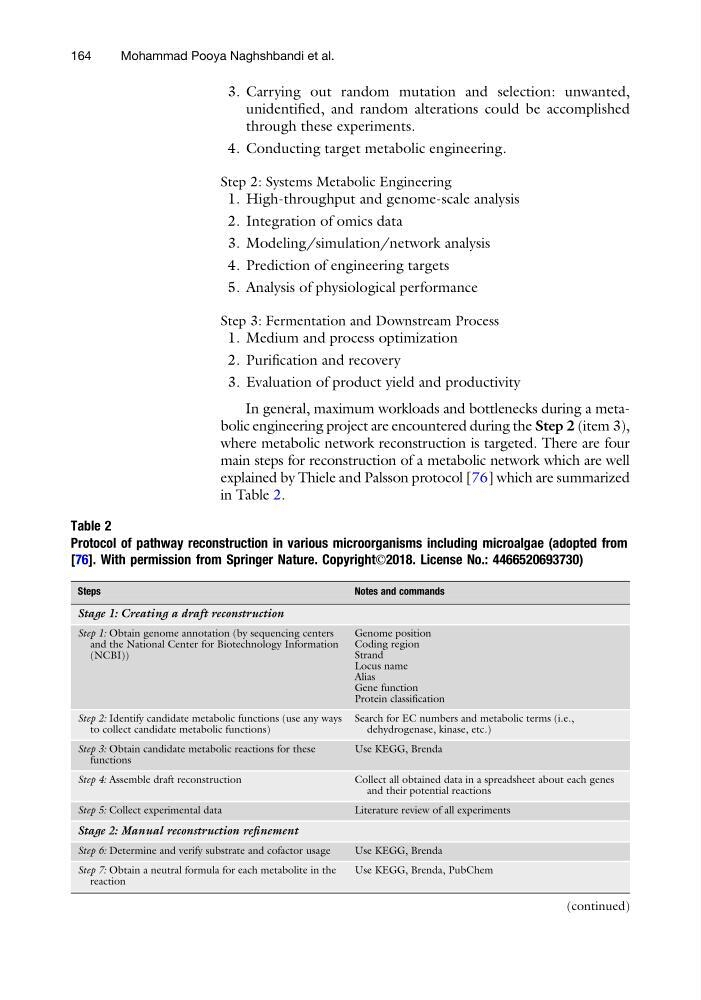
In general, maximum workloads and bottlenecks during a metabolic engineering project are encountered during the Step 2 (item 3),
where metabolic network reconstruction is targeted. There are four
main steps for reconstruction of a metabolic network which are well
explained by Thiele and Palsson protocol [76] which are summarized
in Table 2.
Table 2
Protocol of pathway reconstruction in various microorganisms including microalgae (adopted from
[76]. With permission from Springer Nature. Copyright©2018. License No.: 4466520693730)
Steps
Notes and commands
Stage 1: Creating a draft reconstruction
Step 1: Obtain genome annotation (by sequencing centers
and the National Center for Biotechnology Information
(NCBI))
Genome position
Coding region
Strand
Locus name
Alias
Gene function
Protein classification
Step 2: Identify candidate metabolic functions (use any ways
to collect candidate metabolic functions)
Search for EC numbers and metabolic terms (i.e.,
dehydrogenase, kinase, etc.)
Step 3: Obtain candidate metabolic reactions for these
functions
Use KEGG, Brenda
Step 4: Assemble draft reconstruction
Collect all obtained data in a spreadsheet about each genes
and their potential reactions
Step 5: Collect experimental data
Literature review of all experiments
Stage 2: Manual reconstruction refinement
Step 6: Determine and verify substrate and cofactor usage
Use KEGG, Brenda
Step 7: Obtain a neutral formula for each metabolite in the
reaction
Use KEGG, Brenda, PubChem
(continued)
164
Mohammad Pooya Naghshbandi et al.
unidentified, and random alterations could be accomplished
through these experiments.
4. Conducting target metabolic engineering.
Step 2: Systems Metabolic Engineering
1. High-throughput and genome-scale analysis
2. Integration of omics data
3. Modeling/simulation/network analysis
4. Prediction of engineering targets
5. Analysis of physiological performance
Step 3: Fermentation and Downstream Process
1. Medium and process optimization
2. Purification and recovery
3. Evaluation of product yield and productivity
In general, maximum workloads and bottlenecks during a metabolic engineering project are encountered during the Step 2 (item 3),
where metabolic network reconstruction is targeted. There are four
main steps for reconstruction of a metabolic network which are well
explained by Thiele and Palsson protocol [76] which are summarized
in Table 2.
Table 2
Protocol of pathway reconstruction in various microorganisms including microalgae (adopted from
[76]. With permission from Springer Nature. Copyright©2018. License No.: 4466520693730)
Steps
Notes and commands
Stage 1: Creating a draft reconstruction
Step 1: Obtain genome annotation (by sequencing centers
and the National Center for Biotechnology Information
(NCBI))
Genome position
Coding region
Strand
Locus name
Alias
Gene function
Protein classification
Step 2: Identify candidate metabolic functions (use any ways
to collect candidate metabolic functions)
Search for EC numbers and metabolic terms (i.e.,
dehydrogenase, kinase, etc.)
Step 3: Obtain candidate metabolic reactions for these
functions
Use KEGG, Brenda
Step 4: Assemble draft reconstruction
Collect all obtained data in a spreadsheet about each genes
and their potential reactions
Step 5: Collect experimental data
Literature review of all experiments
Stage 2: Manual reconstruction refinement
Step 6: Determine and verify substrate and cofactor usage
Use KEGG, Brenda
Step 7: Obtain a neutral formula for each metabolite in the
reaction
Use KEGG, Brenda, PubChem
(continued)
164
Mohammad Pooya Naghshbandi et al.