

pathway through metabolic engineering, more specifically, by engineering the rate-limiting steps involved [16, 24].
In the first step of the TAG production cycle, glycerol-3-phosphate is acylated into lysophosphatidate (LPA) by glycerol phosphate acyltransferase (GPAT). Being the first reaction along with
the low activity of the catalyzing enzyme makes this step considerably important rate-limiting. Subsequently, LPA is transformed
into phosphatidate (PA) by lysophosphatidic acid acyltransferase
(LPAAT). Afterwards, diacylglycerol (DAG) is generated by
dephosphorylation of PA [36, 37]. A summary of studies aimed
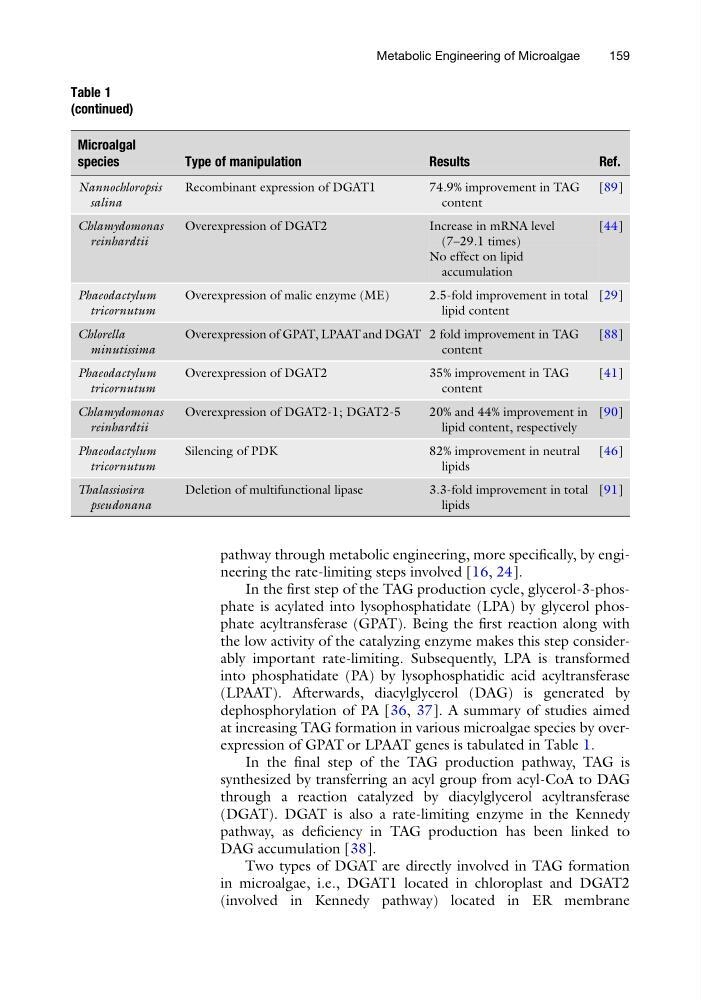
at increasing TAG formation in various microalgae species by overexpression of GPAT or LPAAT genes is tabulated in Table 1.
In the final step of the TAG production pathway, TAG is
synthesized by transferring an acyl group from acyl-CoA to DAG
through a reaction catalyzed by diacylglycerol acyltransferase
(DGAT). DGAT is also a rate-limiting enzyme in the Kennedy
pathway, as deficiency in TAG production has been linked to
DAG accumulation [38].
Two types of DGAT are directly involved in TAG formation
in microalgae, i.e., DGAT1 located in chloroplast and DGAT2
(involved in Kennedy pathway) located in ER membrane
Table 1
(continued)
Microalgal
species
Type of manipulation
Results
Ref.
Nannochloropsis
salina
Recombinant expression of DGAT1
74.9% improvement in TAG
content
[89]
Chlamydomonas
reinhardtii
Overexpression of DGAT2
Increase in mRNA level
(7–29.1 times)
[44]
No effect on lipid
accumulation
Phaeodactylum
tricornutum
Overexpression of malic enzyme (ME)
2.5-fold improvement in total
lipid content
[29]
Chlorella
minutissima
Overexpression of GPAT, LPAAT and DGAT 2 fold improvement in TAG
content
[88]
Phaeodactylum
tricornutum
Overexpression of DGAT2
35% improvement in TAG
content
[41]
Chlamydomonas
reinhardtii
Overexpression of DGAT2-1; DGAT2-5
20% and 44% improvement in
lipid content, respectively
[90]
Phaeodactylum
tricornutum
Silencing of PDK
82% improvement in neutral
lipids
[46]
Thalassiosira
pseudonana
Deletion of multifunctional lipase
3.3-fold improvement in total
lipids
[91]
Metabolic Engineering of Microalgae
159
In the first step of the TAG production cycle, glycerol-3-phosphate is acylated into lysophosphatidate (LPA) by glycerol phosphate acyltransferase (GPAT). Being the first reaction along with
the low activity of the catalyzing enzyme makes this step considerably important rate-limiting. Subsequently, LPA is transformed
into phosphatidate (PA) by lysophosphatidic acid acyltransferase
(LPAAT). Afterwards, diacylglycerol (DAG) is generated by
dephosphorylation of PA [36, 37]. A summary of studies aimed
at increasing TAG formation in various microalgae species by overexpression of GPAT or LPAAT genes is tabulated in Table 1.
In the final step of the TAG production pathway, TAG is
synthesized by transferring an acyl group from acyl-CoA to DAG
through a reaction catalyzed by diacylglycerol acyltransferase
(DGAT). DGAT is also a rate-limiting enzyme in the Kennedy
pathway, as deficiency in TAG production has been linked to
DAG accumulation [38].
Two types of DGAT are directly involved in TAG formation
in microalgae, i.e., DGAT1 located in chloroplast and DGAT2
(involved in Kennedy pathway) located in ER membrane
Table 1
(continued)
Microalgal
species
Type of manipulation
Results
Ref.
Nannochloropsis
salina
Recombinant expression of DGAT1
74.9% improvement in TAG
content
[89]
Chlamydomonas
reinhardtii
Overexpression of DGAT2
Increase in mRNA level
(7–29.1 times)
[44]
No effect on lipid
accumulation
Phaeodactylum
tricornutum
Overexpression of malic enzyme (ME)
2.5-fold improvement in total
lipid content
[29]
Chlorella
minutissima
Overexpression of GPAT, LPAAT and DGAT 2 fold improvement in TAG
content
[88]
Phaeodactylum
tricornutum
Overexpression of DGAT2
35% improvement in TAG
content
[41]
Chlamydomonas
reinhardtii
Overexpression of DGAT2-1; DGAT2-5
20% and 44% improvement in
lipid content, respectively
[90]
Phaeodactylum
tricornutum
Silencing of PDK
82% improvement in neutral
lipids
[46]
Thalassiosira
pseudonana
Deletion of multifunctional lipase
3.3-fold improvement in total
lipids
[91]
Metabolic Engineering of Microalgae
159