

5.4 Recommended Uncertainty Handling at This Point in Model Development
97
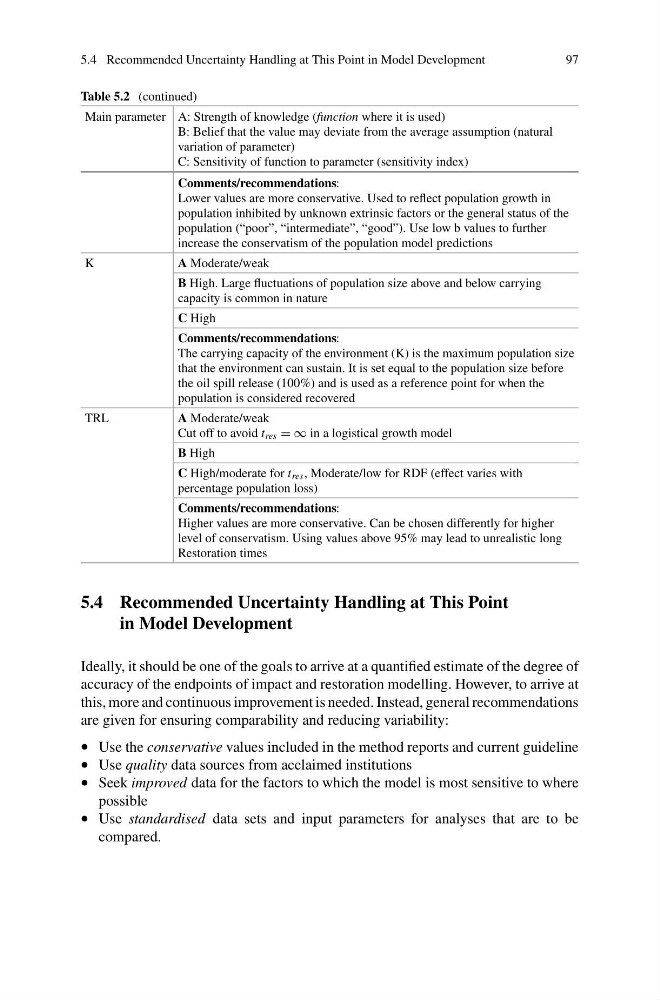
Table 5.2 (continued)
Main parameter A: Strength of knowledge (function where it is used)
B: Belief that the value may deviate from the average assumption (natural
variation of parameter)
C: Sensitivity of function to parameter (sensitivity index)
Comments/recommendations:
Lower values are more conservative. Used to reflect population growth in
population inhibited by unknown extrinsic factors or the general status of the
population (“poor”, “intermediate”, “good”). Use low b values to further
increase the conservatism of the population model predictions
K
A Moderate/weak
B High. Large fluctuations of population size above and below carrying
capacity is common in nature
C High
Comments/recommendations:
The carrying capacity of the environment (K) is the maximum population size
that the environment can sustain. It is set equal to the population size before
the oil spill release (100%) and is used as a reference point for when the
population is considered recovered
TRL
A Moderate/weak
Cut off to avoid t res = ∞ in a logistical growth model
B High
C High/moderate for t res , Moderate/low for RDF (effect varies with
percentage population loss)
Comments/recommendations:
Higher values are more conservative. Can be chosen differently for higher
level of conservatism. Using values above 95% may lead to unrealistic long
Restoration times
5.4 Recommended Uncertainty Handling at This Point
in Model Development
Ideally, it should be one of the goals to arrive at a quantified estimate of the degree of
accuracy of the endpoints of impact and restoration modelling. However, to arrive at
this, more and continuous improvement is needed. Instead, general recommendations
are given for ensuring comparability and reducing variability:
• Use the conservative values included in the method reports and current guideline
• Use quality data sources from acclaimed institutions
• Seek improved data for the factors to which the model is most sensitive to where
possible
• Use standardised data sets and input parameters for analyses that are to be
compared.
97
Table 5.2 (continued)
Main parameter A: Strength of knowledge (function where it is used)
B: Belief that the value may deviate from the average assumption (natural
variation of parameter)
C: Sensitivity of function to parameter (sensitivity index)
Comments/recommendations:
Lower values are more conservative. Used to reflect population growth in
population inhibited by unknown extrinsic factors or the general status of the
population (“poor”, “intermediate”, “good”). Use low b values to further
increase the conservatism of the population model predictions
K
A Moderate/weak
B High. Large fluctuations of population size above and below carrying
capacity is common in nature
C High
Comments/recommendations:
The carrying capacity of the environment (K) is the maximum population size
that the environment can sustain. It is set equal to the population size before
the oil spill release (100%) and is used as a reference point for when the
population is considered recovered
TRL
A Moderate/weak
Cut off to avoid t res = ∞ in a logistical growth model
B High
C High/moderate for t res , Moderate/low for RDF (effect varies with
percentage population loss)
Comments/recommendations:
Higher values are more conservative. Can be chosen differently for higher
level of conservatism. Using values above 95% may lead to unrealistic long
Restoration times
5.4 Recommended Uncertainty Handling at This Point
in Model Development
Ideally, it should be one of the goals to arrive at a quantified estimate of the degree of
accuracy of the endpoints of impact and restoration modelling. However, to arrive at
this, more and continuous improvement is needed. Instead, general recommendations
are given for ensuring comparability and reducing variability:
• Use the conservative values included in the method reports and current guideline
• Use quality data sources from acclaimed institutions
• Seek improved data for the factors to which the model is most sensitive to where
possible
• Use standardised data sets and input parameters for analyses that are to be
compared.